

What Type of Nose Do I Have? Quick Nose Shape Test (3 Questions)
To find out what type of nose you have, look at your own photos and answer three questions. This nose shape quiz works from your bridge, tip and width, and the answers point to a type such as Greek, Roman or button.
Bridge: from the side, is it straight, curved outward or dipped inward?
Tip: is it rounded, pointed, turned up or pointing down?
Width: from the front, does the nose look narrow, medium or wide?
The three answers show what nose shape you have. You need one side-profile photo and one front photo. There is no official list of nose types, so the names are common labels, not diagnoses, and many noses sit between two types. For what every type looks like, see the nose types chart.
The nose is also only one part of how a face reads. If you want to see how it fits with your other features, an attractiveness test scores several of them at once.
Before You Start: Take Two Photos
Take one front photo and one side-profile photo before you answer the questions. A bad angle changes how the bridge and tip look, so the photos matter as much as the answers.

Distance: shoot from a few feet away, or ask someone to take the photo. Close-up selfies make the nose look wider than it is.
Side photo: turn a full 90 degrees, keep your chin level and your face relaxed.
Front photo: look straight at the camera, with your head not tilted and the camera at eye level.
Light: even light from the front, with no hard shadow under the nose.
Clear view: hair off your face and no glasses, since frames hide the bridge.
Question 1: What Does Your Bridge Look Like From the Side?
The bridge is the ridge that runs from between your eyes down to the tip. Trace it with a finger on your side photo and pick the closest match.
Straight: an even line from the root to the tip, with no hump.
Convex: the line curves outward, sometimes with a visible hump. Roman, aquiline and hawk noses are convex.
Concave: the line dips inward, and the tip often turns up. Snub and celestial noses are concave.

Judge the bridge on the side photo only. A slightly concave bridge can look straight from the front.
Question 2: What Does the Tip Do?
The tip is the end of the nose, held up by cartilage. Look at it on the side photo first, then confirm on the front photo.
Rounded and small: a button tip.
Rounded and large: a bulbous, or fleshy, tip.
Pointed: a sharp, narrow end.
Turned up: the tip points slightly upward.
Pointing down: the tip sits low and angles downward.
Question 3: How Wide Does the Nose Look From the Front?
Width covers the bridge, the base and the nostrils. On your front photo, compare the base of the nose with the rest of your face and pick narrow, medium or wide.
A quick check: compare the width of the base with the gap between the inner corners of your eyes. In one anthropometric study of adults in Curitiba, Brazil, 88% had a nose base wider than that gap, so call yours wide only if it is clearly wider, and narrow if it is clearly narrower. This is a self-check shortcut, not a medical standard.
Your Result: Find Your Nose Type
Your nose type is the row below that best matches your answers about the bridge, tip and width. The names are informal labels from anatomy and cosmetic-surgery guides, not medical diagnoses, and one nose can fit more than one row.
If your answers are | Your likely nose type |
|---|---|
Straight bridge, neutral tip, narrow to medium width | Greek (straight) |
Straight bridge, broad tip | Nixon |
Convex bridge with a raised arch, medium width | |
Strongly convex bridge, tip pointing down | Hawk (hooked) |
Slightly concave bridge, short nose, tip turned up | Snub |
Concave bridge in a ski-slope line, tip turned up | Celestial |
Short, small nose with a small rounded tip | |
Large, rounded tip, any bridge | Bulbous (fleshy) |
Tip pointing down, no strong hump | Drooping |
Wide base and nostrils | Wide |
Narrow bridge and nostrils | Narrow |
Nose bends to one side | Crooked |
Each type is described in more detail in the nose types guide.
What If You Land Between Two Types?
That is normal: most noses mix traits from several types. Name your nose by the trait you notice first and treat the second one as a detail.
Describe it in two parts: for example, a straight bridge with a bulbous tip, or a convex bridge with a turned-up tip.
Repeat the photos: take a second set on another day. If your answer changes, the angle or the light was the cause.
Remember your age: if you are a teenager, your nose is probably still changing, so the result can change too.
Keep it in perspective: a type name only describes shape. If a bent nose or trouble breathing worries you, ask a doctor.
Nose Shape Detector: How AI Nose Analysis Works and Where It Gets It Wrong
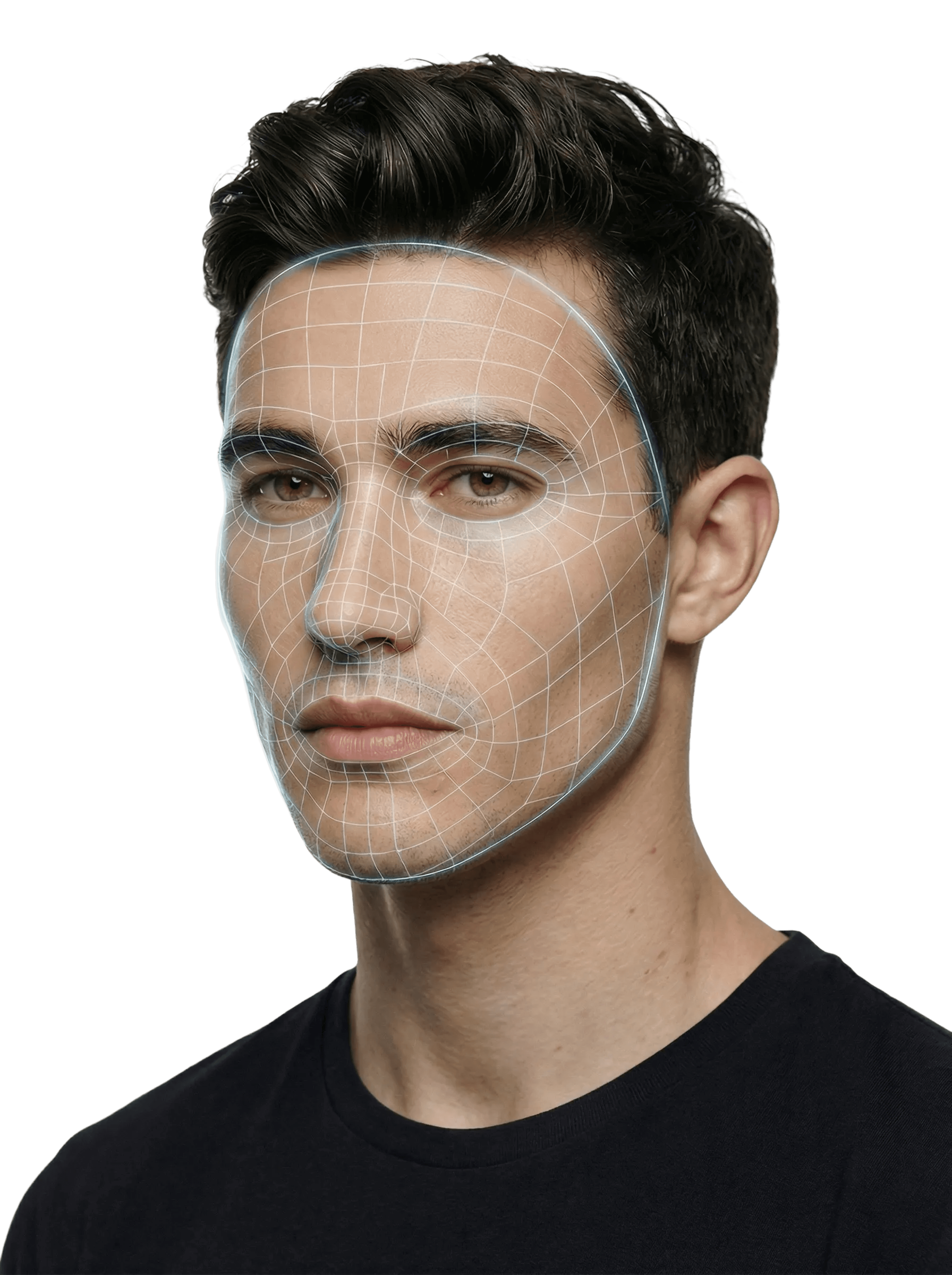
An AI nose shape detector, also called a nose type detector or nose shape analyzer, estimates your nose type from a photo. It finds landmarks on your face, measures proportions such as nose width and length, and matches them to a label like Greek, Roman or button. Because there is no official classification of nose types, the label is a best guess, not a measured fact.
How an AI Nose Detector Works
Most AI nose shape detectors, whether an online analyzer, a scanner or an app, follow similar steps:
You upload a photo or use your camera.
The software places landmarks on your face. Google's MediaPipe Face Mesh, a widely used model, estimates 468 3D face landmarks from a single camera image.
It measures the nose, typically its width, length and tip angle, and from a side photo the bridge profile.
It assigns a label, using fixed rules or a trained model, from a list of nose types its makers chose.
What a Detector Can't See
The bridge from a front photo. A hump or a dip shows only from the side, so a detector given a front photo can only estimate it.
Your photo's flaws. Shooting at a short distance makes the nose look broader, according to a JAMA Facial Plastic Surgery study of selfie distortion. Head tilt and shadows change the picture too.
A shared standard. Tools choose their own lists of nose types, so two detectors can give different labels for the same photo.
How to Read a Detector Result
Compare the label with your own side photo and the table above.
Treat it as one of two close types, not a verdict.
Run two or three photos. If the label changes, trust the pattern, not one result.
Treat any "ideal nose" score as one tool's opinion, since there is no agreed standard.
What the Maxxing Scan Shows for the Nose
The Maxxing face scan scores your nose out of 100 and adds a short explanation that comments on the bridge and the tip. It also scores your other features, so you can see how the nose compares with the rest of your face. Use the table above to name your nose type. As with any AI analysis, the result is a model's estimate, not a verdict.
FAQ
Can AI determine my nose shape?
AI can estimate it from a photo by measuring facial landmarks and matching a label, but the result is a best guess. There is no official list of nose types, and a front photo cannot show the bridge profile, so check any label against your own side photo.
What is my nose type? Can I find it from a photo?
Yes. Take a front photo and a side photo from a few feet away, answer the three questions of this nose type quiz about the bridge, tip and width, and match your answers to the table.
Why does my nose look different in different photos?
Camera distance, angle and light change how a nose looks. Close-up shots make it look broader, and a tilted head changes the line of the bridge and tip. Compare photos taken from the same distance.
Does my nose type show my ancestry?
No. Nose shape cannot reliably tell you where your ancestors came from. The National Human Genome Research Institute states that there is more genetic variation within self-identified racial groups than between them.