

PSL Scale: The Complete Guide to the Attractiveness Rating System (2026)
PSL Scale: The Complete Guide to the Attractiveness Rating System
If you've spent any time in looksmaxxing spaces, you've seen it constantly: "He's a PSL 6 at best," "That jawline is mogging everyone in the room," or "Stop coping — you're not above a 5." The PSL Scale is the universal language of the looksmaxxing community. But if you're new to it, the whole system — the tiers, the slang, the bell curve — can feel like learning a foreign language overnight.
This guide covers everything: where PSL came from, how every tier is defined, the facial metrics behind each rating, the slang glossary you actually need, and what you can realistically do to ascend. No cope. Just the framework.
What Does PSL Stand For?
PSL stands for PUAHate / Sluthate / Lookism — three interconnected forums where the rating system was built from the ground up. Each one was part of a broader community that took the blackpill seriously: looks matter more than game, personality, or status in determining attraction, and pretending otherwise is cope.
PUAHate — Pushed back hard against pickup artist culture, arguing that no amount of "game" overcomes a weak face. Face > everything became the founding principle.
Sluthate — A successor forum continuing the same themes.
Lookism — A dedicated aesthetics and looksmaxxing forum where members rate each other, discuss facial metrics, and share maxxing journeys.
These communities built the PSL Scale to cut through the social inflation that ruins casual ratings. When everyone's calling randoms a 7 out of politeness, the numbers become meaningless. PSL forces honesty by anchoring the scale to a real bell curve.
In more recent usage, PSL is also sometimes redefined as Proportion, Size, and Lineation — the three geometric principles underlying facial attractiveness. Both definitions float around; the origin story is the more widely accepted one.
How the PSL Scale Actually Works
The single most important thing to understand: PSL is not the same as a casual 1–10. This is where most normies get confused when they first encounter the community.
The PSL Scale is calibrated to a normal distribution (bell curve). That means:
Most people cluster around PSL 4–5 — this is the honest average, not a 6 or 7
PSL 6+ is genuinely above average — top 15–25%, not just "decent looking"
PSL 7+ is rare — top 5–10%, the kind of face that mogs a room just by walking in
PSL 8+ is model-tier — less than 1% of the population, Chad territory
PSL 10 is theoretical — perfect facial harmony doesn't exist; it's a mathematical reference point
By contrast, casual ratings get inflated by social pressure. Nobody wants to tell their friend he's a 4. The result is a useless scale where everyone clusters between 6 and 8, mogging one another with equally meaningless numbers. PSL fixes this by making 4–5 the realistic midpoint.
The other key feature: PSL is a bones rating. It measures facial bone structure and harmony — your forward maxilla, gonial angle, canthal tilt, and orbital structure. Hairstyle, clothing, personality, and "vibe" are excluded by design. This is what makes PSL useful as a diagnostic tool: it tells you what your genetics actually gave you, separate from what you've frauded on top.
For everything beyond raw PSL — how looks interact with status, physique, and personality — check out our full breakdown of looksmaxxing.
The Complete PSL Scale: Every Tier Explained
PSL 10 — Theoretical Perfect
Doesn't exist. A PSL 10 is a mathematical ideal — zero measurable asymmetry, perfect thirds, golden ratio proportions across every metric. No real human has hit this. It functions as the ceiling of the model, not an achievable rating.
PSL 9 — Elite / Gigachad
Top 0.01% — roughly 1 in 10,000
Gigachad territory. World-class genetics — the kind of face that mogs every other face in any setting without effort. Near-perfect forward growth, exceptional jawline definition, strong brow ridge, ideal canthal tilt, and total facial harmony. Think top-tier runway models or certain actors at their physical peak. Seeing a real PSL 9 in the wild is a rare event.
PSL 8 — Model Tier / Chad
Top 0.1–1% — roughly 1 in 100 to 1 in 1,000
Chad-tier. Professional model material. Excellent bone structure with very few detectable flaws — strong forward projection, defined gonial angle, prominent cheekbones, hunter eyes. Somebody at PSL 8 mogs the vast majority of men they encounter without trying. This is the tier looksmaxxers with serious hardmaxxing journeys are targeting.
PSL 7 — Very Attractive / Chadlite
Top 5–10%
Chadlite range. Genuinely good looking by almost any standard — strong features, solid facial harmony, above-average bone structure. A PSL 7 regularly gets approached and complimented; people remember their face. Not quite mogging at Chad level, but clearly in a different tier from the average normie. This is realistically the ceiling for most people through softmaxxing + hardmaxxing combined.
PSL 6 — Above Average / High Tier Normie (HTN)
Top 15–25%
HTN range. Noticeably attractive — good features that stand out positively in most settings. The High Tier Normie doesn't mog the room but is consistently rated attractive. Many conventionally attractive guys — the ones who get steady matches and compliments — sit here. PSL 6 is a solid, respectable outcome from a focused looksmaxxing journey. This is the realistic ascension target for most LTNs.
PSL 5 — Average / Mid Tier Normie (MTN)
Middle 25th–75th percentile
MTN range. Dead center of the bell curve. No major flaws, no standout features — the textbook normie. Blends into a crowd, doesn't mog anyone, doesn't get mogged visibly either. This is where the honest majority of the population lands. A lot of people who think they're PSL 6–7 are coping at PSL 5. Accepting this is the first step toward a real looksmax journey.
PSL 4 — Slightly Below Average / Low Tier Normie (LTN)
Bottom 25–40%
LTN range. Some noticeable flaws — minor asymmetry, weak bone structure, or poor facial thirds — but not visually striking in a negative way. Wouldn't stand out badly in a room. Most people at PSL 4 who begin looksmaxxing seriously can ascend to MTN or even HTN range through consistent softmaxxing.
PSL 3 — Below Average
Bottom 10–25%
Noticeable facial flaws — poor symmetry, recessed chin or maxilla, weak jaw, unfavorable canthal tilt — that place this person clearly below average to most raters. Climbing out of this range likely requires at least some hardmaxxing alongside full softmaxxing.
PSL 2 — Unattractive
Bottom 5–10%
Significant structural issues that are apparent to virtually everyone. Well below average. Reaching LTN from here would require substantial change; this is the range where hardmaxxing becomes the dominant discussion in serious looksmax communities.
PSL 1 — Severe
Bottom 1%
Extreme facial abnormalities. Extremely rare, usually associated with medical conditions or significant structural disfigurement. Not a typical looksmaxxing discussion tier.
PSL Slang Glossary: The Full Dictionary
The PSL community runs on its own vocabulary. Here's every major term you need:
Term | PSL Range | Meaning |
|---|---|---|
Gigachad | 9+ | Near-perfect genetics, elite mogging potential |
Chad | 8+ | Model-tier bone structure |
Chadlite | 7–7.5 | Very attractive, just below elite |
HTN | 5.5–6.5 | High Tier Normie — above average |
MTN | 4.5–5.5 | Mid Tier Normie — dead average |
LTN | 3.5–4.5 | Low Tier Normie — slightly below average |
Normie | 4–6 | Average range — the majority of the population |
Subhuman | ≤3 | Significantly below average; community's harshest label |
PSL vs. the Casual 1–10 Scale
Here's why normies' ratings are essentially useless for self-assessment purposes, and how they map to honest PSL scores:
Casual Rating | PSL Equivalent |
|---|---|
10 (perfect) | PSL 7–8 |
8–9 (hot) | PSL 6–7 |
7 (attractive) | PSL 5.5–6 |
5–6 (average) | PSL 4.5–5.5 |
3–4 (below average) | PSL 3.5–4.5 |
1–2 (ugly) | PSL 2–3 |
The brutal reality: most people who casually rate themselves or others a "7" are PSL 5 at best. Social inflation is built into every casual rating — nobody wants to tell someone the truth about their face. The PSL bell curve removes that inflation by forcing raters to acknowledge that PSL 5 is the honest average, not 6.5.
This is why the looksmaxxing community adopted PSL. It's based. When someone tells you "you're a PSL 4.5 but you can hit 5.5 through leanmaxxing and skinmaxxing," that's actionable information. "You're a 7, bro" tells you nothing.
The 5 Facial Metrics Behind Your PSL Score
PSL ratings aren't arbitrary opinions. They're built on five measurable criteria grounded in legitimate attractiveness research. A major meta-analysis by Gillian Rhodes (Psychological Bulletin, 2006) confirmed that symmetry, averageness, and sexual dimorphism are universal attractiveness predictors across cultures — the exact principles PSL uses.
1. Symmetry
How balanced the left and right halves of your face are. High symmetry signals developmental stability and is the single most consistent predictor of attractiveness across all cultures and studies. Significant asymmetry — a jawline that tracks to one side, uneven orbital rims, off-center nose — drags your PSL more than almost anything else. This is also one of the hardest things to improve without surgery.
2. Proportions
How your features relate to each other geometrically. The key references are the Rule of Thirds (equal upper, middle, and lower thirds vertically) and the Golden Ratio (~1:1.618). Forward maxilla growth relative to the lower face, proper chin projection, and balanced bizygomatic width (cheekbone-to-cheekbone distance) all feed into this metric. Faces that naturally approximate these proportions get rated as more attractive by observers who've never heard of the ratios.
3. Sexual Dimorphism
How distinctly sex-typical your features are. For men: a defined, wide jaw with good gonial angle, a prominent brow ridge and supraorbital rim, strong cheekbone projection, hunter eyes with positive canthal tilt. These are markers of high testosterone and are core to the Chad phenotype. For women: fuller lips, higher cheekbones, softer jaw, larger eyes relative to face size. Strong dimorphism signals reproductive health and correlates directly with higher PSL. A man with prey eyes and a weak brow ridge is coping if he thinks he's hitting 7+.
4. Skin Quality
Skin is the surface layer over your bone structure. Excellent skin doesn't fix bad bones, but poor skin can mog your actual structure into looking worse than it is. Clear, even-toned skin with good texture signals health and youth. For many LTNs and MTNs, skinmaxxing alone delivers visible PSL improvement faster than any other intervention. Our AI face analysis tool breaks down how skin quality is affecting your current rating.
5. Facial Harmony
How well all your features work as a unified system. You can have a strong jaw, solid cheekbones, and decent eyes — but if the proportions between them are off, the face reads as disharmonious. A large nose with a weak midface, or wide-set eyes with a narrow lower third, creates dissonance that tanks PSL even when individual features are strong. Harmony is the hardest metric to quantify, but AI models and experienced raters can assess it reliably.
PSL Score Distribution: Where Do Most People Actually Fall?
Understanding the real distribution kills cope about your rating fast:
~68% of people fall between PSL 4–6 (one standard deviation from average)
~95% of people fall between PSL 3–7
~2% of people score PSL 7+ — these are the faces actively mogging in most rooms they enter
~2% of people score PSL 3 or below
PSL 8+ is less than 1% of the population — genuine Chads are that rare
This is why a real, unfrauded PSL 6 is a significant achievement — you're already in the top 15–25% of facial attractiveness. And why PSL 5 is nothing to be ashamed of: it's literally where the majority of humans honestly sit. The cope is thinking you're a 6 when you haven't done a single looksmax and you're taking selfies with a front camera from below at unfavorable lighting.
Can You Actually Improve Your PSL Score?
Yes — but take the blackpill on what's possible. Your bone structure sets a biological ceiling. No maxxing journey goes from PSL 4 to PSL 9. What is achievable is optimizing within your genetic range, which is meaningful movement for virtually anyone who hasn't been looksmaxxing at all.
Softmaxxing (Non-Surgical Ascension)
Softmaxxing reveals and enhances your existing bone structure without touching the bones themselves. Most people who say softmaxxing "doesn't work" are either LDAR-ing or doing it wrong.
Leanmaxx — Get your body fat down to 10–15% (for men). This is often the single highest-ROI looksmax because facial fat obscures jawline definition and cheekbone projection. Chads don't have fat faces. Going from skinnyfat to lean can be worth 0.5–1.0 PSL for a lot of people. It's not cope; it's bone structure that was already there.
Skinmaxx — Build a consistent routine: SPF daily, retinol at night, a basic moisturizer. Clear skin amplifies whatever bones you have. Acne and poor texture mog your PSL down without touching your structure at all.
Mewing — Proper tongue posture (tongue resting flat against the roof of the mouth) encourages forward maxilla positioning over time. The effect is most pronounced in younger looksmaxxers, slow in adults, and not a miracle — but it's zero-cost and the right posture supports better facial development.
Grooming optimization (hairmaxx) — Well-shaped eyebrows frame your brow ridge and orbital area. Facial hair can visually define a weak jaw. The right haircut frames your face and adds to or subtracts from your perceived frame. These are the easiest and fastest PSL improvements.
Posture correction — Forward head posture ruins your jawline angle and neck aesthetics even with decent bones. Fixing it is free and immediate.
Realistic softmaxxing ceiling: +0.5 to +1.5 PSL for most people, with the biggest gains coming from leanmaxxing and skinmaxxing.
Hardmaxxing (Surgical Ascension)
Hardmaxxing goes after the bones and soft tissue that softmaxxing can't touch:
Rhinoplasty — Reshaping the nose to improve facial harmony and proportions. For many people this is the highest-impact procedure for overall PSL because nose size and shape affects the entire facial third balance.
Orthognathic surgery — Jaw repositioning. Targets recessed maxilla or mandible directly. High-impact, high-risk, significant recovery.
Chin implants / genioplasty — Adding forward projection to the chin improves lower-third balance and jawline definition. One of the more common hardmaxx choices with relatively predictable results.
Cheek implants or filler — Adding cheekbone projection improves midface attractiveness and contributes to the high-cheekbone look associated with Chadlite+.
Canthoplasty / canthopexy — Eye surgery to improve canthal tilt — turning prey eyes toward hunter eyes. One of the most PSL-relevant surgical interventions for men.
Realistic hardmaxxing ceiling: +1.0 to +2.0 PSL with the right procedures for the right person, with real surgical risk and individual variation.
Curious what your current baseline is before you start? Our attractiveness test and rate my photo tools give you an unfrauded AI-based starting point.
How to Find Out Your PSL Score
Two approaches — one self-directed, one AI-powered:
Self-Assessment (Brutal Honesty Required)
No frauding. Shoot in neutral natural light, neutral expression, rear camera. Then rate yourself on each metric:
Jaw definition — Does your jawline have visible angle and definition? Is there a clear gonial angle? Or does it slope into your neck?
Eye area — Do you have a positive canthal tilt (hunter eyes) or negative (prey eyes)? Deep-set or forward orbital rims?
Symmetry — Cover each half of your face separately. How different do they look?
Midface harmony — Is your nose proportionate to your cheekbones and orbital spacing? Is your maxilla forward or recessed?
Skin quality — In flat natural light, how does your complexion look? Texture, tone, clarity.
The honest problem with self-assessment: most people are either overcoping (rating themselves too high) or in the other direction. External ratings from people with no social investment in sparing your feelings are more reliable.
AI-Powered PSL Analysis
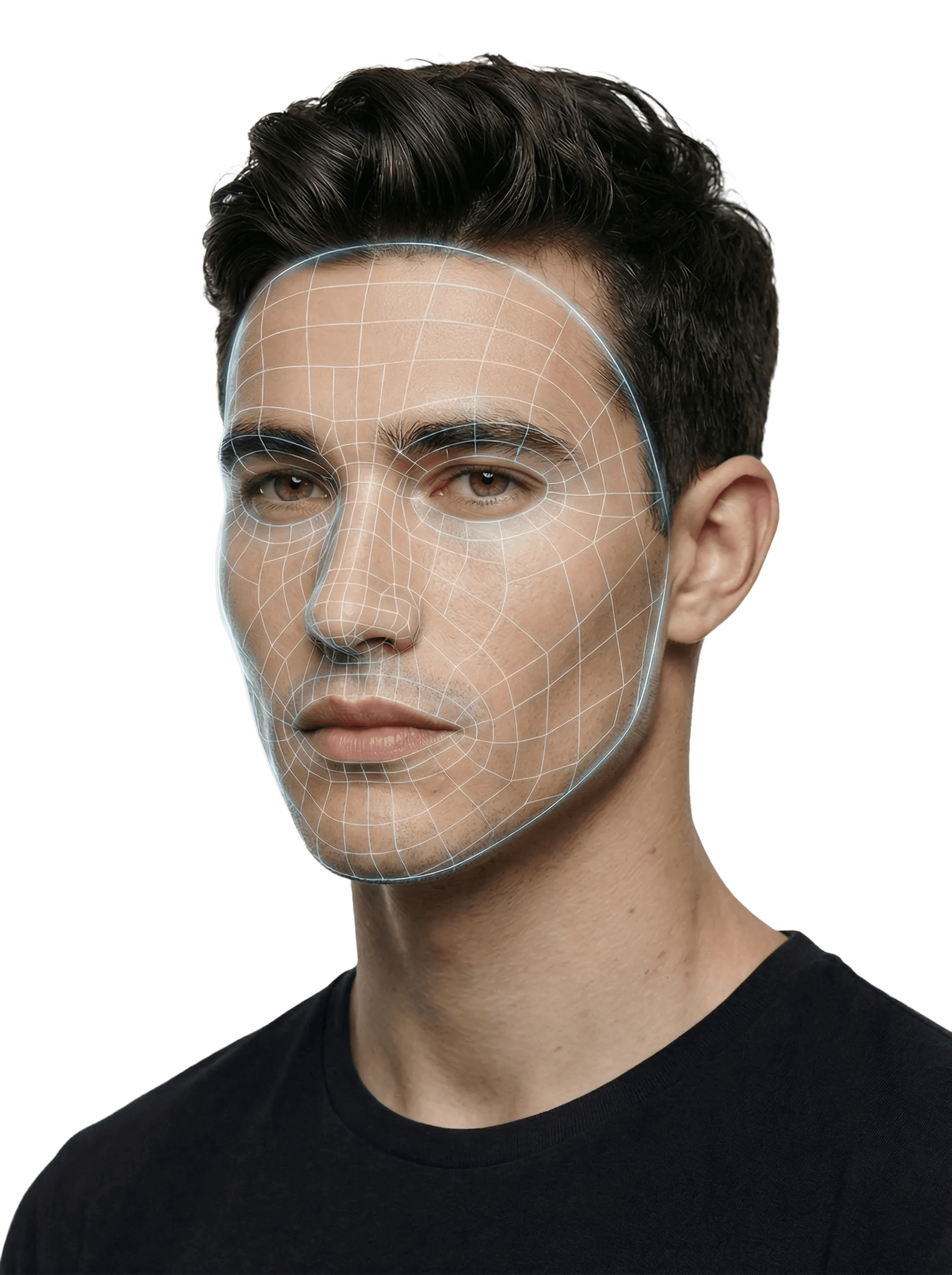
Our AI face analysis tool evaluates 128+ facial landmarks — symmetry, proportions, sexual dimorphism, skin quality, and facial harmony — and delivers a detailed metric breakdown. It's the closest thing to an unbiased rate thread without posting your face publicly.
For accurate results that aren't frauded by the camera:
Use the rear camera — front cameras have lens distortion that inflates facial width and warps proportions
Natural diffused light — no direct harsh light creating fake shadows that define your jaw
Neutral expression — smiling or squinting changes the perceived structure of your face
Front-facing and profile — both angles capture what matters
You can also see how your facial structure stacks up via our celebrity look alike finder, or check what you look like through a fully objective AI lens.
PSL Scale and Looksmaxxing: The Connection
The PSL Scale is the analytical foundation of the entire looksmaxxing movement. Without a shared rating framework, every conversation about facial improvement is vague and subjective. With PSL, a looksmaxxer can say "I'm LTN/PSL 4, targeting my recessed chin and skin, trying to ascend to HTN by leanmaxxing and maybe rhinoplasty down the line" — and every serious maxxer in the thread immediately understands the full picture.
PSL turns the quest to ascend into something measurable. You know where you started. You know what the metrics are. You know what +0.5 to +1.5 points realistically looks like. That's the difference between a purposeful looksmax journey and just doing random stuff and hoping your face improves.
The PSL framework is also what separates genuine looksmaxxing from simply trying to glow up through style. Frauding with good outfits or an expensive haircut doesn't change your PSL — it changes how your PSL is perceived under favorable conditions. Real ascension means changing the metrics themselves: bone structure, skin quality, and actual facial proportions. Our looksmaxxing guide goes deep on the full journey — how to prioritize, what to tackle first, and realistic timelines.
Criticisms of the PSL Scale
Taking the blackpill doesn't mean being blind to the genuine criticisms of the PSL framework, and some of them are worth engaging with honestly.
Researchers Anda Iulia Solea and Lisa Sugiura (SAGE Journals) describe it as "a systematic pseudoscientific framework that codifies the incel hierarchical worldview by ranking individuals through a racialised and gendered hierarchy." The Conversation has covered how the scale grew from incel forums and is now being monetized by looksmaxxing influencers. These aren't dismissible.
The real criticisms:
Subjectivity disguised as objectivity — Symmetry and proportions are measurable, but the specific weightings between metrics in PSL ratings aren't scientifically standardized. Two experienced raters can reach different scores on the same face.
Eurocentric bias — The scale has historically reflected Eurocentric beauty standards. What's rated "ideal" in terms of forward growth, facial structure, and dimorphism reflects cultural and racial assumptions, not pure geometry.
Mental health risk — Obsessive self-rating, constant rate-thread posting, and identity-level attachment to a PSL number is a straight path to dysmorphic thinking. Looksmaxxing communities have documented cases of people who started looksmaxxing and ended up more unhappy than before, not because of PSL — but because they turned a diagnostic tool into a life sentence.
It ignores everything that matters in real interaction — PSL is a bones rating. It excludes voice, confidence, social presence, humor, personality, and all the things that determine whether someone actually wants to spend time with you. High PSL + nothing else = Gymcel energy.
The based take: The geometric metrics behind PSL — symmetry, proportions, sexual dimorphism — are backed by legitimate science. They're real. PSL is a useful diagnostic and a shared language. But it's a partial model. It captures one input into attractiveness and ignores most of the others. Use it to identify what you can improve and track real progress — not as a verdict on your ceiling or your worth.
Frequently Asked Questions
What does PSL stand for? PSL originally stands for PUAHate, Sluthate, and Lookism — the three forums where the scale was built. In modern looksmaxxing spaces it's sometimes redefined as Proportion, Size, and Lineation.
Is PSL 5 bad? No — and this is one of the biggest cope spots in the community. PSL 5 is the honest average. Most people who think they're PSL 6–7 based on casual ratings are MTN range when rated properly. Average is not a failure; it's the baseline. The point of looksmaxxing is to ascend from wherever you are, not to treat average as a death sentence.
What's a good PSL score? PSL 6 (HTN) is genuinely above average — top 15–25%. PSL 7 (Chadlite) means you're mogging the majority of men you encounter — top 5–10%. PSL 8+ (Chad) is model-tier and statistically rare. Hitting PSL 6 through a serious softmaxxing + hardmaxxing journey is a legitimate, achievable ascension goal for many LTNs.
What's the difference between PSL and SMV? PSL is strictly a bones rating — facial geometry only. SMV (Sexual Market Value) is the full package: PSL + height + physique + wealth + status + social confidence. A PSL 5 Gymcel with high income, height, and social proof can have significantly higher real-world SMV than a PSL 7 with no other qualities. Don't confuse the two. Looksmaxxing raises your PSL; SMV-maxxing is the broader project.
Can I actually improve my PSL? Yes, within your genetic ceiling. Softmaxxing — leanmaxxing, skinmaxxing, hairmaxxing, mewing, posture — can add 0.5–1.5 points for most people. Hardmaxxing can add another 1–2 points with the right procedures. The cope is thinking you can go from PSL 4 to PSL 9. The based reality is that going from PSL 4.5 to PSL 6 through a focused looksmax journey is genuinely achievable for most people.
What are "hunter eyes" and why do they matter for PSL? Hunter eyes refers to a positive canthal tilt — the outer corner of the eye sits higher than the inner corner, creating an intense, predatory look. It's one of the most discussed facial features in PSL communities because it contributes significantly to perceived attractiveness and facial dominance. Prey eyes (negative canthal tilt, outer corner lower than inner) are associated with weaker PSL scores for men. Canthoplasty is one of the more extreme hardmaxx interventions targeting this.
What is "frauding" in the context of PSL? Frauding is using angles, lighting, filters, grooming, or styling to appear at a higher PSL than your actual facial structure warrants. A well-lit photo from a slight above-angle with a sharp haircut on a man who's leanmaxxed can read PSL 6 when he's realistically 5 unfrauded. There's nothing wrong with presenting yourself well — but frauding your rate thread photo gives you a useless rating, and frauding yourself about your PSL leads to cope instead of progress.
What is mewing and does it actually move PSL? Mewing is correct tongue posture: tongue resting flat against the entire roof of the mouth, lips sealed, teeth lightly touching. It's claimed to encourage forward maxilla growth and improved jaw definition over time. The scientific evidence is limited and most pronounced in adolescents, not adults. The honest take: it's low-cost, risk-free, and habit-level — just do it as a baseline. Don't expect it to turn prey eyes into hunter eyes or ascend you from LTN to HTN by itself.
How do I find out my PSL score? Start with our AI face analysis — it evaluates your facial landmarks across all five key PSL metrics and gives you a detailed breakdown with no social inflation. You can also try our attractiveness test for a quick rating or rate my photo for a score on a specific photo. To see how your features compare population-wide, the how normal am I tool is worth checking.
The Bottom Line
The PSL Scale is a bell-curve-calibrated attractiveness rating system built on five facial metrics: symmetry, proportions, sexual dimorphism, skin quality, and harmony. It's harsher than casual ratings by design — because honest baselines are the only kind that actually help you ascend.
The based summary:
PSL 5 = average — most people honestly sit here, cope or no cope
PSL 6 = HTN — top 15–25%, a real and achievable ascension goal
PSL 7 = Chadlite — top 5–10%, mogging most rooms passively
PSL 8+ = Chad — model-tier, less than 1% of the population
Don't LDAR. Don't cope about your baseline. And don't turn a rating into an identity. Use PSL as a diagnostic tool: find your honest starting point, identify which metrics are dragging you down, and build a focused looksmax plan around what's actually moveable.
Ready to find your real number? Run our AI face analysis for a full metric breakdown — no frauding, no social inflation, just the data.
Sources: Incels Wiki (PSL Rating); LooksMaxxers (PSL Scale Explained); PSLScale.net (What Is PSL); Know Your Meme (PSL Scale); Rhodes, G. (2006). The evolutionary psychology of facial beauty. Psychological Bulletin, 132(4); The Conversation (The Pseudoscientific Attractiveness Scale); SAGE Journals — Solea & Sugiura.