



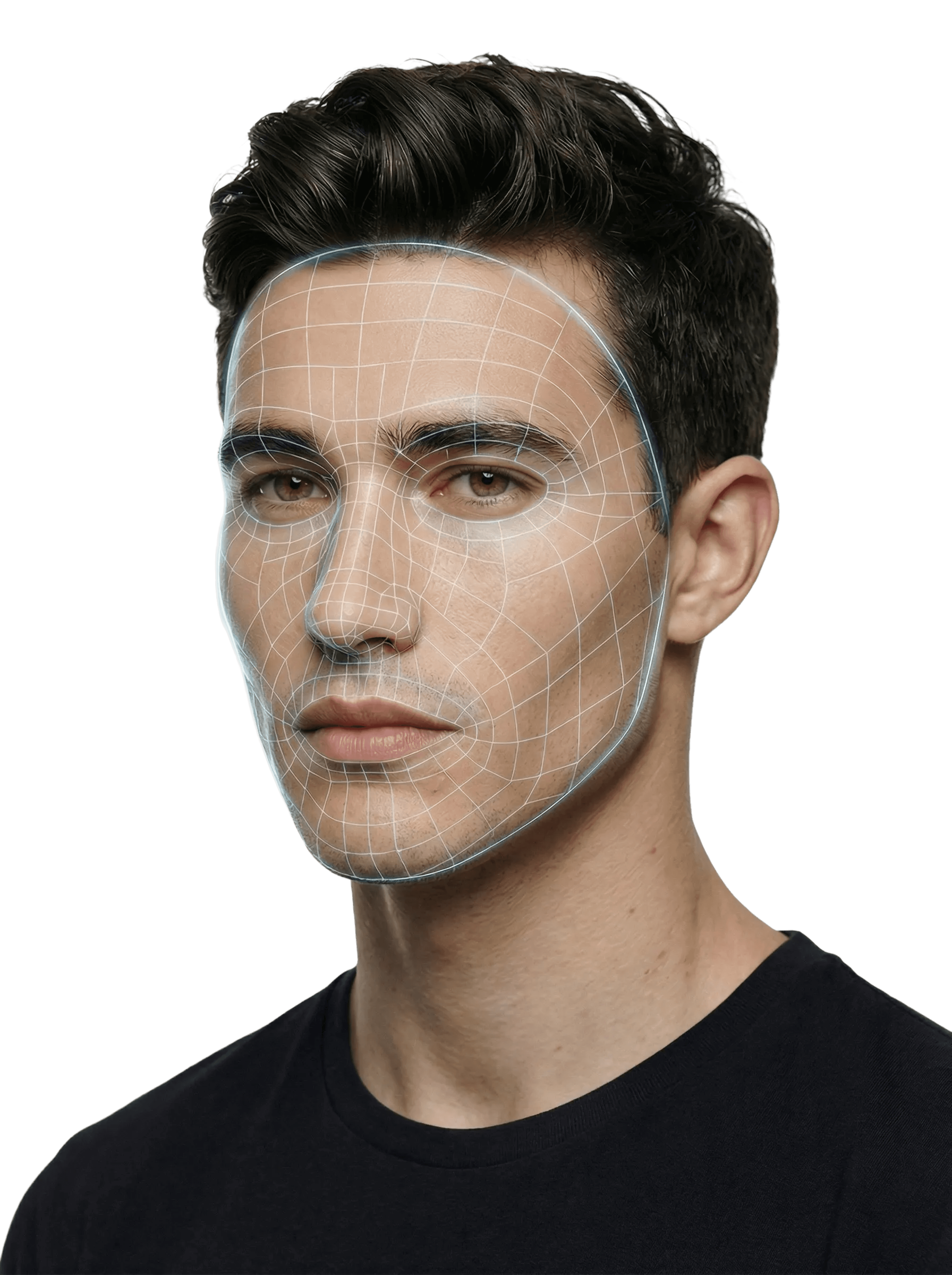
Nose Types: 12 Nose Shapes, Chart, and How to Identify Yours
Nose types are groups of nose shapes described by three things: the profile of the bridge (straight, convex or concave), the shape of the tip, and the width of the nose and nostrils. There is no official classification, which is why popular guides count anywhere from 10 to 18 types. This guide uses 12 common names, shows what each one means, and explains how to tell which one you have.
The nose is one of the facial features that changes how a whole face reads, but its shape is only a description. It says nothing about your personality, and a nose often mixes traits from several types.
In an attractiveness test, the nose is scored as one feature among several, and the result is a model's estimate, not a verdict.
How Nose Types Are Classified
Nose shapes are classified by three structural features: the bridge profile (straight, convex or concave when seen from the side), the tip (rounded, pointed, upturned or drooping), and the width of the nose at the bridge and nostrils. No single standard exists, so the names for combinations vary between sources.
A systematic review of nasal profile analysis found numerous methods in use, each measuring a different set of parameters. Without one agreed method, guides group the same noses differently.
Bridge profile: straight, convex, concave
The bridge (the nasal dorsum) is the ridge running from the root of the nose between the eyes down to the tip. In anatomy research it is classified as straight, convex or concave.
Straight: an even line from root to tip, no hump.
Convex: the bridge curves outward, sometimes with a visible hump. Roman, aquiline and hawk noses belong here.
Concave: the bridge dips inward and the tip often turns up. Snub and celestial noses belong here.
Check this from the side. A slightly concave bridge can look straight in a front-facing photo.
Tip: rounded, pointed, upturned, drooping
The tip is the end of the nose, supported by cartilage rather than bone. It can be small and round, large and rounded (bulbous), sharp, turned up, or pointing down.
Width: narrow, medium, wide
Width covers the bridge, the base of the nose and the nostrils. Researchers measure it with the nasal index: nose width divided by nose height, times 100. A higher number means a wider nose relative to its height.
Nose Shapes Chart: 12 Types With Names
Twelve names cover most nose descriptions you will see online: Greek, Roman, hawk, snub, celestial, button, Nixon, bulbous, wide, narrow, crooked and drooping. They are informal labels, not medical diagnoses, and one nose can fit more than one row.
Type | Bridge profile | Tip | Width and notes |
|---|---|---|---|
Greek (straight) | Straight, no hump | Neutral | Narrow to medium |
Roman (aquiline) | Convex, with a raised arch or small hump | Neutral to slightly downward | Medium |
Hawk (hooked) | Strongly convex | Points downward | Often narrow |
Snub | Slightly concave | Short, turned up | Short nose overall |
Celestial | Concave, ski-slope line | Turned up | Narrow to medium |
Button | Short and small | Small, rounded | Narrow to medium |
Nixon | Straight | Broad | Wide tip on a straight bridge |
Bulbous (fleshy) | Varies | Large, rounded | Fuller tip, softer outline |
Wide (broad) | Often lower | Varies | Wide base and nostrils |
Narrow | Varies | Varies | Narrow bridge and nostrils |
Crooked | Bends to one side | Varies | Asymmetric from root to tip |
Drooping | Varies | Points down | Tip sits low, often more visible with age |
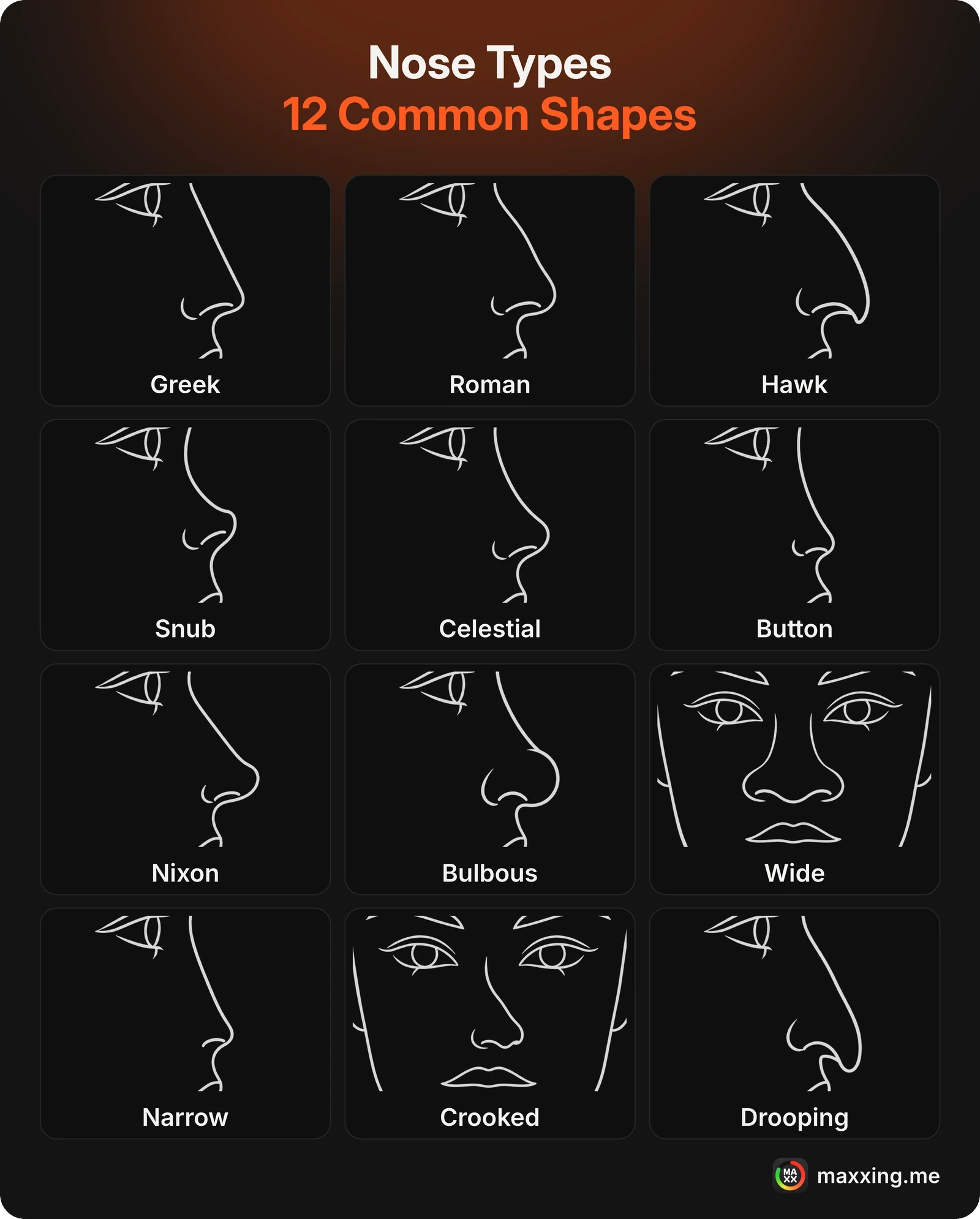
These names come from common usage in anatomy and cosmetic-surgery guides, not from a formal standard. Research papers describe noses by features such as the bridge profile, tip shape and width.
Roman and hawk noses are both convex. The difference is how far the bridge curves and where the tip points. Snub, celestial and button noses are the short, turned-up group, but only snub and celestial have a concave bridge.
How to Tell Your Nose Type
You can identify your nose type with two photos and the chart above: trace the bridge in a side view, check the tip, then judge the width from the front. Take the photos from a few feet away, because close-up selfies make a nose look wider than it is.
A mathematical model published in JAMA Facial Plastic Surgery found that a selfie taken about 12 inches from the face makes the base of the nose look about 30% wider and the tip about 7% wider than a photo taken from 5 feet.
Step back. Put the camera about 5 feet (1.5 m) away, or ask someone to take the photo. Zoom in instead of moving closer.
Shoot a side profile. Turn 90 degrees, keep your chin level and your face relaxed, with even light from the front. A tilted head changes the line of the bridge.
Trace the bridge. Follow it from between the eyes to the tip: straight, a hump (convex) or a dip (concave).
Check the tip. Is it rounded, pointed, turned up or pointing down?
Take a front photo. Judge how wide the base and nostrils look compared with the rest of your face.
Match the three traits to the chart. Expect to land between two rows, since most noses mix traits.

A photo shows shape but does not measure it. A face scan can score your nose next to your other features, and how AI face analysis works is a model estimating how the nose looks in a photo, not labeling your nose type.
Do Nose Types Differ Between Women and Men?
On average, men's noses are larger than women's, and size is the most consistent difference researchers report. Nose shapes overlap heavily between the sexes, so "female nose types" and "male nose types" describe tendencies in averages, not separate categories.
Face size: in a large set of 3D face scans, males were significantly larger than females across all 63 facial regions measured.
Nose size: a 3D study of noses from childhood to old age found that male increases in nasal dimensions were mostly larger than female ones.
Nose height: in a study of 240 adults aged 16 to 50 in India, men's noses were taller in every age group, for example about 58 mm versus 52 mm at ages 41 to 50.
Ideals for a "feminine" or "masculine" nose are cultural, not anatomical. A cross-cultural study of nasal preferences found no single set of proportions that defines an ideal nose across cultures.
Which Nose Type Is the Most Common, and Which Is the Rarest?
We could not find representative worldwide data on how common each named nose type is. The names are informal, and studies measure the bridge, tip and width in different ways, so counts from one study cannot be compared with another.
No agreed method: a systematic review found numerous methods for analyzing the nasal profile, each with its own parameters.
Types overlap: one nose can be straight and wide, or convex with a rounded tip, so a nose often counts for two types at once.
Groups differ: nose measurements change with age, sex and population, so a percentage from one group does not describe everyone. In the India study above, nose height increased with age in both men and women.
If a guide names the most common or rarest type with a percentage, check whether it links to a study.
Is There a Most Attractive Nose Type?
No nose type is objectively the most attractive. Studies find that preferences differ between cultures, between surgeons and the general public, and over time, so any ranking of nose types reflects one group's taste.
Across countries: a cross-cultural study that showed edited nose images to surgeons and the public in 50 countries found no single set of parameters that defines an ideal nose. Surgeons preferred wider nasal roots and tips and more projection than the general public did.
Across time and context: a 2026 systematic review of nasal aesthetic preferences concluded that preferences are dynamic and depend on context. It also noted that the research leans on Eurocentric standards and underrepresents Black populations.
A nose is also judged against the rest of the face. It marks the line between the middle and lower sections in the facial thirds, and the same nose can read differently on a different face shape.
Do Nose Shapes Change With Age?
Yes. The nose grows fastest in childhood and adolescence, and its dimensions keep changing slowly through adulthood. If you are a teenager, your nose is probably still changing.
Puberty: a systematic review of studies of white adolescents placed the end of the nasal growth spurt at about 13.1 years for girls and 14.7 years for boys. In a 3D study of boys and girls aged 6 to 14, girls had a sharp growth spurt at ages 11 to 12, while boys grew at a steadier rate up to 13.
Adulthood: a 3D study of noses from childhood to old age found that nasal volume, area and length increased with age, while the angle of the tip decreased.
The tip: in the India study of adults aged 16 to 50, nose height and breadth increased with age. The authors link a drooping tip to cartilage moving and skin thinning over time.
This is why a nose that matched the "button" row in your teens can read differently at 40.
Can You Change Your Nose Type?
Only surgery changes the structure of a nose. Fillers add volume to reshape the contour for a limited time, and everything else changes how the nose looks: camera distance, angle, lighting and makeup shading can make the same nose look wider, longer or more upturned.
Photos: the selfie effect above is the biggest one. A close-up photo can make the base of the nose look about 30% wider.
Makeup: contouring changes where shadows fall. It does not change the shape of the bridge or the tip.
Fillers ("liquid rhinoplasty"): injected filler adds volume to smooth a bump or add definition to the bridge or tip. Surgeons from the American Society of Plastic Surgeons say the results typically last six months to a year. In a meta-analysis of 8,604 patients, blocked blood vessels were reported in 0.35% and vision loss in 0.09%. The authors concluded that serious complications are uncommon but can occur, and an earlier systematic review noted that they may be underreported. Choose a board-certified plastic surgeon for it.
Surgery: rhinoplasty reshapes the bridge, tip or width. It is a major procedure with real risks, so it is a decision to make with a surgeon who is certified by the American Board of Plastic Surgery, not with a chart. The American Society of Plastic Surgeons lists the risks as anesthesia risks, bleeding, infection, poor wound healing or scarring, difficulty breathing, an unsatisfactory nasal appearance and the possibility of revision surgery.
The nose keeps changing through the teen years, as the section above shows. A systematic review of nasal growth in white adolescents estimated that 98% of girls are nasally mature by age 15.8 and 98% of boys by 16.9, and concluded that nose surgery can safely be performed after age 16 in girls and 17 in boys. The review was written to schedule surgery for patients with cleft lip and palate, so timing for any individual is a decision for a doctor.
Does Your Nose Show Your Ancestry?
No. Nose shape cannot reliably tell you where a person's ancestors came from. Some nose measurements, such as nostril width, differ on average between populations, but individuals overlap widely, and most human genetic variation sits within groups rather than between them.
What research found: a study of people with West African, South Asian, East Asian and Northern European ancestry found that nostril width and the width of the nose base differ more between populations than chance alone would explain, and that nostril width is linked to the temperature and humidity of ancestral climates. The authors call this a simplified explanation of a complex history.
What it does not mean: the National Human Genome Research Institute states that there is more genetic variation within self-identified racial groups than between them.
The names in this guide describe shape only. They say nothing about a person's ethnicity, race or origin.
FAQ
What is the most common nose type?
No reliable worldwide data exists. Named nose types overlap, and studies measure them in different ways.
What is a Roman nose?
A Roman nose, also called an aquiline nose, has a convex bridge with a raised arch or a small hump. It is one of the convex types in the chart above.
How do I determine my nose type?
Take a side-profile photo from about 5 feet away, trace the bridge (straight, convex or concave), check the tip, judge the width from a front photo, then match the three traits to the chart.
What is the most feminine nose shape?
No nose type belongs to one sex. Men's noses are larger on average, but ideas of a feminine or masculine nose are cultural.
At what age does nose shape stop changing?
Growth is fastest in childhood and adolescence. In one systematic review, the nasal growth spurt ended at about 13 for girls and about 15 for boys, and nose dimensions keep changing slowly in adulthood.
Is there a lucky nose shape?
We found no scientific evidence that nose shape predicts luck or personality.
Sources
Methods of analysis of the nasal profile: a systematic review with meta-analysis
Systematic review of nasal aesthetic preferences, Aesthetic Surgery Journal, 2026
Zaidi et al., Investigating the case of human nose shape and climate adaptation, PLoS Genetics, 2017
Complications secondary to nonsurgical rhinoplasty: a systematic review and meta-analysis, 2021
American Society of Plastic Surgeons, the nonsurgical nose job: is liquid rhinoplasty for you?
American Society of Plastic Surgeons, rhinoplasty risks and safety
American Society of Plastic Surgeons, questions to ask about rhinoplasty