



High vs Low Cheekbones: How to Tell Which You Have
High cheekbones peak close to the eyes, roughly level with the bridge of your nose. Low cheekbones peak lower, closer to nostril level. Which one you have comes mostly down to bone structure and the soft tissue over it, and most people land somewhere in between.
Cheekbone height is one of the traits covered in our facial feature analysis, where each feature is read separately. Below is a simple way to check yours, what changes how they look in photos, and what is and isn't fixable.
If you'd rather skip the mirror, our attractiveness test scores your cheekbones next to your other features.
High Cheekbones vs Low Cheekbones: What's the Difference?
High cheekbones have their most prominent point close to the eyes, around the level of the nose bridge. Low cheekbones peak lower, nearer the nostrils. Both describe where the zygomatic (cheek) bone projects most, not how big it is, and neither is a medical category.
High cheekbones | Low cheekbones | |
|---|---|---|
Where the peak sits | Just below the eyes, near the nose bridge | Closer to nostril level |
How light falls | Shadow under the bone, sharper contour | Softer shadow, flatter-looking cheek |
Face outline | More angular | Rounder, softer |
Also called | High-set | Low-set |
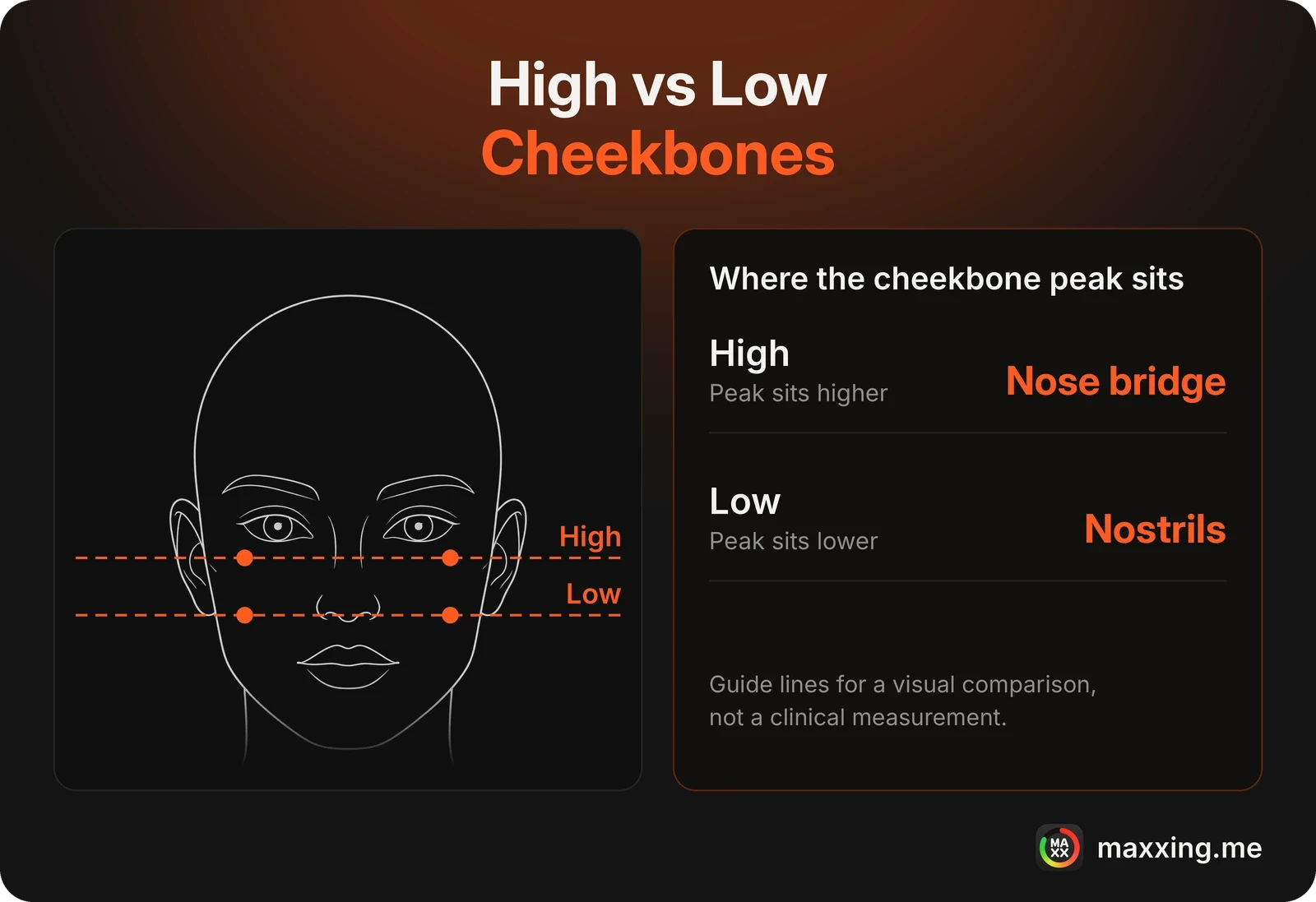
"High" and "low" describe position. A cheekbone can be high-set but flat, or low-set but prominent, so position and projection are two separate things.
How to Tell If You Have High or Low Cheekbones
To tell if your cheekbones are high or low, find the widest, most prominent point of the bone and compare its height to your nose: close to the bridge means high, around the nostrils means low. The finger test and a front-facing photo give the same answer.
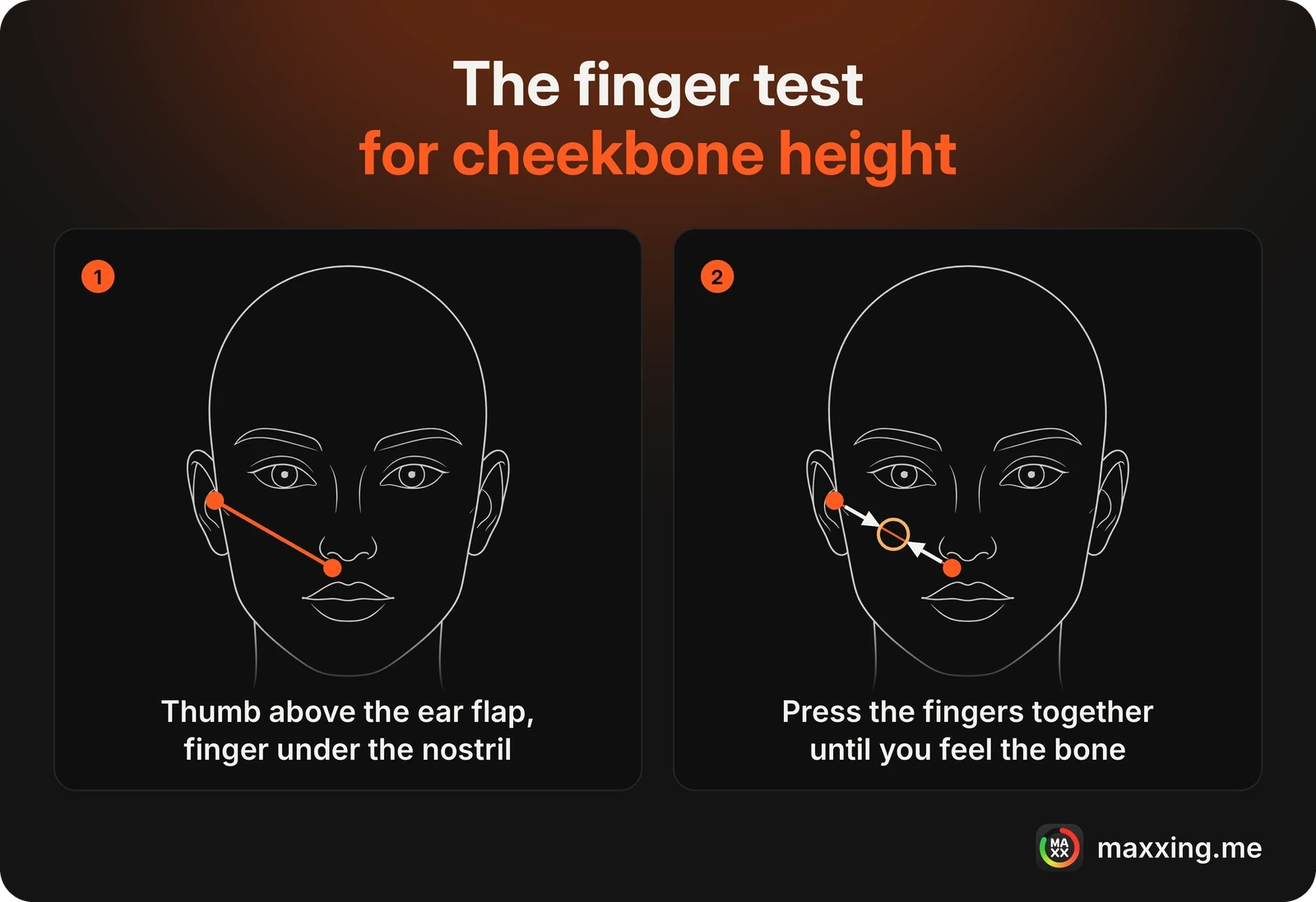
Set up. Relax your face, look straight ahead, and use even light (a window in front of you works better than a ceiling lamp).
Finger test. Put your thumb next to your ear, just above the small cartilage in front of the ear canal (the tragus), and your index finger under your nostril. Press them together until you feel the bone under the skin, as described in wikiHow's guide.
Read the spot. If your fingers meet near the bridge of your nose or just under your eyes, your cheekbones are high. If they meet around nostril level, they are low.
Check on a photo. Take a front-facing photo with a neutral face and compare where the widest part of the cheek falls against your nose bridge and nostrils.
If it lands between the two, that's normal: your cheekbones are medium-set.
Why Your Cheekbones Look Higher or Lower in Photos
Your cheekbones can look higher or lower from photo to photo because the bone doesn't move but everything over it does. A genuine smile engages the muscle around the eye, which raises the cheeks, so the same face can read as higher-set when smiling than when neutral.

Lighting does the rest. Light from the front flattens the cheek, while light from the side or slightly above creates the shadow under the bone that makes it look defined. Compare photos taken in the same light with the same expression before deciding which type you have.
High Cheekbones vs Prominent, Wide and Flat Cheekbones
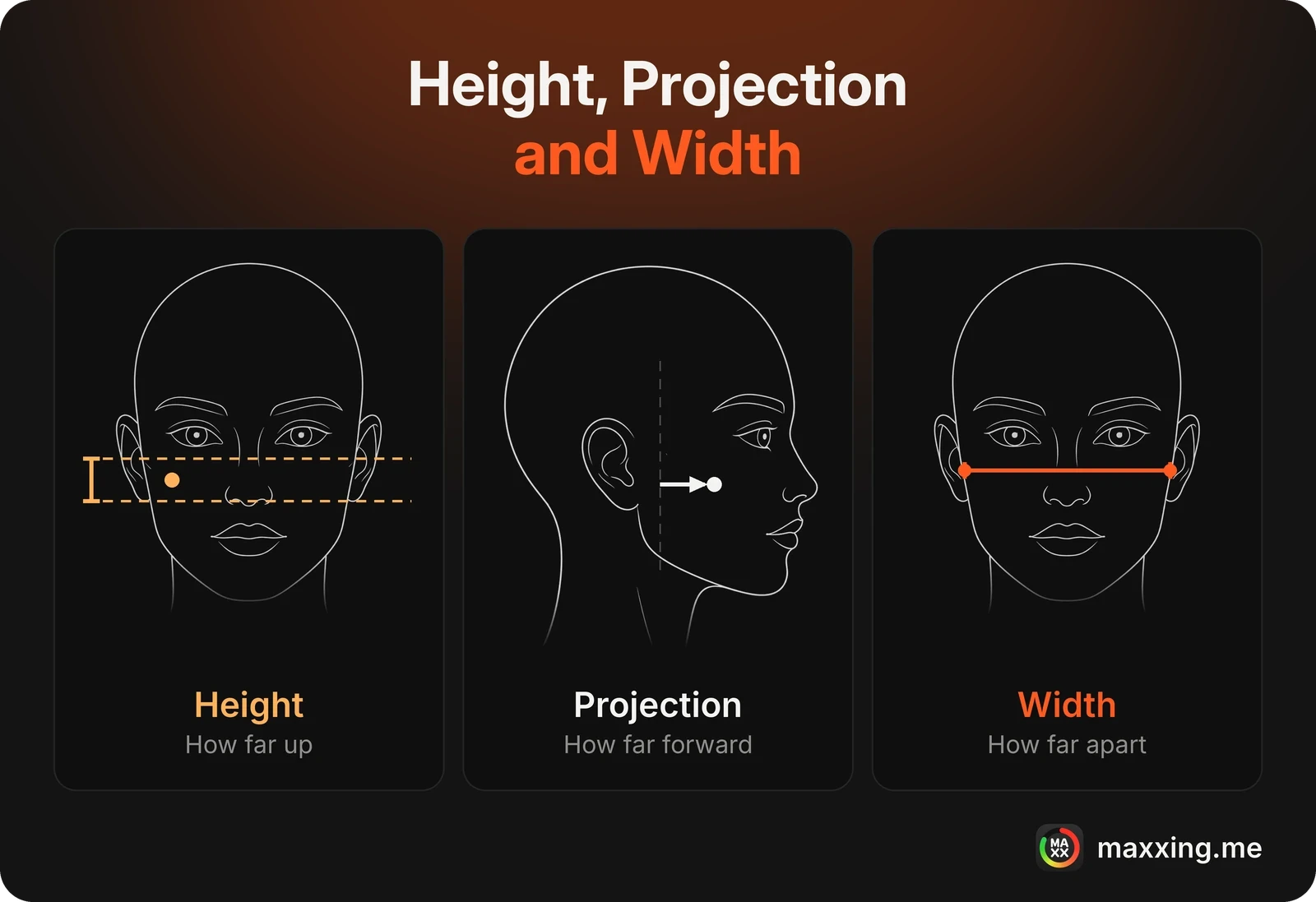
Height, prominence and width are three different traits, so "high vs low" alone doesn't tell you how defined your cheekbones look. Height is where the bone peaks, prominence is how far it projects, and width is how far apart the bones sit across the face.
Trait | What it describes | What it changes |
|---|---|---|
Height (high or low) | Where on the face the bone peaks | Whether the contour starts near the eyes or nearer the mouth |
Prominence | How far the bone and cheek project forward and out | How much shadow and definition shows |
Width | Distance between the bones across the face | How wide the midface looks |
Flat cheekbones | Little projection, at any height | A smoother cheek with less shadow |
The cheek is built in layers from bone to skin, including fat pads, so what you see in the mirror is bone plus everything over it. Two people with the same bone can look different.
Cheekbones also sit inside your midface. To see how long yours reads, check our guide to the midface ratio.
High vs Low Cheekbones in Women and Men
The height test is the same for everyone. What differs is how the feature reads on average: cheekbone prominence is one of five shape cues that differ statistically between male and female faces, alongside eyebrow prominence, eye size, facial height and jawbone prominence. Those are group averages, and plenty of women have very defined cheekbones while plenty of men have flatter ones.
Women: look at cheek fullness and face shape together with height, since soft tissue changes how defined the bone looks.
Men: cheekbones are usually judged next to the jaw and brow, which counted for more in the attractiveness research below. Our jawline rating guide covers that side.
Tools that estimate cheekbone prominence from a photo give you a model's estimate, not a measurement of your bone. We explain the difference in how AI face analysis works.
Are High Cheekbones More Attractive?
Not clearly. Neither height is "better," and research suggests cheekbones count for less than people assume. In a study where 922 participants ranked faces, jawbone prominence and eyebrow thickness counted for more in overall attractiveness than cheekbone prominence or eye size, though the differences were small to moderate.
One feature never decides how a face reads. Cheekbones work together with the jaw, brows, eyes and skin, so it makes more sense to look at them as a set than to judge them alone.
Which Celebrities Have High or Low Cheekbones?
wikiHow's guide to cheekbones lists Keira Knightley and Cillian Murphy as examples of high cheekbones, and Zoë Kravitz and Nicole Kidman as examples of low cheekbones.
These are visual impressions from photos, not measurements, and lists differ from source to source, so treat them as rough reference points.
Cheekbones and Age
Your cheekbones don't move as you age, but the tissue around them does, so they can look higher or lower over time. Research on the aging midface describes gradual change in both bone and fat rather than one peak age.
Bone: a review of facial skeletal aging reports selective bone loss in parts of the midface, mainly around the maxilla.
Fat, one finding: in a CT study of cadaver heads (12 heads, older vs younger groups), the midfacial fat compartments sat lower in the older group.
Fat, another finding: an MRI study of 20 women found larger cheek fat pad volumes in older than in younger women, and concluded that sagging alone doesn't explain aging in the midface.
The studies are small and don't fully agree, so there is no simple rule such as "cheekbones look best at X." Clinic blogs often claim that high cheekbones age better, but the research above looks at fat and bone changes in general, not at cheekbone height.
Can You Change How High or Low Your Cheekbones Look?
You can't move the bone without surgery, but you can change how defined your cheekbones look. Most of it comes down to light, expression and what sits over the bone.
Light: side or slightly overhead light creates the shadow that makes the cheek look defined. Front light flattens it.
Expression: a genuine smile lifts the cheeks, as covered above.
Styling: makeup that uses shadow and light can make cheekbones look higher, and a haircut that frames the cheek changes how the midface reads.
Soft tissue: the fat over the bone changes with weight, which changes how visible the contour is. Crash diets or dehydration for this aren't worth it: they carry real health risks and don't change the bone.
Mewing and facial exercises: the evidence doesn't support them moving cheekbones or other bone structure. Our guide to whether mewing works goes through the research.
What About Fillers and Surgery?
Dermal fillers are described in the medical literature as a minimally invasive alternative to surgery for adding projection to the cheeks. Cheek implants are surgery: a small 2024 database study of 84 patients concluded that implants in the cheekbone and jaw region were safe overall, with complications more likely when combined with other procedures.
Either way, these are medical decisions for adults, made with a board-certified specialist. The American Society of Plastic Surgeons recommends choosing a board-certified plastic surgeon. This guide doesn't cover techniques or costs.
FAQ
Are high cheekbones rare?
There is no standard measurement for "high," so there is no reliable figure for how common they are. Many people fall between clearly high and clearly low.
What face shape has strong cheekbones?
Cheekbones can look defined on any face shape. To see yours, take our face shape test.
Which ethnicities have high or low cheekbones?
Cheekbone height isn't tied to ethnicity or ancestry. It varies widely within every group and can't tell you where someone's family is from.
Do high cheekbones say anything about personality?
No. Healthline notes that having high or low cheekbones doesn't indicate anything about a person.
Can one cheekbone be higher than the other?
Mild differences between the two sides are covered in our guide to facial asymmetry.
Sources
Low Cheekbones vs. High Cheekbones: How to Locate and Modify, Healthline
What are High and Low Cheekbones? How to Tell Which Ones You Have, wikiHow
Aging Changes of the Midfacial Fat Compartments: A Computed Tomographic Study, PubMed
Trust ASPS: choosing a board-certified plastic surgeon, American Society of Plastic Surgeons