


Midface Ratio: What It Is, How to Measure It, and What's Ideal
The midface ratio compares two distances on your face: the space between your pupils and the distance from your pupils down to your upper lip. Divide the first by the second, and you get a single number. Most online guides call a result around 1.0 ideal, but that benchmark comes from looksmaxxing forums, not from medical research.
The midface ratio is one of the proportions a facial feature analyzer can look at. On its own, it says little about how a face comes across — that depends on how all your features work together, the kind of overall impression an attractiveness test tries to score.
The closest research found that faces looked most attractive when their proportions matched an average face, not a single magic number (Pallett et al., 2010).
Midface height differs by sex on average: in one 3D imaging study, women's midface skeleton was about 4 mm shorter vertically than men's (Abushehab et al., 2024).
What Is the Midface Ratio?
The midface ratio is your interpupillary distance (IPD) — the distance between the centers of your pupils — divided by the vertical distance from your pupils to the top of your upper lip. It describes whether the middle of your face reads compact or elongated relative to how far apart your eyes are.
Measurement | Runs from → to | What it reflects |
|---|---|---|
Interpupillary distance (IPD) | Center of one pupil → center of the other | Eye spacing |
Midface height | Line through the pupils → top edge of the upper lip | Nose length and upper lip length |
Midface ratio | IPD ÷ midface height | How the two compare |

A ratio above 1.0 means your eyes are spaced wider than your midface is tall. A ratio below 1.0 means your midface is taller than your eye spacing.
Why Some Calculators Flip the Formula
Some guides divide midface height by IPD instead. Both versions land near 1.0 for a balanced face, so the numbers look similar — but they read in opposite directions:
IPD ÷ midface height (the most common version): a higher number means a shorter, more compact midface.
Midface height ÷ IPD (the flipped version): a higher number means a longer midface.
A result of 0.95 in the standard formula equals about 1.05 in the flipped one. Before you compare your number to a chart, check which formula the calculator uses.
Where the Midface Ratio Comes From
The midface ratio isn't one of the classic facial proportion canons used in orthodontics and plastic surgery, and no peer-reviewed study defines an ideal value for it. It spread through looksmaxxing forums, and online calculators picked it up from there.
The closest research is a 2010 study by Pallett, Link, and Lee (Vision Research):
Method: participants compared versions of the same faces in which only the spacing of the eyes and mouth had been changed.
Result: faces were rated most attractive when the eye-to-mouth distance was about 36% of face length and the distance between the eyes was about 46% of face width.
What it means: those proportions matched the average face. The authors described these averages as the face's real "golden ratios," in place of the 1.618 golden ratio — see our golden ratio face test guide for how that number is used.
Limits: the study measured eye-to-mouth distance against face length, not the midface ratio itself, and it tested only white women's faces. The researchers noted that men's faces and faces from other groups need separate study (ScienceDaily).
What Is the Ideal Midface Ratio?
The ideal midface ratio is usually given as about 1.0 — a 1:1 ratio, where your eye spacing equals your midface height — or a narrow range around it, such as 1.0 to 1.05. That target is a looksmaxxing convention, not a clinical standard: no peer-reviewed study has set a cutoff for a good or bad midface ratio.
Forums and calculators sort results into rough bands. The cutoffs change from source to source, so read this table as a summary of how the number is talked about online, not as a scale:
Midface ratio (IPD ÷ height) | How it's usually described online |
|---|---|
1.1 and above | Short or very compact midface |
About 1.0–1.05 | "Ideal" or balanced |
About 0.9–0.99 | Slightly long midface |
Below 0.9 | Long midface |
The sources don't agree with each other:
Popular ratio lists on looksmaxxing forums put the ideal anywhere from 0.93–1.01 to 1.0–1.1, and individual threads add their own ranges in between.
So a 1.1 midface ratio is ideal on one list and outside the ideal range on another, and a 0.95 is ideal in some lists and slightly long in others.
What Research Says About Facial Proportions
Research on facial attractiveness points to averageness, not to any single ratio. Faces with proportions close to the average of a group tend to be rated as more attractive than faces that are pushed toward an extreme.
Pallett et al. (2010): when only the position of the eyes and mouth changed, attractiveness peaked at the proportions of the average face in the study set (Vision Research).
Tennstedt et al. (2026): a preprint on male faces found support for the same idea — average eye spacing relative to face width was linked to higher ratings of beauty (arXiv).
What's missing: we found no large study reporting typical midface ratio values for adults, so there's no measured average to compare your number against.
Midface Ratio in Men and Women
There's no separate ideal midface ratio for men or for women — no study has defined one. What research does show is that both measurements behind the ratio differ by sex on average:
Eye spacing: in a study of Iranian adults, average IPD was 61.1 mm in women and 63.6 mm in men (Fesharaki et al., 2012).
Midface height: in a 3D imaging study of white adults, women's midface skeleton was about 4 mm shorter vertically than men's (Abushehab et al., 2024). That study measured bone, not the distance from pupils to lip.
What it means for the ratio: both numbers tend to be smaller in women, so a smaller face doesn't automatically mean a different midface ratio.
Is a longer midface more masculine? On average, men have a vertically taller midface, so a longer midface is somewhat more common in men. Whether it reads as masculine depends on the rest of the face — jaw, brow, and cheekbones included.
How to Measure Your Midface Ratio
To measure and calculate your midface ratio, take a straight-on photo, mark the center of each pupil, and measure the distance between them. Then measure straight down from that pupil line to the top edge of your upper lip, and divide the first number by the second. Pixels work fine, as long as both distances come from the same photo.
Take the right photo.
Face the camera straight on, with the lens at eye level, a neutral expression, and lips closed.
Have someone shoot from about 5 feet away. An arm's-length selfie makes the nose look about 30% wider than it is (Ward et al., 2018), which distorts the middle of the face.
Look straight into the lens so both pupils sit centered in your eyes.
The full photo checklist is in our guide to measuring facial thirds.
Mark the center of each pupil and draw a horizontal line through both points.
Measure your IPD — the length of that line between the two pupil centers.
Measure your midface height — straight down from the pupil line to the top edge of your upper lip, at the center of the mouth.
Divide IPD by midface height.

Example: your IPD measures 324 pixels and your midface height measures 281 pixels. 324 ÷ 281 = 1.15.
Why Your Number Might Be Off
Lens distortion. Close-up phone shots enlarge whatever is nearest the camera, mostly the nose.
Head tilt. Tilting your head up or down changes how long the midface looks in a photo.
Expression. A smile lifts the upper lip and shortens the midface height.
Gaze. Looking away from the lens or at something close shifts where your pupils sit and can change the measured IPD.
Landmark placement. Small errors add up: if your IPD is 300 pixels, placing the lip point 10 pixels too low drops the ratio from 1.00 to about 0.97.
Measure two or three photos and average the results instead of trusting a single number.
Midface Ratio Calculators
A midface ratio calculator places the landmarks on your photo for you and returns the number. It's faster than measuring by hand, with the same limits:
Tools don't all use the same landmarks or the same version of the formula, so one photo can get different results on different sites.
A calculator can't fix a close-up selfie or a tilted head.
Most tools show the ratio on its own, without the rest of the face around it.
For a look at how AI tools read faces more broadly, see our guide to AI face analysis.
Want to see how your features work together? The Maxxing face test analyzes your facial proportions and scores individual features — cheekbones, nose, lips, chin, and jawline — with a short explanation for each score, plus an overall attractiveness score. Like any AI rating, the results are a model's estimate, not an objective measurement.
Midface Ratio vs. Middle Third vs. FWHR
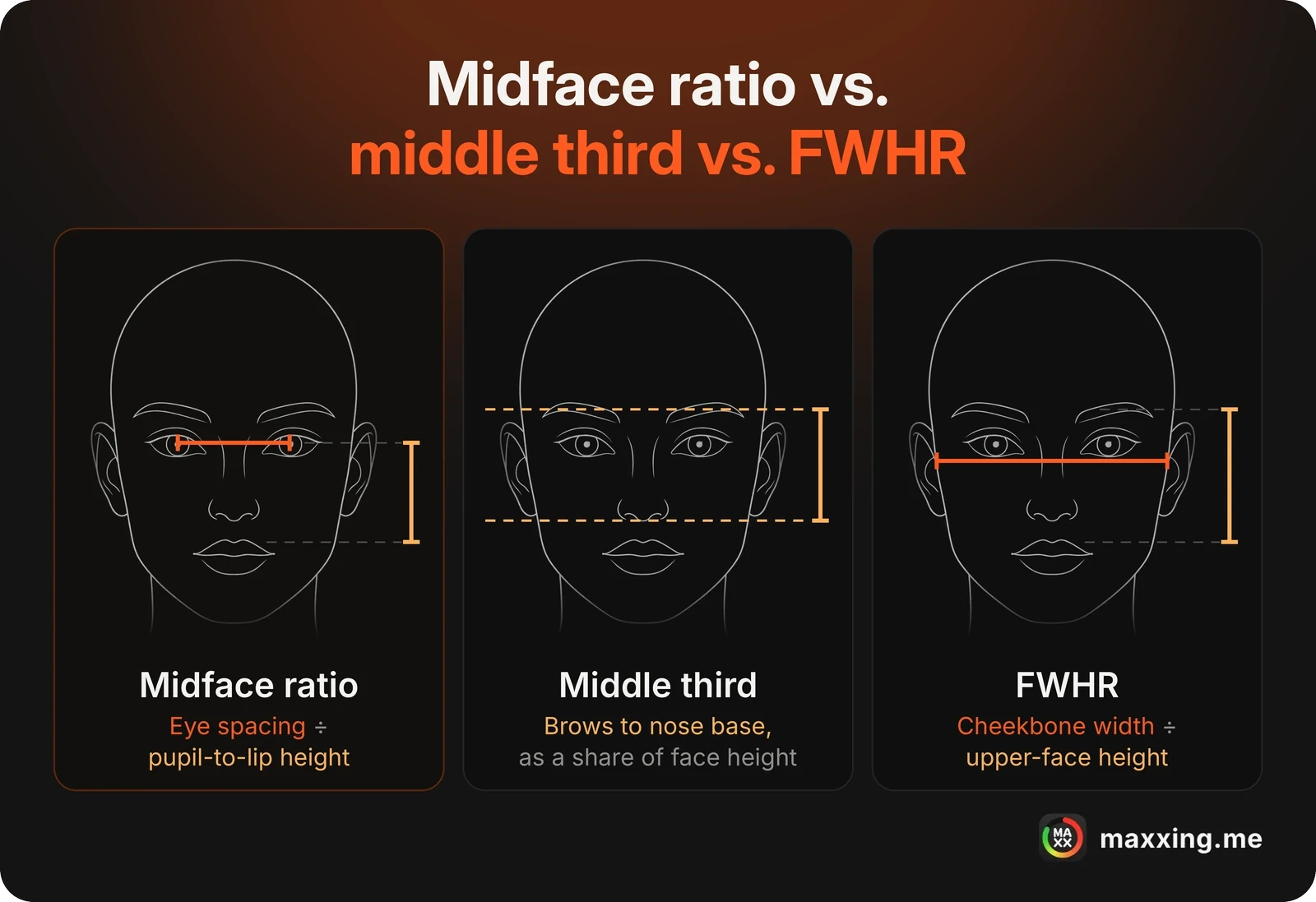
The midface ratio, the middle third, and the facial width-to-height ratio (FWHR) all describe the middle of the face, but they measure different things. The midface ratio compares eye spacing to midface height, the middle third compares midface height to the rest of the face, and FWHR compares face width to midface height.
How it's calculated | Common reference | Where it comes from | |
|---|---|---|---|
Midface ratio | IPD ÷ distance from pupils to upper lip | About 1.0 | Looksmaxxing forums and online calculators |
Middle third | Brows to base of the nose, as a share of face height | One-third of the face (the 1:1:1 rule); in most adults it's the shortest third | Classical art canons, orthodontics, plastic surgery |
FWHR | Width between the cheekbones ÷ height of the upper face | No agreed ideal; studies measure height from different points (Hodges-Simeon et al., 2021) | Psychology and anthropology research |
Chin to midface ratio | Compares midface height with chin height | No research benchmark | Looksmaxxing forums |
A few things this clears up:
"Is 1.4 or 1.5 a good face ratio?" Values like these usually refer to FWHR or to face length versus width, not to the midface ratio, which online charts put around 1.0.
"What is the middle face ratio?" The word "midface" has several definitions. In orthodontics, it's often the region from the brows to the base of the nose (Chalala & Ghafari, 2019) — the same zone as the middle third, not the pupil-to-lip distance the midface ratio uses.
"What is the 1/3 face rule?" It's the classic idea that the upper, middle, and lower thirds of the face are equal in height. Our guide to the 1/3 face rule and facial thirds covers how it's measured and how rarely real faces follow it.
What Makes a Midface Look Long or Short
A midface reads long when the distance from the eyes to the upper lip is large compared with eye spacing, and short when it's small. Because the ratio has two parts, a "long midface" can come from a long nose or upper lip — or from eyes set relatively close together.
Eye spacing. A narrower IPD lowers the ratio even when midface height is average.
Nose length. The distance from your eye line to the base of your nose makes up most of the midface height.
Upper lip length. The space between the nose and the lip (the philtrum) is part of the measurement too.
Upper jaw growth. How far the upper jaw grows downward sets the base for both the nose and the lip. Excess vertical growth of the upper jaw, called vertical maxillary excess, is a common cause of a long face (Nasrun et al., 2021).
Cheekbones, chin, and nose shape. They don't change the number, but they shape how the whole face reads — one reason the ratio alone can't tell you how your midface actually looks.
Under-eye area. When the cheekbones under the eyes are flat or the area has lost volume, the lower eyelid looks longer, and the midface can look longer with it (Chaiet & Williams, 2013).
Age. As the face ages, the soft tissue of the cheeks descends and loses volume, which can make the area under the eyes look longer (Chaiet & Williams, 2013).
The photo itself. A close-up selfie or a tilted head can make a midface look longer or shorter than it is.
Is a "Bad" Midface Ratio a Flaw?
There's no medical definition of a bad midface ratio. In forums, "bad" usually means a number below the 0.9–1.0 range — a longer midface — and sometimes a very high one, too.
The ratio is one number out of many. The same midface ratio can read differently depending on the jaw, brows, cheekbones, and hairstyle around it. Research on averageness also doesn't support the forum idea that a shorter midface is always better: the most attractive proportions in studies were the average ones, not the most compact.
Before you focus on the midface, look at the whole face. The midface ratio doesn't include the chin at all, yet the chin strongly affects how long the whole face looks (Deshpande & Munoli, 2011), and in one study a chin set too far back or too far forward lowered attractiveness ratings (Naini et al., 2019).
If a long lower face or midface comes with bite problems, jaw pain, or trouble breathing through your nose, an orthodontist or an oral and maxillofacial surgeon can assess it.
Curious how your features read as a whole? The Maxxing test gives an overall attractiveness score along with separate scores and explanations for features like cheekbones, nose, and lips. It's a model's estimate, so use it as a starting point, not a verdict.
Can You Change Your Midface Ratio?
You can't change your midface ratio without medical treatment, and one half of it — the distance between your pupils — realistically can't be changed at all. What you can change is how your midface reads: brows, facial hair, hair, and makeup shift where the eye lands. Surgery can change the nose, lip, jaw, and chin, with real risks.
What Changes How Your Midface Reads
Brows. Brow shape and height move the line where the midface seems to start.
Facial hair. A mustache visually breaks up the space between the nose and the upper lip.
Makeup. Blush and contour applied across the cheeks draw the eye sideways instead of down the face.
Hair. Volume at the sides makes the face read wider; height at the crown makes it read longer.
Glasses. Frames add a horizontal line across the middle of the face.
None of these change the measurement. They change the impression, which is what other people actually see.
Medical Options
These change the actual proportions. Each carries real risks, cost, and recovery time, and should start with a consultation with a board-certified plastic surgeon or an oral and maxillofacial surgeon:
Rhinoplasty — can shorten a long nose or rotate its tip upward; in a multicenter study of 138 patients concerned about a long nose, shortening was achieved in 88% (Ali et al., 2011). Because the ratio is measured to the upper lip, it changes how the midface looks more than the number itself.
Lip lift — surgically shortens the space between the nose and the upper lip. A 2026 systematic review found it safe and effective for restoring upper-lip proportions (Journal of Cosmetic Dermatology, 2026).
Orthognathic (jaw) surgery, such as Le Fort I osteotomy — repositions the upper jaw. It's done mainly to correct bite and jaw problems; moving the upper jaw up is the standard surgical treatment for vertical maxillary excess, which can cause a long face, a gummy smile, and sometimes an open bite (Nasrun et al., 2021).
Chin surgery (genioplasty) or a chin implant — changes the lower face, not the midface, but can improve the overall balance of the face in front and side views (Deshpande & Munoli, 2011).
Cheek or under-eye implants — add projection below the eyes where bone support is lacking, which can soften the look of a long midface (Chaiet & Williams, 2013).
Dermal fillers — a temporary way to add volume to the cheeks, which can change how the midface reads. A 2025 meta-analysis found hyaluronic acid fillers for the midface generally safe (Medicina, 2025).
Orbital box osteotomy — major skull and face surgery that moves the eye sockets. It’s used to correct widely spaced eye sockets (orbital hypertelorism), a congenital craniofacial condition, and is done in specialized craniofacial centers (Sharma, 2014). In practice, IPD is the part of the ratio that stays as it is.
Under 18? Your face is still growing, so the measurements behind your midface ratio are still changing. In one large study, average IPD was about 4.8 mm wider at ages 10–19 than at ages 5–9, and it kept increasing into the 20s (Fesharaki et al., 2012). Don't make decisions based on your midface ratio now; if your bite or breathing bothers you, start with an orthodontist.
What Doesn't Have Evidence
Mewing (resting the tongue against the roof of the mouth). The American Association of Orthodontists says there's no research showing it benefits your jawline or oral health, and pressing too hard can shift your teeth and bite (AAO).
Facial exercises. A 2025 systematic review found the evidence too weak to say they work even for signs of aging (Aesthetic Surgery Journal Open Forum, 2025). They act on muscle and soft tissue, not on bone or eye spacing.
Bone smashing (hitting the face with hard objects to "reshape" bone). It has no scientific support and can injure you. Don't try it.
If measuring your face is taking over — you check photos again and again, compare ratios, or avoid mirrors or people because of how your face looks — talk to a doctor or a mental health professional before considering any procedure.
FAQ
What is a good midface ratio?
Most online guides call a midface ratio around 1.0 good, and popular forum lists put the ideal somewhere between about 0.93 and 1.1. Those ranges are community conventions: no study has defined a good midface ratio, and research on attractiveness favors average proportions over any single number.
Is a 0.9 midface ratio bad?
No. A 0.9 midface ratio means your midface is slightly taller than your eye spacing — what forums call a slightly long midface. It isn't a medical problem, and small errors in where you place the landmarks can move the number by 0.03 or more, so check the photo before you trust the result.
Is a 1.1 or 1.2 midface ratio good?
A 1.1 or 1.2 midface ratio means your eye spacing is wider than your midface is tall — a compact midface. Some forum lists count 1.1 as ideal, others put it outside the ideal range, and none of them are based on research.
Is a short midface attractive?
A short, compact midface is often treated as desirable in looksmaxxing communities, but research doesn't show that shorter is better. In facial attractiveness studies, proportions close to the average were rated the most attractive (Pallett et al., 2010).
Does your midface ratio change with age?
It can. In a study of 756 adults, people aged 51–70 had a wider average IPD than people in their 20s (Yildirim et al., 2015). A study of Iranian adults found the same pattern: average IPD kept increasing after age 30 and was about 1 mm wider after 50 than at 30–50 (Fesharaki et al., 2012). The soft tissue of the cheeks also descends and loses volume with age, which can make the area under the eyes look longer. For how age shows in a face overall, see how old do I look.
Is the midface ratio the same as facial thirds?
No. Facial thirds compare the heights of the upper, middle, and lower face, while the midface ratio compares eye spacing to the distance from your pupils to your upper lip. They use different landmarks, so the two measurements can point in different directions for the same face.
Can ChatGPT measure my midface ratio?
AI chatbots like ChatGPT can describe a face in a photo, but they estimate proportions by eye instead of placing landmarks and measuring distances, and they may give different answers for the same photo. For an actual number, measure the photo yourself or use a landmark-based calculator.
Sources
Pallett PM, Link S, Lee K. New "golden" ratios for facial beauty. Vision Research, 2010
ScienceDaily. New "golden ratios" for female facial beauty, 2009
Deshpande SN, Munoli AV. Osseous genioplasty: a case series. Indian Journal of Plastic Surgery, 2011
Sharma RK. Hypertelorism. Indian Journal of Plastic Surgery, 2014
American Association of Orthodontists. Does mewing actually reshape your jaw?