



Golden Ratio Face Calculator: How the Test Works and What Your Score Means
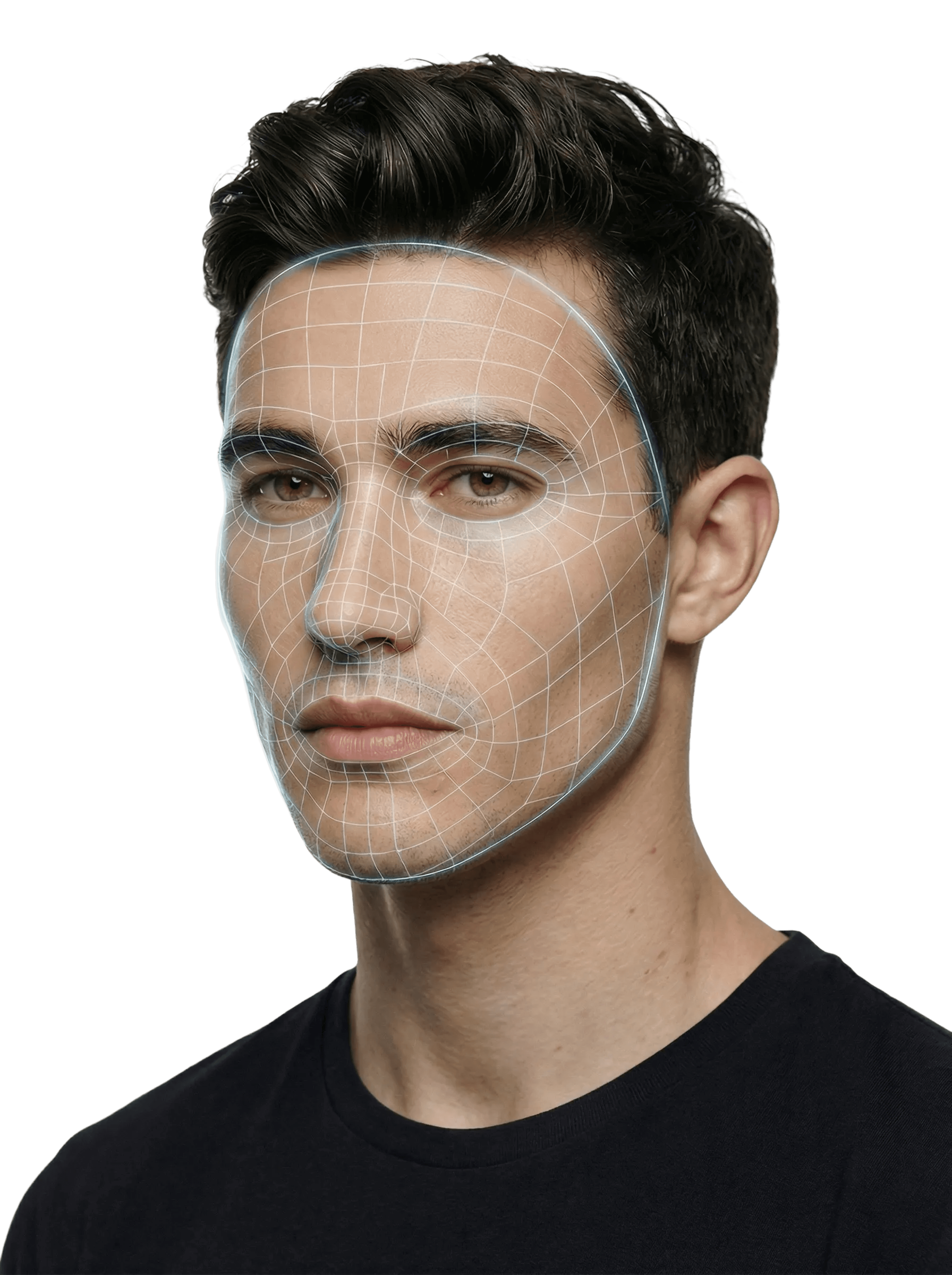
A golden ratio face calculator finds landmarks on your face in a photo, measures the distances between them, and compares the resulting ratios with phi — about 1.618. The score shows how closely a few of your proportions match that number, not how attractive you are. Studies that tested the golden ratio against attractiveness ratings have mostly found a weak link or none at all.
This guide covers how a golden ratio face test works, which ratios it checks, how to measure your face by hand, and what your score can and can't tell you. For a wider look at how AI reads your features, see our guide to facial feature analysis, or find out how an AI attractiveness test scores a face as a whole.
What is a golden ratio face?
A golden ratio face is a face whose proportions come close to phi (φ), a mathematical constant of about 1.618. The idea behind it is that certain facial measurements — most often face length divided by face width — should equal 1.618, and that faces closer to that number look more attractive.
Where the number comes from
The math. Phi is the ratio you get when you split a line so that the whole line relates to the longer part exactly as the longer part relates to the shorter one. Euclid described it around 300 BC.
The myths. Popular claims that the Parthenon, the pyramids, or Renaissance paintings were built on phi are mostly unsupported, as mathematician George Markowsky showed in his 1992 paper Misconceptions about the Golden Ratio.
How the golden ratio ended up on faces
Most golden ratio overlays you see online trace back to the Marquardt mask. Stephen Marquardt, a facial surgeon, built a "Golden Decagon" mask out of golden triangles and pentagons after studying the faces of models and movie stars, as he explained in a 2002 interview in the Journal of Clinical Orthodontics. He presented it as a template of an ideal face.
The mask has a well-known problem. A 2008 analysis in Aesthetic Plastic Surgery found that it best describes the masculinized white female faces common among fashion models — and that its proportions don't match what most people actually prefer, especially in women's faces.
Golden ratio vs. facial thirds and fifths
Many calculators mix the golden ratio with two older rules, the neoclassical canons. These rules split the face into equal parts, so their target is 1:1, not 1.618.
Rule | What it measures | Target |
Golden ratio | Face length to face width (plus other pairs, depending on the tool) | 1.618 : 1 |
Facial thirds | Hairline to brows, brows to base of the nose, base of the nose to chin | Three equal parts |
Facial fifths | Face width split into five sections; the middle one is the gap between the inner eye corners | Five equal parts |
The thirds rule is usually credited to Leonardo da Vinci. A 2017 review in Cutis notes that these canons were meant to apply to everyone, but real proportions vary by ethnicity. If a calculator reports your "thirds," it's checking this canon, not phi.
How a golden ratio face calculator works
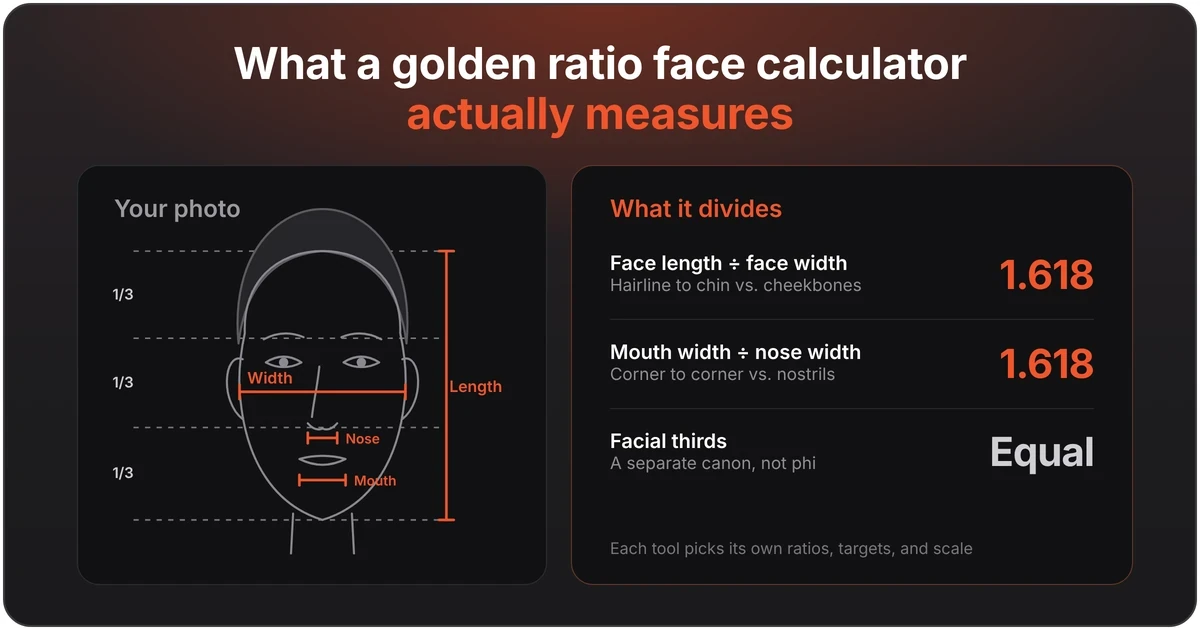
A golden ratio face calculator is software that detects points on your face in a photo, measures selected distances between them, turns those distances into ratios, and scores how far each ratio sits from a target — usually 1.618. Most tools then average those gaps into one number, shown as a percentage or a score out of 100.
The process behind a golden ratio calculator for your face looks like this:
You upload a front-facing photo. Some tools also accept a live camera feed or manual measurements.
The tool maps your face. Many calculators use face-mesh models that place hundreds of points — around 468 to 478 in the tools we looked at — on the face outline, eyes, brows, nose, lips, and chin.
It measures distances. For example, hairline to chin, cheekbone to cheekbone, or the width of the nose and mouth.
It turns distances into ratios. Each ratio is one distance divided by another.
It scores the gap. The closer a ratio is to the target, the higher that part of the score.
Which ratios the calculators measure
There is no standard list. These are the pairs that come up most often:
Ratio | What's measured | Target most tools use |
Face length to face width | Hairline to chin vs. cheekbone to cheekbone | 1.618 |
Mouth width to nose width | Corner to corner of the mouth vs. the width of the nostrils | 1.618 |
Nose-to-lip distance | Base of the nose to the upper lip, compared with another vertical distance (it varies by tool) | 1.618 |
Eye spacing | Distance between the eyes compared with eye width or face width | Varies by tool |
Facial thirds | Hairline to brows, brows to nose base, nose base to chin | Equal parts, not phi |
Midface ratio | A looksmaxxing measure of the middle of the face | Not phi |
The last two rows aren't golden ratio measurements at all, but calculators often add them to the same report. Facial thirds come from the neoclassical canon above. The midface ratio is a separate metric from online looksmaxxing communities.
Why different calculators give different scores
Run the same photo through three calculators and you'll likely get three different results. That's not a glitch — the tools aren't measuring the same thing:
Different ratios. Among the calculators ranking on Google, one scores 3 ratios, others 5, 6, or 8, and one reports 11.
Different targets. At least one tool doesn't compare your face length to 1.618 directly but to an adjusted target, because few real faces come close to phi.
Different landmarks. Where exactly the "hairline" or the "edge of the face" sits is an estimate, especially with bangs or a receding hairline. A few millimeters change the ratio.
Different scales. A percentage, a score out of 100, and a letter grade can't be compared with each other.
A golden ratio score only means something within one tool, and only for photos taken the same way.
How to check your face's golden ratio by hand
To check your face against the golden ratio by hand, measure your face length from hairline to chin, measure its width across the cheekbones, and divide length by width. A result of 1.618 matches phi. You'll need a ruler or a soft tape measure and two minutes — no app required.
Measuring your face directly
Prepare. Pull your hair back so your hairline and jaw are visible. Keep a neutral expression and look straight ahead.
Measure face length. Go from your hairline — where the hair starts at the top of the forehead — to the bottom of your chin.
Measure face width. Go across the widest part of your face, usually the cheekbones.
Divide. Face length ÷ face width = your ratio.
Repeat. Measure twice and use the average. The hairline in particular is easy to place a few millimeters off.
Example: a face 19 cm long and 13.5 cm wide gives 19 ÷ 13.5 = 1.41.
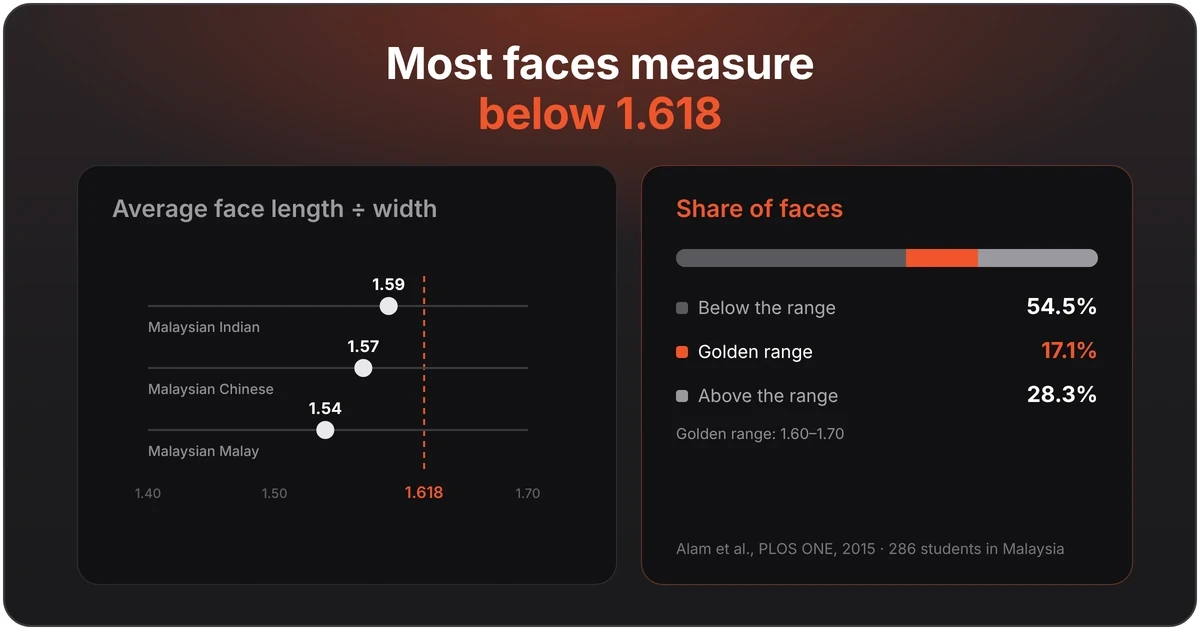
Don't be surprised if your number lands below 1.618 — most faces do. In a study of 286 university students in Malaysia, measured the same way (hairline to chin over cheekbone width), average ratios ranged from 1.54 to 1.59 across three ethnic groups. Only 17.1% of faces fell in the 1.60–1.70 range the researchers counted as golden, and more than half came in below it.
The same two measurements are also what you need to find your face shape — length versus width is the main thing that separates an oval face from a round or oblong one.
Measuring from a photo instead
You can do the same on a photo with any image editor that shows pixel distances. Ratios don't have units, so pixels work as well as centimeters.
Use a straight-on photo with your head level, not tilted up or down.
Have someone take it from about 5 feet away rather than holding the phone at arm's length. Close-up selfies distort proportions — more on that below.
Measure the same points as above: hairline to chin, cheekbone to cheekbone.
Want to check more than one ratio? Mouth width divided by nose width is the next most common pair calculators compare with 1.618.
Using a golden ratio face calculator with photo upload
When you upload a photo to a golden ratio face calculator, the photo itself can change your score as much as your face does. Camera distance, head tilt, expression, hair, and beauty filters all shift the distances the tool measures, so the same person can get noticeably different results from two selfies taken a minute apart.
Why selfies distort your ratios
A phone held at arm's length sits too close to your face for accurate proportions. In a 2018 study in JAMA Facial Plastic Surgery, researchers modeled how camera distance changes facial dimensions:
At about 12 inches — a typical selfie — the base of the nose looked about 30% wider relative to the cheekbones in men and 29% wider in women.
At about 5 feet, a standard portrait distance, there was no difference from the face's real proportions.
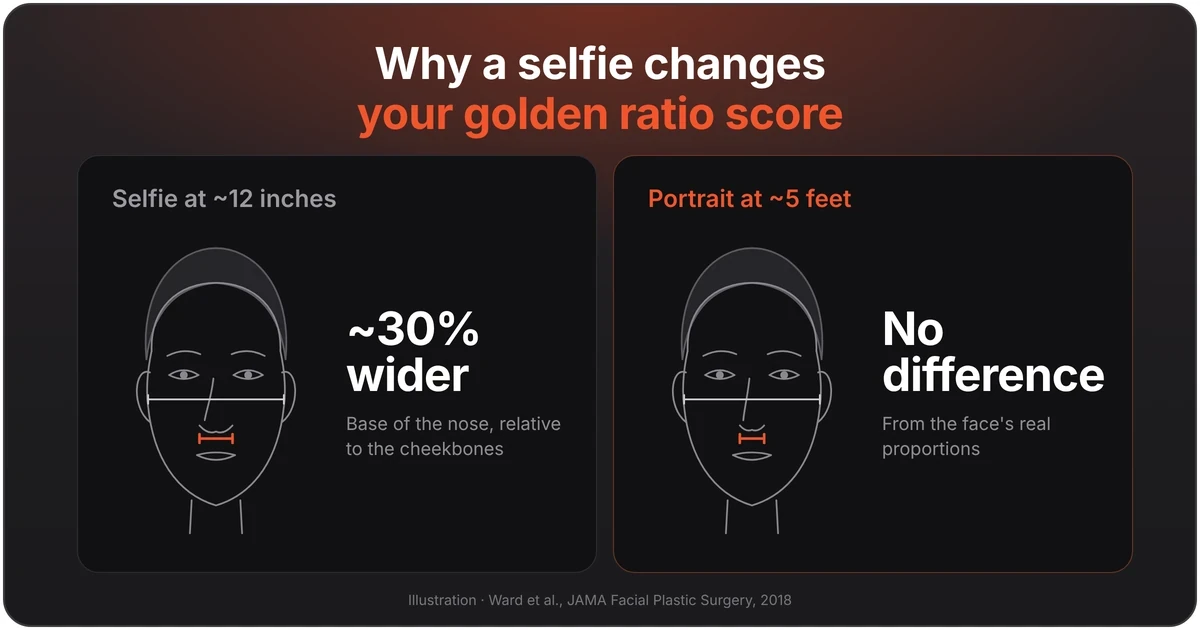
That matters because nose width and cheekbone width are exactly the kind of distances calculators divide into each other. A close-up selfie can lower a nose-related ratio before the tool has measured anything about your actual face.
What else changes the result
Head tilt. Tilting your chin up or down shortens or stretches vertical distances like hairline to chin.
Expression. A smile widens the mouth, which changes any ratio that uses mouth width.
Hair. Bangs or a hat hide the hairline, so the tool has to guess where your face starts.
Beauty modes and filters. Phone beauty settings can slim the face or enlarge the eyes. A golden ratio face filter on TikTok or Instagram is different again: it lays a mask over your face for show and doesn't measure anything.
Front view only. A front-facing photo can't show how far your nose, lips, or chin project, so a calculator that works from one front photo doesn't assess your profile at all.
Checklist for a more consistent result
Ask someone to take the photo from about 5 feet away, or use a timer and a stand.
Keep your head level and look straight into the camera.
Use even, front-facing light without harsh shadows.
Pull your hair back off your forehead.
Keep a neutral expression with your mouth closed.
Turn off beauty mode and filters.
Use the same setup every time you compare results.
Before uploading, it's also worth checking what the tool does with your photo — whether it's processed only on your device or stored on a server. That's usually spelled out in its privacy policy.
The same rules help with any photo you want judged, not just a golden ratio test — see our guide on how to pick a photo that rates well.
What your golden ratio face score means
A golden ratio face score shows how close a handful of your facial ratios are to the targets one particular tool uses. There's no universal "good" score: each calculator picks its own ratios, targets, and scale, so a score only makes sense next to other results from the same tool.
What counts as a good golden ratio face score?
Each tool draws its own lines. One popular calculator, for example, calls 80–89 "highly proportionate" and says roughly the top 15% of its results land there. Those bands describe that tool's users, not a research standard.
A more useful reference point is what real faces look like. As the Malaysian study above showed, most faces measure below 1.618 on the classic length-to-width check, and only about one in six falls in the golden range.
Why nobody scores 100%
No real face matches every ratio a calculator checks. Even the celebrity rankings that make headlines top out around 94%, and those come from one surgeon's measurements, not from peer-reviewed research (more on them in the FAQ).
What the score doesn't tell you
How attractive you are. Most studies find little or no link between golden ratio scores and attractiveness ratings — see the next section.
How others see you. A front-view ratio leaves out skin, hair, expression, and your profile.
Whether anything needs fixing. A ratio below 1.618 is normal, not a flaw.
A golden ratio score reduces your face to a few front-view distances. For a broader read, the Maxxing test analyzes your facial proportions and other features from a front and a side selfie and gives you a personal report. Like any AI score, treat it as one model's estimate, not a verdict.
Does the golden ratio predict attractiveness?
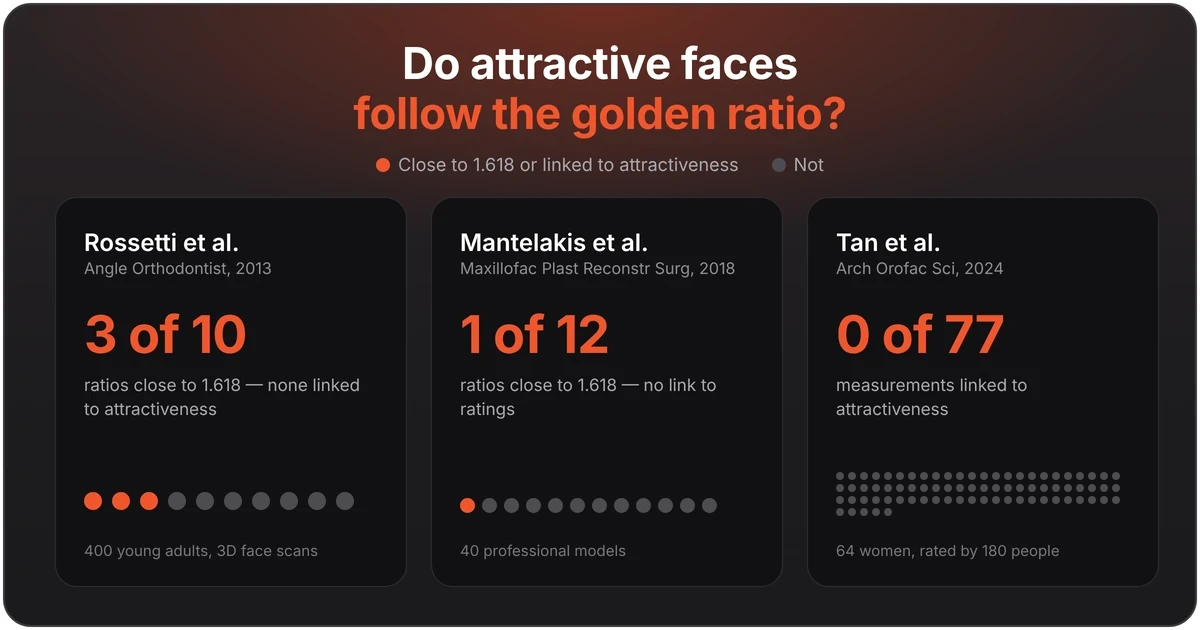
Mostly, no. Studies that measured real faces and compared them with attractiveness ratings have found that facial ratios rarely match 1.618 — and that faces rated more attractive don't come closer to it. This holds across 3D scans, photos of professional models, and studies in different populations.
What the studies found
Study | Who was measured | What they found |
400 young adults, 3D face scans, rated by a jury | 7 of 10 facial ratios differed from 1.618; ratios weren't related to attractiveness | |
Mantelakis et al., Maxillofacial Plastic and Reconstructive Surgery (2018) | Photos of 40 professional Black models, rated 1–10 | Only 1 of 12 ratios was close to 1.618; no correlation with ratings |
64 Malay women, rated by 180 people | None of 77 measurements — golden ratio, classical canons, "ideal" ratios and angles — correlated with attractiveness |
Even the models study — a group selected for their looks — didn't show golden ratio proportions. The authors suggested judging each ratio on its own terms rather than against one universal number.
Why the idea persists
It sounds precise. One number is easier to remember than "it depends."
It's easy to find. With enough measurements on a face, a few will land near 1.618 by chance.
Celebrity rankings keep it in the news. Lists of "mathematically perfect" faces are widely shared, even though they aren't peer-reviewed.
Research points to other traits instead. A review in the Annual Review of Psychology found that faces close to the population average and more symmetrical faces tend to be rated as more attractive. If you're curious about the second one, see our guide to facial symmetry.
Face beauty ratio: what research measures instead of phi
"Face beauty ratio" is the name many calculators give to how closely your proportions match phi. The best-known research alternative comes from a 2010 study in Vision Research, which found two proportions that made faces look most attractive — and neither of them is 1.618.
The two ratios from the study
Ratio | How it's measured | Most attractive value |
Width ratio | Distance between the pupils ÷ face width, measured between the inner edges of the ears | About 0.46 (46%) |
Length ratio | Vertical distance from eye level to the mouth ÷ face length, measured from hairline to chin | About 0.36 (36%) |
How to calculate your face beauty ratio

Take a straight-on photo from about 5 feet away, hair pulled back.
Width ratio: measure the distance between the centers of your pupils, then your face width between the inner edges of your ears. Divide the first by the second.
Length ratio: measure the vertical distance from eye level to your mouth, then your face length from hairline to chin. Divide the first by the second.
Compare your results with 0.46 and 0.36.
Example: pupils 6.2 cm apart and a face 13.5 cm wide give 6.2 ÷ 13.5 = 0.46.
What the study actually showed
Researchers digitally moved the eyes and mouth on photos of women's faces and asked university students to pick the more attractive version in pairs, across four experiments. The preferred proportions matched the average of a separate set of 40 faces. In other words, the "ideal" sat close to an average face — the same pattern behind what makes a face conventionally attractive.
Limits to keep in mind
Women's faces only. The authors note that ideal ratios for men's faces may differ, and their study didn't test them.
White faces only. The ratios may vary across ethnic groups and ages.
Small samples. A few dozen faces and students per experiment.
Hair changes the result. Face length starts at the hairline, so bangs or a different hairstyle can change how long a face looks, as lead researcher Pamela Pallett told NBC News.
Treat these numbers as a finding about average faces in one group, not as a target for your own.
How to use your result
Use a golden ratio score as a curiosity, not a to-do list. It describes a few distances on one photo, and the research above shows those distances say little about how attractive a face is. What it can do is show you how much your photos vary — and which parts of your look you can actually change.
Compare like with like. Only compare scores from the same tool, with photos taken the same way. A jump between two different calculators means nothing.
Work on what changes how you look. A haircut that frames your face, grooming, skin care, and better light and camera angles change your photos far more than a few millimeters ever could.
Know what doesn't change. Your bone proportions are set once you've finished growing. Mewing and jaw exercises promise to reshape them, but the American Association of Orthodontists says no current research shows a benefit to the jawline, and that uneven tongue pressure can shift teeth and strain the jaw joint.
Leave structural changes to specialists. Changing facial bone structure means surgery. If you're considering any procedure, talk to a board-certified facial plastic surgeon or oral and maxillofacial surgeon — and don't base that decision on a calculator score.
Any tool that rates your face has the same limits. Our guide to how AI attractiveness tests work explains what they measure and where they fall short.
FAQ
What's a good golden ratio face score?
There's no universal good score — each calculator sets its own scale and bands. Compare scores only within the same tool and photo setup. On the classic length-to-width check, most real faces measure below 1.618, so a lower number is normal.
What is the most attractive face ratio?
No single ratio makes a face attractive. In a 2010 study in Vision Research, white women's faces looked most attractive when the distance between the pupils was about 46% of face width and the eye-to-mouth distance was about 36% of face length — proportions close to an average face, not to 1.618.
Is the golden ratio different for men's and women's faces?
Calculators use the same 1.618 target for everyone. Research doesn't back one target for either sex: the 46% and 36% ratios above were tested only on women's faces, and the Marquardt golden ratio mask was found to fit masculinized women's faces best. In a study of Malaysian students, men's and women's face length-to-width ratios differed significantly in only one of three ethnic groups.
Is there an app to check your face's golden ratio?
Yes — there are many web calculators and phone apps. They differ in which ratios they measure, what targets they use, and what they do with your photo. Pick one that shows which points and ratios it measured, and check its privacy policy before uploading.
Who has the perfect golden ratio face?
Nobody. The widely shared lists of celebrities with "the most perfect" faces come from one UK plastic surgeon's own measurements, reported through the media, such as this 2019 ranking. Top scores in those lists reach about 94%, and none of the rankings are peer-reviewed research.
What is the 1:3 face rule?
It's another name for the rule of facial thirds: the face splits into three equal parts — hairline to brows, brows to the base of the nose, and the base of the nose to the chin. It's a classical canon of equal proportions, separate from the golden ratio, and a 2017 review in Cutis notes that real proportions vary by ethnicity.
Can AI chatbots check your golden ratio?
A chatbot like ChatGPT can look at a photo and describe your proportions, but it usually doesn't show which points it measured or how, so you can't check the numbers. A dedicated calculator at least shows its landmarks and ratios. Either way, the result is an estimate with the same limits described above.
Is a golden ratio face calculator accurate?
A calculator can measure distances on your photo fairly precisely, but its score depends on the photo, the landmarks it picks, and the target it uses. More importantly, the score doesn't reliably reflect attractiveness: studies using 3D face scans, studies in Malaysia, and a study of Black professional models found no consistent link. Facial proportions also vary across ethnic groups, which a single 1.618 target ignores.
Can you change your facial ratios?
Not your bone proportions, short of surgery. The American Association of Orthodontists says no current research shows that mewing benefits the jawline. What you can change is how your face is framed and photographed — hairstyle, grooming, light, and camera distance.
Sources
Markowsky (1992), Misconceptions about the Golden Ratio, College Mathematics Journal
Alam et al. (2015), Multiracial Facial Golden Ratio and Evaluation of Facial Appearance, PLOS ONE
Rhodes (2006), The Evolutionary Psychology of Facial Beauty, Annual Review of Psychology
Pallett, Link & Lee (2010), New "Golden" Ratios for Facial Beauty, Vision Research
American Association of Orthodontists (2025), Does Mewing Actually Reshape Your Jaw?
Newshub (2019), Bella Hadid named most beautiful woman according to Golden Ratio