



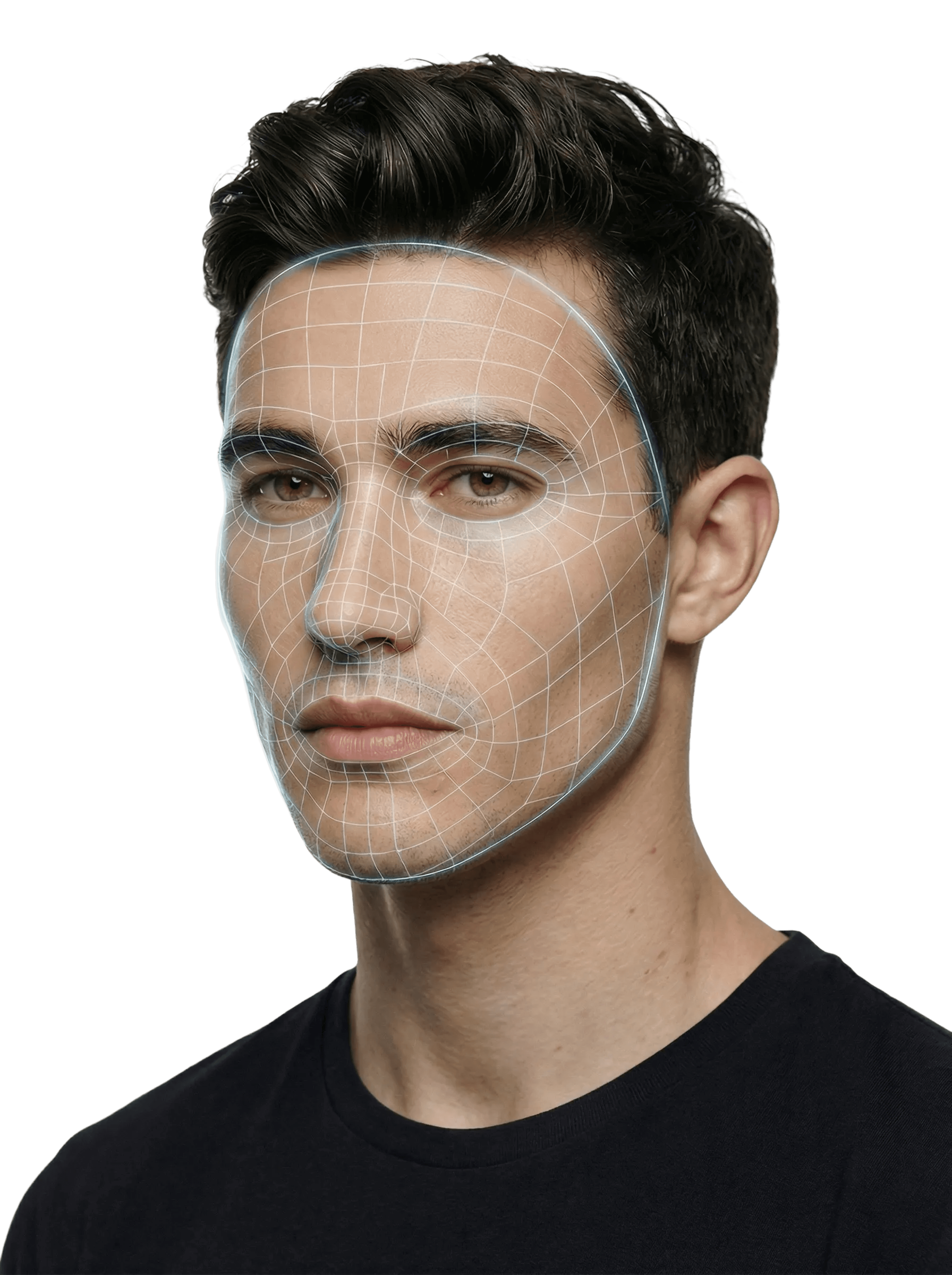
Conventionally Attractive: What It Means and How to Check
Conventionally attractive means having looks that most people in a given culture, at a given time, would agree are attractive. The term describes agreement among observers, not an objective fact about a face. That agreement can be measured, and research shows it is strong but far from complete.
This guide explains where that standard comes from and how to check if you're conventionally attractive using signals that actually tell you something. For a quick AI read of your own photos, you can take the Maxxing test. For the bigger picture of how you come across, see our guide to how attractive you look to others.
What does "conventionally attractive" mean?
Calling someone conventionally attractive means their looks fit a convention: a standard of attractiveness that most people in their culture share, rather than a universal law or one person's taste.
Three things define it:
It's based on agreement. A 2000 meta-analysis in Psychological Bulletin by Judith Langlois and colleagues found that raters largely agree on who is and isn't attractive, both within a culture and across cultures. If many strangers rate the same faces, their rankings tend to line up.
It shifts with culture and media. What counts as conventional changes from place to place and over time, as the section on men and women below shows.
It's separate from personal attraction. That's why the phrase often comes with a qualifier, as in "conventionally attractive, but not my type." It separates what most people agree on from what one person finds attractive.
What makes a face conventionally attractive?
Faces tend to be rated as conventionally attractive when they have three traits that research finds across cultures. A review in the Annual Review of Psychology by Gillian Rhodes found all three are attractive in both male and female faces:
Averageness: proportions close to the population average
Symmetry: left and right sides that closely mirror each other
Sexual dimorphism: how typically masculine or feminine a face looks
Skin quality, a pleasant expression, and grooming also play a part.
Averageness
Averageness doesn't mean plain or ordinary. It means a face whose proportions sit close to the mathematical average of faces in a population.
In a 1990 study in Psychological Science, Judith Langlois and Lori Roggman digitally blended photos of faces into composites. What they found:
Adults rated the composites as more attractive than almost all of the individual faces that went into them.
The more faces were blended in, the more attractive the composite became.
The authors linked this to two ideas: evolution may favor traits close to the population mean, and the brain may prefer faces that match its prototype of a face.
Symmetry
Symmetry means how closely the left and right sides of a face mirror each other. No face is perfectly symmetrical, but more symmetrical faces tend to be rated as more attractive.
Part of the reason seems to be health. In a 2007 study in Perception, Rhodes and colleagues found that the appeal of symmetrical faces was largely explained by how healthy they looked: once perceived health was taken into account, most links between symmetry and attractiveness disappeared.
If you're curious how this applies to your own face, see our guide to facial symmetry.
Sexual dimorphism, skin, and expression
Sexual dimorphism refers to features that typically differ between male and female faces, such as jaw width and brow ridge prominence. How it differs for men and women is covered in the next section.
Skin. In a study of facial skin homogeneity, participants rated a face as prettier after its skin tone and texture were made more even, sometimes without noticing that the face had changed at all.
Expression and grooming. A relaxed, pleasant expression and basic grooming also feature on the list of traits Rhodes describes.
What about the golden ratio?
The golden ratio (about 1.618) is often presented as the formula for a beautiful face, but research gives it little support. When Pallett, Link, and Lee tested facial proportions directly, faces looked most attractive when:
the distance between the eyes and mouth was about 36% of the face's length
the distance between the eyes was about 46% of the face's width
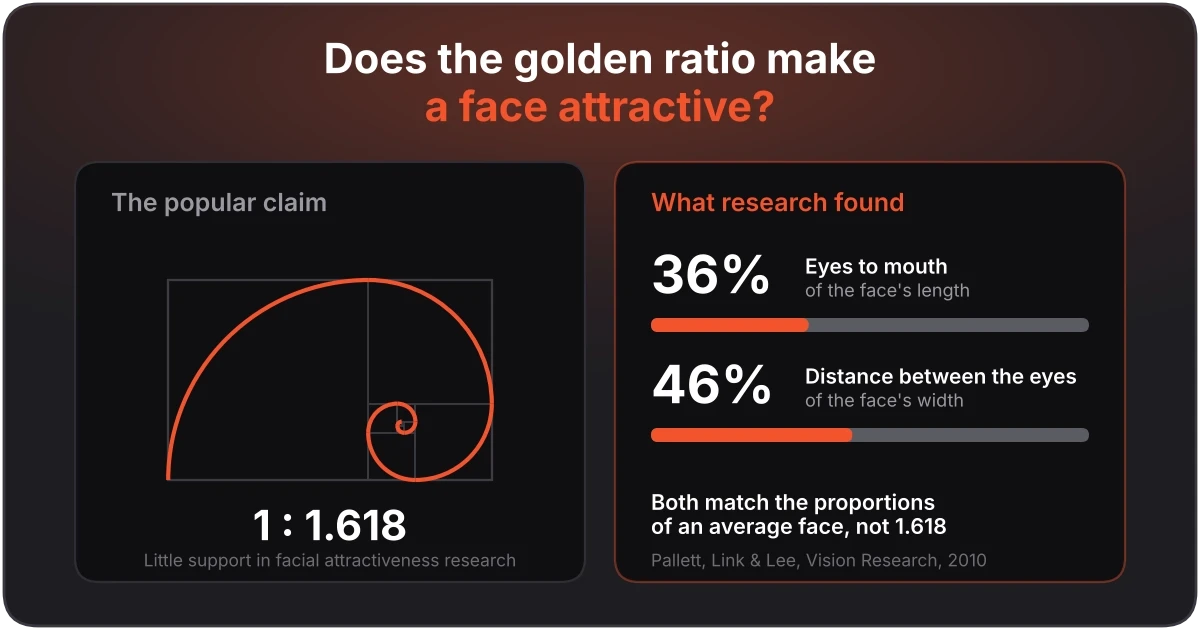
Those proportions match an average face, not the golden ratio. The study used a small set of white female faces, so it doesn't settle the question for every face. Still, it suggests that the proportions people actually prefer are closer to an average face than to the golden ratio.
If you want to check your own proportions, our guide explains how a golden ratio face calculator works and how to measure your face by hand.
Conventionally attractive men vs. women
The core traits of a conventionally attractive man or woman are the same: averageness, symmetry, and healthy-looking skin. The main difference is sexual dimorphism, and here the research is less settled than online advice suggests. How much people prefer strongly masculine or feminine features depends on where they live.
What is a conventionally attractive man?
A conventionally attractive man has a face that fits the shared standard in his culture: averageness, symmetry, healthy-looking skin, and moderately masculine features.
What the research shows:
Masculine features read as strong. These include a more prominent jawline and brow ridge, which people tend to associate with physical strength and dominance, as a 2025 paper in Frontiers in Psychology summarizes the research.
Dimorphism helps, up to a point. The Rhodes review found that sexual dimorphism adds to attractiveness in male faces, and a later study by Rhodes and colleagues found that a healthy appearance explains part, but not all, of that appeal.
The preference isn't universal. A 2014 study in PNAS by Isabel Scott and colleagues tested 12 populations with very different levels of economic development and found preferences for exaggerated sex-typical faces only in highly developed environments. The impression that very masculine men look aggressive also grew stronger with development and urbanization.
Slightly softer faces often do better. In a 1998 study in Nature, David Perrett and colleagues found that people preferred slightly feminized male faces to average or masculinized ones, and that making a face more masculine also made it look colder and less honest.
The link is weak across populations. A 2021 study in Scientific Reports that compared several populations found the link between facial masculinity and attractiveness in men to be weak or absent.
In other words, a conventionally attractive male face isn't simply the most masculine one. If the jaw is the feature you're focused on, our jawline rating guide covers how it's assessed.
What is a conventionally attractive woman?
A conventionally attractive woman has a face that fits the same kind of shared standard.
What the research shows:
Feminine features help. Larger eyes, softer contours, and a smaller jaw are linked to attractiveness, along with averageness, as the same 2025 research summary puts it.
The preference is partly learned. In the 1998 Perrett study, people preferred female faces made slightly more feminine than average, in both UK and Japanese samples, and the preference was stronger when they judged faces from their own population.
The link is moderate. The 2021 cross-population study found the link between femininity and attractiveness to be moderate in women, stronger than in men.
Exaggeration isn't universal either
The Scott study found the preference for exaggerated sex-typical traits only in highly developed settings.
How body ideals vary across cultures
Body ideals vary even more than face ideals. The International Body Project, led by Viren Swami, surveyed 7,434 people across 10 world regions and found that:
the ideal female body differed between regions
within Malaysia and South Africa, people in lower-income settings preferred heavier bodies than people in higher-income settings
age, body weight, and exposure to Western media all predicted which body a person found ideal
body dissatisfaction and the desire to be thinner were common in higher-income settings worldwide
Conventional vs. unconventional vs. subjective attractiveness
These terms differ in whose judgment they describe. Conventional attractiveness is what most people agree on, subjective attractiveness is what one person finds appealing, and unconventional attractiveness is appeal that doesn't follow the usual template.
Term | What it means | Whose judgment | How people use it |
Conventionally attractive | Fits the standard most people in a culture share | Most raters in a culture | "She's conventionally attractive, but not my type." |
Unconventionally attractive | Appealing despite features that break the usual template | Many people, with less agreement | "He has an unusual face, but it works." |
Subjectively attractive | Attractive to one particular person | One person | "I find him really attractive." |
"Objectively attractive" | Usually a stronger way of saying conventionally attractive | Most raters; no rater-free measure exists | "She's objectively attractive." |
The gap between these categories is large, which is why so many people are attractive without being conventionally attractive. A face can sit outside the usual template and still appeal to a lot of people, and a face that fits the template perfectly can leave a particular person cold.
Is anyone objectively attractive?
No. There is no way to measure attractiveness without people doing the rating. What research does show is strong but partial agreement: roughly half of how attractive a face seems to someone reflects taste they share with others, and the other half reflects their own preferences.
Online, especially in looksmaxxing communities, claims about objective attractiveness are often attached to numeric scores such as the PSL scale, but those scores are still judgments made by people or by a model.
What the research shows
The clearest evidence comes from studies that separate shared taste from personal taste:
In three experiments, psychologist Johannes Hönekopp found that shared and private taste contributed about equally to judgments of facial attractiveness. He also argued that researchers had overstated how much people agree by misreading a common reliability statistic.
A 2015 study in Current Biology led by Laura Germine and Jeremy Wilmer drew on more than 35,000 volunteers, then had 547 pairs of identical twins and 214 pairs of non-identical twins rate 200 faces. The researchers estimated that a person's face preferences overlap with other people's by about 50% and differ by about 50%. Those differences came mostly from individual life experience, not genes.
A 2016 study by Helmut Leder and colleagues put personal taste at about 40% of attractiveness judgments for faces, compared with 75% for abstract art.
What "objective" means in research
When researchers use the word "objective," they usually mean something specific: the average of ratings from several independent judges, as one 2010 study describes its method. That makes "objectively attractive" a stronger-sounding version of "conventionally attractive."

A more accurate word would be intersubjective: true for most people, but still a judgment people make. The same consensus is what numbered attractiveness scales from 1 to 10 try to capture.
Am I conventionally attractive? How to check
You can't settle it from the mirror or from your friends. Because conventional attractiveness is about agreement, the most useful signal is how a broad group of strangers rates you, ideally across several neutral photos. Popular "signs," like compliments or second glances, are weak evidence on their own.
Signs that tell you less than you think
Compliments. People compliment out of politeness, affection, or because they like your outfit or haircut. A compliment tells you that one person reacted well in one moment.
Second glances. People look twice for many reasons: clothes, height, a familiar face, or something happening behind you.
What friends and family say. In three studies by Kevin Kniffin and David Sloan Wilson, how much people liked and respected someone had a large effect on how physically attractive they found that person, an effect strangers didn't share. Their answer is about you as a person, not about how a stranger sees your face.
Dating results. Matches and dates depend on photos, profiles, timing, and the local dating pool, so they are a noisy measure of looks alone.
What gives you a better read
Two things give you a more reliable answer:
Ratings from many strangers. The closest thing to a real answer is a rating from many people who don't know you, because that is what "conventional" measures.
Several photos, not one. Ratings shift with the photo itself: in a 1990 study by Harry Reis and colleagues, smiling faces were rated as more attractive than the same people with a neutral expression. Use several recent photos with even light and a relaxed expression.

If you want a quick AI read on your photos, the Maxxing test scans your face, hair, and style from a photo and gives you a personal report. Treat any score as one model's estimate, not a verdict, and compare results across a few photos.
Our guide to how attractiveness tests work explains what these tools measure and where they fall short.
Are we prettier or uglier than we think?
You may have seen the claim that other people see you as 20% more attractive than you see yourself. The study usually cited for it found something close to the opposite:
In a 2008 series of experiments, Nicholas Epley and Erin Whitchurch morphed participants' photos to look more or less attractive.
People tended to recognize a more attractive version of their face as their own.
The effect was tied to how positively they felt about themselves at an automatic level.
That doesn't mean everyone overrates their looks. How people see themselves varies a lot from person to person, and some are much harder on their own appearance than others are. The practical point is that your own impression, in either direction, is a poor stand-in for how others see you.
Why it matters: pretty privilege
Pretty privilege is the advantage people tend to get when others see them as attractive. The 2000 Langlois meta-analysis found that attractive children and adults were judged more positively and treated more positively than less attractive people, even by people who knew them.
Two things to keep in mind:
These are averages across many studies, not a rule for any one person.
The advantage attaches to how others perceive you, and that perception depends on far more than bone structure: skin, grooming, expression, and the photos people see of you all shape it.
FAQ
What percentage of people are conventionally attractive?
There is no fixed number. Attractiveness ratings form a range, not two groups, so where "conventionally attractive" begins is a choice about where to draw the line, not a research finding. Any figure you see, like "the top 20%," simply restates that cutoff.
Can you be attractive without being conventionally attractive?
Yes. Studies estimate that roughly half of how attractive a face seems to someone comes from their personal taste rather than shared standards. A face that breaks the usual template can still be very appealing to many people, which is what "unconventionally attractive" describes.
Is conventionally attractive the same as beautiful or hot?
Not exactly. "Conventionally attractive" makes a specific claim: that most people in a culture would agree. "Beautiful" and "hot" are general compliments that say nothing about agreement, so people use them both for faces that fit the convention and for faces that don't.
How can you look more conventionally attractive?
Focus on what you can realistically change:
Skin. Research on skin evenness shows that even changes too subtle for people to notice can raise how attractive a face looks.
Grooming and haircut. Both are fully in your control and change how your face is framed.
Photos. How you present yourself in photos shapes how strangers rate you.
Changes to bone structure are a medical matter for a board-certified specialist, so skip at-home methods that promise to reshape your face. Our looksmaxxing guide covers realistic changes in more detail.
Who are conventionally attractive celebrities?
Celebrities can serve as a reference point for what counts as conventional, because media shapes beauty ideals: exposure to Western media predicted body ideals in the International Body Project. Online "most attractive" rankings, though, measure popularity and voting, not facial features. If you're curious which famous faces yours resembles, try our celebrity look-alike guide.
Is ChatGPT good at rating attractiveness?
AI chatbots may be better at ranking faces than at scoring them. A 2026 preprint compared ratings from 2,513 people with four commercial AI models (Claude, Gemini, GPT, and Grok):
The models tracked the order in which people ranked faces closely.
They rated faces more favorably and within a narrower range than people did.
The study has not yet been peer-reviewed and reflects the models as they were at the time, so treat its findings as preliminary and a chatbot's score as likely to run high.
Sources:
Epley & Whitchurch (2008), Personality and Social Psychology Bulletin
Frontiers in Psychology (2025), Big Bodies, Blurred Lines
Germine et al. (2015), Current Biology
Grandas et al. (2026), arXiv preprint
Hönekopp (2006), Journal of Experimental Psychology
Kleisner et al. (2021), Scientific Reports
Kniffin & Wilson (2004), via ScienceDaily
Langlois et al. (2000), Psychological Bulletin
Langlois & Roggman (1990), Psychological Science
Leder et al. (2016), Frontiers in Human Neuroscience
Nestor et al. (2010), Journal of Clinical and Aesthetic Dermatology
Pallett, Link & Lee (2010), Vision Research
Perrett et al. (1998), Nature
Reis et al. (1990), European Journal of Social Psychology
Rhodes (2006), Annual Review of Psychology
Rhodes et al. (2007), Perception
Scott et al. (2014), PNAS
Sun et al. (2022), Frontiers in Psychology
Swami et al. (2010), Personality and Social Psychology Bulletin