



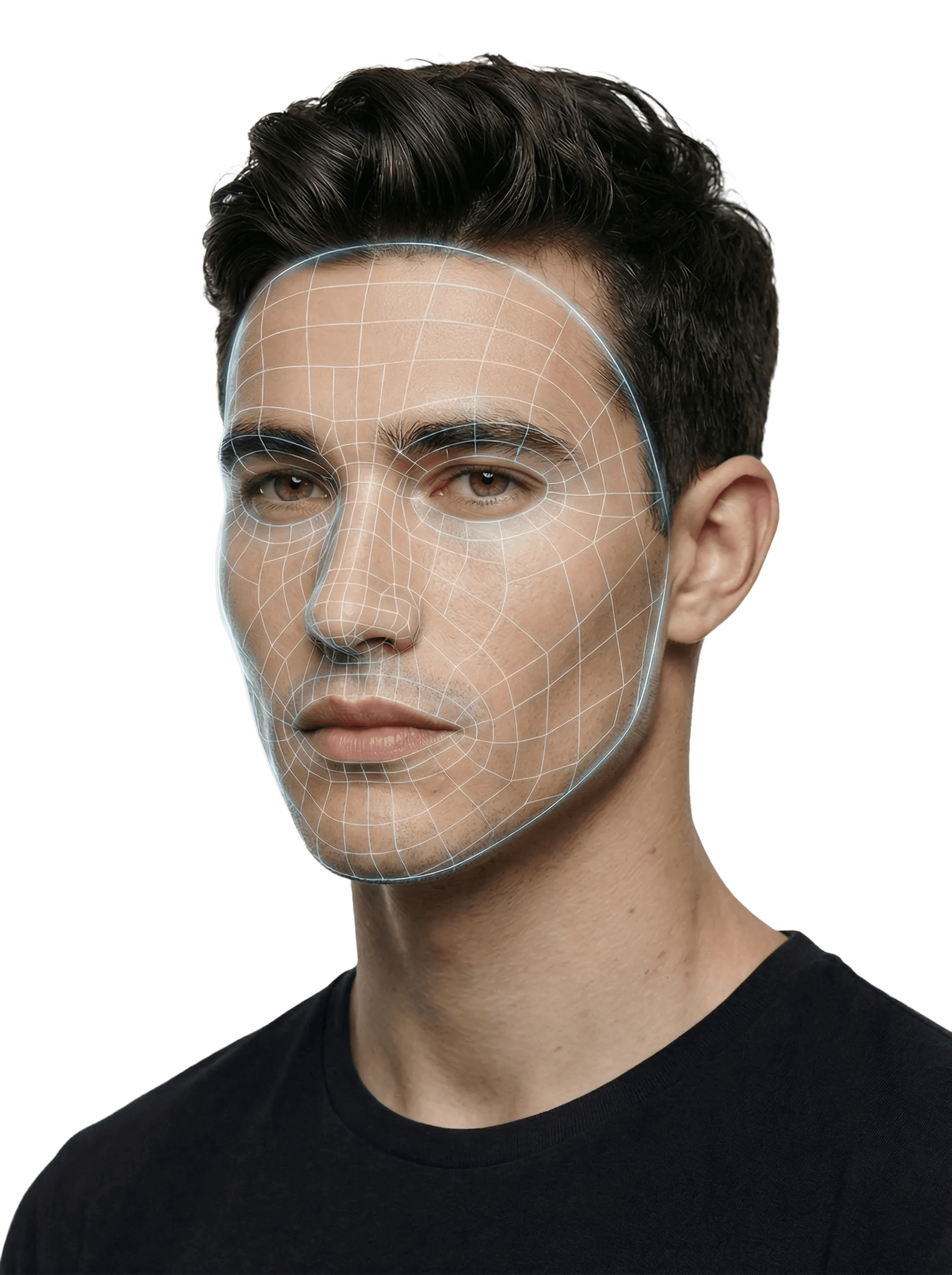
AI Ethnicity Guesser: What Ethnicity Do I Look Like, Ethnicity From Face
An ethnicity from face test (sometimes called ethno guesser, ethnicity guesser, or AI ethnicity guesser) tries to estimate your likely ethnic background based on facial features in a photo. These tools analyze visible traits like eye shape, skin tone, bone structure, and feature proportions, then match patterns to large datasets to suggest possible ethnic categories.
If you’ve ever wondered what is my ethnicity, what ethnicity do I look like, or guess my ethnicity by photo, this guide explains how ethnicity detection works in AI, what it can and can’t tell you, how it differs from DNA testing, and how to interpret the results correctly. Integrated at the end are contextual links that connect to deeper facial analysis tools like AI face analysis, beauty analyzer, and facial feature analyzer.
Ethnicity Test, Ethno Guesser, Ethnicity Guesser AI: How They Work
Ethnicity guesser tools use computer vision and machine learning to analyze facial images and extract key features such as distances between landmarks, bone structure, skin appearance, and contour shapes. These indicators are then compared with patterns learned from labeled face databases.
Software pipelines often follow these steps:
Detect and align the face in the image
Normalize lighting and pose
Extract deep visual features
Compare features to a training dataset grouped by population categories
Deep learning models have been developed specifically to classify ethnicity from facial images using convolutional neural networks (CNNs) and other architectures (source: Deep Learning Ethnicity Recognition Using Facial Images). These systems demonstrate that visual features carry statistical signals correlated with broad geographical groups, but they are not definitive ancestry identifiers.
What Ethnicity Do I Look Like? Ethnicity Test Online and Ethno Guesser Quizzes
People usually ask “what ethnicity do I look like?” or take a guess my ethnicity quiz because they want insight into how strangers perceive their face, or out of curiosity about possible ancestral signals.
These online ethnicity guesser tools typically work by:
Classifying face features into pre-defined ethnic groups
Outputting probabilities for each category
Providing a primary guess based on highest match
For many users, free ethnicity test tools and ethnicity by photo guessers offer a quick snapshot, but they remain probabilistic estimates rather than precise labels. They are best used alongside facial analysis tools rather than as standalone verdicts.
AI Ethnicity Guesser vs Face Ethnicity Analyzer vs Ethnicity Face Scanner
Different tools use slightly different terms:
AI ethnicity guesser: machine-learning systems trained to predict ethnic grouping from images
Face ethnicity analyzer: often broader systems that include other assessments like age and gender
Ethnicity face scanner: tools designed to evaluate ethnic signals from multiple visual cues
Regardless of naming, all these rely on pattern recognition in facial geometry and appearance. They work best when images have neutral expressions, good lighting, and clear frontal viewpoints — factors that align with other visual assessments like a beauty analyzer or facial feature analyzer.
Ethnicity by Photo: What AI Can and Can’t Detect
AI ethnicity detection by photo can generate outputs that roughly categorize faces into major global or regional groupings. Studies show that models achieve measurable performance on labeled datasets, sometimes exceeding 70–90% accuracy depending on the number of categories and training quality (source: Ethnicity Classification Based on Facial Images using Deep Learning).
However:
Results are sensitive to dataset biases
Some ethnic groups may be under-represented in training sets
Output reflects visual resemblance, not ancestry certainty
This is similar to how other demographic attributes (age, gender) are inferred from face images — they provide a statistical likelihood, not a biological fact.
Ethnicity vs Nationality: Clarifying “What Nationality Do I Look Like”
Many users also wonder what nationality do I look like or use nationality guesser tools alongside ethnicity from face tools. Nationality describes legal country affiliation and cultural citizenship, whereas ethnicity relates to shared heritage, culture, and historical lineage.
Facial features do not encode legal nationality. Any suggestion that a face looks Italian, Japanese, or Mexican is at best a culturally rooted stereotype rather than a verified biological indicator.
DNA Testing for Ethnicity vs AI Ethnicity Detection
DNA tests estimate ancestral origins by comparing your genetic markers with reference populations. While ethnicity dna test and dna testing for ethnicity can often provide rich breakdowns of heritage components, AI ethnicity guessers work purely on visual data from photos.
Genetic research confirms that human genetic variation is distributed along gradients and overlaps extensively across groups that might be socially categorized as distinct (source: Human genetic variation and the concept of race). This means that visually inferred ethnicity categories and DNA ancestry results often tell different stories — both are probabilistic and informative in different ways.
AI Ethnicity Detection in the Context of Facial Analysis
Ethnicity estimation often plays a supporting role in broader facial analysis, which might include:
age estimation
attractiveness scoring
symmetry and proportion measurement
For example, an AI face analysis can provide a fuller picture of how your features are perceived, which is more actionable than ethnicity alone. Linking ethnicity with other assessments like attractiveness calculator and beauty test can help you understand which traits influence social perception most, and what to prioritize in improvement.
Practical Interpretation: What Your Results Mean
When an AI ethnicity guesser returns a category like “South Asian,” “East Asian,” or “Middle Eastern,” it represents the closest match in a trained model’s dataset. These tools do not:
define your ancestral heritage with certainty
replace DNA testing
capture the full cultural or familial identity
Instead, they provide a rough estimation of how visual patterns in your face align with statistical groupings in a given dataset.
How Maxxing Converts Ethnicity Signals Into Actionable Guidance
Maxxing does not treat ethnicity categories as a “score.” Instead, facial structure signals are integrated into personalized analysis that prioritizes:
grooming and facial framing
hairstyle and presentation
proportion and symmetry
This contextual feedback links appearance characteristics to what moves the needle most in perceived attractiveness and first impressions.
If you want a deeper breakdown of all facial signals — including those that influence ethnicity perception — start by exploring a holistic analysis with try Maxxing.
Key Takeaways for Ethnicity From Face and AI Ethnicity Guesser
• AI ethnicity guessers analyze facial geometry and features to estimate broad ethnic categories based on patterns.
• These tools return probabilistic matches, not objective identity labels.
• Ethnicity from photo complements other appearance signals like age and attractiveness.
• Nationality and ethnicity are conceptually different; faces do not encode nationality.
• DNA ancestry and AI visual estimators operate on distinct data sources.