



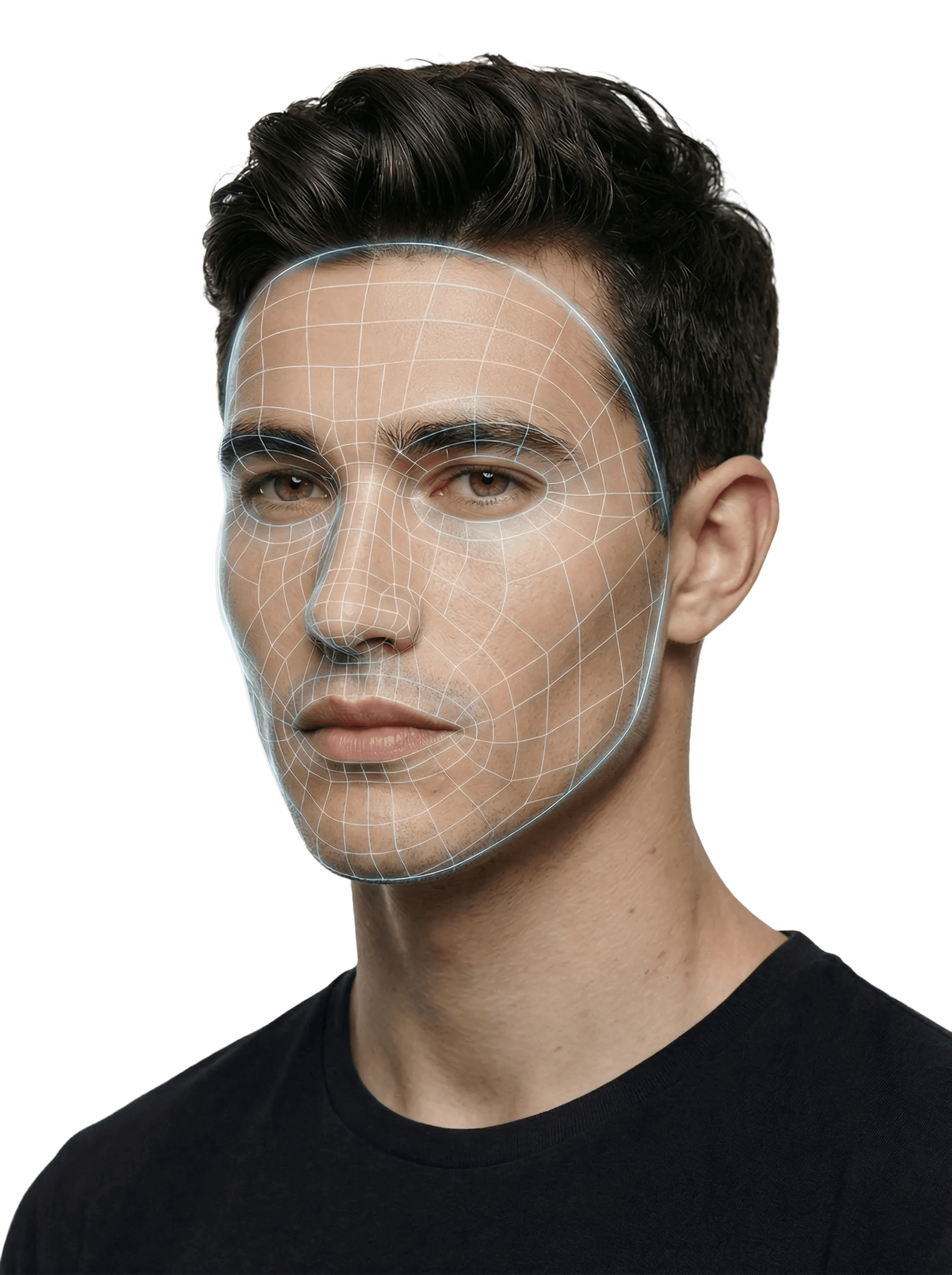
Facial Feature Analyzer: AI Analysis of Your Face and How to Act on It
A facial feature analyzer is a tool that uses artificial intelligence to map your facial landmarks, measure proportions and symmetry, and provide insights into how attractive your face appears relative to common aesthetic patterns. It is not a superficial “beauty score generator.” Instead, it breaks down key elements of your face — such as the width of your jawline, the distance between your eyes, the fullness of your lips and the balance between facial thirds — and compares them against data-driven models. This can help you understand why certain features stand out and where subtle changes might make a big difference. Modern analyzers, like those built into AI face analysis platforms, rely on complex algorithms rather than crude “golden ratio” templates and offer a more nuanced assessment of your face.
For people who want objective feedback rather than guesswork, a facial feature analyzer provides a starting point. By seeing precisely how your features deviate from statistically attractive norms, you can prioritize improvements and stop obsessing over minor flaws. Many users begin with a broader attractiveness test that scores overall appeal, then dive deeper with facial feature analysis to pinpoint specific areas. If you want a fully personalized plan based on your unique face, try Maxxing — our AI-driven system turns raw data into an actionable roadmap. Try Maxxing.
What Exactly Does a Facial Feature Analyzer Measure?
A modern facial feature analyzer is an AI‑powered system that evaluates a range of physical traits. Here are the core elements it assesses:
Facial symmetry and averageness. The AI maps dozens of landmarks (pupils, nose tip, mouth corners, chin, ears) and calculates how closely the left and right sides mirror each other. It also compares your face to composite “average” faces created by blending many images. Research shows that average faces and symmetrical faces tend to be rated more attractive than individual ones, though perfectly symmetrical faces are not always the most appealing. A facial feature analyzer highlights asymmetries so you know whether they are within normal ranges or unusually pronounced. (source: facial symmetry had only a small effect on rated attractiveness)
Face shape and proportions. Measuring the ratio of your face’s width to its height, the length of your jawline, and the size of your forehead relative to the lower thirds helps the AI classify your face shape (oval, round, square, heart, etc.). Certain shapes are perceived differently across genders and cultures. Faces that emphasize sexual dimorphism — sharper jawlines and more prominent brow ridges in men, softer cheeks and smaller chins in women — tend to be rated higher.
Feature placement and spacing. The distance between your eyes, the length of your nose relative to facial width, the positioning of your mouth and the fullness of your lips all contribute to perceived harmony. For example, narrow spacing between eyes can make the midface seem compact, while wide spacing might elongate the look. AI systems evaluate these distances and compare them with statistical averages.
Skin texture and luminance. Beyond geometry, many analyzers consider skin quality. Smooth texture, even tone, and appropriate luminance contrast (e.g., brighter eyes and lips relative to surrounding skin) influence attractiveness. Studies reveal that female faces are deemed more attractive when there is a larger luminance difference between the eyes/mouth and skin, while the opposite pattern benefits male faces. Thus, a facial feature analyzer often reports on skin quality and colour balance.
Sexual dimorphism cues. Masculine features in men and feminine features in women influence attractiveness through evolutionary mechanisms. For example, testosterone increases jaw and cheekbone prominence in men, while estrogen produces rounder cheeks and smaller noses in women. An analyzer can quantify how well your features align with these hormonal markers.
These measurements feed into an overall interpretation. Some analyzers assign numeric scores; others provide qualitative feedback (“balanced midface,” “prominent jawline,” “asymmetric brow”). The goal is not to judge but to inform. By understanding the structural factors that influence perception, you can make smarter decisions about grooming, styling, and lifestyle changes.
How AI Analyzes Facial Features: Under the Hood
At its core, a facial feature analyzer performs a series of technical steps:
Face detection and alignment. The system identifies your face in the image and aligns it so that the eyes, nose, and mouth are in consistent positions. This ensures that subsequent measurements are comparable across different photos.
Landmark detection. Using convolutional neural networks (CNNs) or other computer vision methods, the AI locates key points on your face — typically 68 to 86 landmarks for most consumer tools. These correspond to the corners of your eyes, edges of your nose, lips, jawline and more.
Measurement and ratio calculation. The algorithm calculates distances, angles and ratios between landmarks. It may apply geometric morphometric analysis or deep learning models to extract high‑level features. Studies using geometric morphometrics and deep learning find that eye-related areas are often most influential in determining attractiveness.
Comparison with statistical models. Measurements are compared against normative datasets. Some systems use the Facial Aesthetic Index (FAI) or Facial Youthfulness Index (FYI) — indices that evaluate skin texture, symmetry and wrinkles to generate attractiveness and youthfulness scores. Others train deep neural networks on large datasets labeled with attractiveness ratings. These models learn complex patterns in shape and texture that correlate with human judgments. (source: What Does it Mean to Be Beautiful? Exploring the Limits of AI-Driven Beauty Assessment )
Scoring and feedback. Finally, the tool translates the raw data into a score or descriptive assessment. A high-quality analyzer will contextualize the result (“above-average symmetry” or “narrow jaw relative to midface”) rather than simply outputting a number.
This process may sound mechanical, but it reveals meaningful patterns. For example, geometric morphometric studies have shown that average faces are often rated more attractive than individual faces. They also reveal that extreme uniqueness can be both highly attractive and unattractive — a U‑shaped relationship that highlights the trade-off between distinctiveness and harmony. Deep learning models, meanwhile, identify salient features such as eye shape, brow tilt, or cheek curvature that drive attractiveness perceptions. By combining multiple methods, AI analyzers capture nuances that simple ratios or golden‑ratio masks miss.
Why Simple “Golden Ratio” Masks Don’t Work
Many websites still claim that the golden ratio (1.618) or ready‑made masks like Marquardt’s Phi Mask can determine facial beauty. In practice, these mathematical models are limited. They derive from Western ideals and fail to account for the full diversity of human faces. The neoclassical canons often paired with it, for example, divide the face into vertical fifths and horizontal thirds; they assume the distance between the inner corners of the eyes equals the width of one eye. However, these proportions differ across ethnic groups. Afro-Caribbean and East Asian faces often deviate from these ratios yet are still perceived as attractive. Our golden ratio face calculator guide explains what these tools measure and what studies have found.
AI‑driven tools such as the FAI and FYI were developed to offer more nuanced assessments by analyzing skin texture, symmetry and wrinkles across diverse datasets. Even these tools have limitations: they may overgeneralize due to insufficient representation of certain demographics. When using any facial feature analyzer, it’s crucial to understand that mathematical ideals are guidelines, not universal laws. Beauty encompasses cultural and individual preferences as well as evolutionary factors. A holistic assessment combines quantitative data with personal goals and context.
Key Facial Features That Drive Attractiveness
Understanding which features contribute most to attractiveness can help you interpret your analysis. The following traits are consistently linked to positive ratings across scientific studies and cultural contexts:
Symmetry and Averageness
Faces with high symmetry and close to the average of a population tend to be rated more attractive. This may reflect evolutionary preferences for genetic health. However, perfect symmetry is not necessarily ideal; slight asymmetries often make faces appear more natural and distinctive. Averageness reduces idiosyncratic flaws by blending multiple faces, explaining why composite images often appear more appealing.
Sexual Dimorphism
Masculine features in men (pronounced brow ridge, strong jawline, deeper-set eyes) and feminine features in women (rounded cheeks, smaller chin, fuller lips) signal sex‑specific hormones like testosterone and estrogen. Studies show that increasing sexual dimorphism in male and female faces raises attractiveness ratings. Your facial feature analysis may reveal how strongly your features align with your gender’s dimorphic markers. If a weak jawline or recessed chin lowers your masculine impression, targeted jawline rating guidance can highlight solutions.
Skin Quality and Luminance Contrast
Skin health and brightness significantly affect attractiveness. Smooth texture, even tone and proper luminance contrast between eyes, mouth and surrounding skin improve perceptions. Female faces are more attractive when eye and lip contrast is increased, whereas male faces benefit from lower contrast. Blemishes and uneven pigmentation detract from perceived beauty. A facial feature analyzer that assesses skin can highlight areas for improvement. Pair your analysis with a beauty test to get comprehensive skin and facial feedback.
Eye and Brow Characteristics
The shape and size of your eyes, the openness of your eyelids, and the curve of your brows influence perceived approachability and youthfulness. Geometric morphometric studies show that eye‑related areas are particularly important. Wide-set, large eyes often signal youth and are associated with feminine attractiveness, while slightly deeper-set eyes and straighter brows can enhance masculine appeal. AI tools highlight subtle asymmetries and spacing issues that humans may miss.
Nose and Lip Proportions
The length and width of your nose relative to your face and the fullness of your lips contribute to harmony. Shorter noses with a gentle curve are generally preferred in women, while men benefit from slightly longer, straighter noses. Fuller lips are associated with youth and femininity; thin lips can appear more masculine or aged. A facial feature analyzer compares these measurements to population averages and may suggest adjustments. If you’re curious about lip ratios, a face symmetry test or face shape test can offer supplementary insights.
Chin and Jawline Definition
Jawline prominence and chin shape heavily influence perceived strength and attractiveness. In men, a wide, well-defined jawline signals testosterone and dominance; in women, a softer jawline with a small chin conveys femininity. According to morphometric findings, longer and narrower jaws correlate with taller stature and higher attractiveness in men. If your analysis indicates a recessed or weak jawline, exploring options like weight management or facial exercises can help. Our looksmaxxing guide and how to looksmaxx article detail methods to enhance facial structure naturally.
Using Your Facial Feature Analysis to Improve
Once you receive your analysis, the next step is interpretation. Here’s how to make the most of the data:
Review the breakdown, not just the score. A single number cannot capture the complexity of your face. Focus on the individual metrics (symmetry, nose ratio, eye spacing) and see which ones deviate most from population averages.
Prioritize high-impact changes. Not every deviation needs fixing. Identify elements that significantly influence perception. For example, smoothing skin texture or adjusting your hairstyle to better frame your face can produce noticeable improvements faster than obsessing over millimetric differences in eye spacing.
Use controlled photos. Lighting, camera angle and expression can alter results. Take multiple photos under consistent conditions to see whether an issue persists. A rate my face exercise with several angles will give you a better sense of which features consistently attract comments.
Combine AI with human feedback. A facial feature analyzer provides objective data, but real-life perceptions involve context, personality and movement. Ask trusted friends or use communities like rate me judiciously to gauge how your static results translate to social settings. Keep in mind that online communities can be skewed toward particular demographics or harsh standards, so interpret comments carefully.
Plan your improvements. Once you know your priorities, build a routine that targets them. Improving skin quality may involve adjusting skincare and nutrition; enhancing the jawline might require body recomposition or facial exercises; improving feature harmony could involve grooming, hairstyles or even cosmetic dentistry. If you want expert guidance, our ai face analysis platform and beauty analyzer provide tailored recommendations.
Limitations and Ethical Considerations
Facial feature analyzers are powerful tools, but they are not infallible. Several caveats are worth noting:
Dataset bias. AI models learn from the data they are trained on. If certain ethnicities, genders or age groups are underrepresented, the algorithms may misinterpret features or provide skewed scores. This is one reason why the golden ratio or Western-centric masks fail to capture global diversity. When evaluating your results, consider whether the training data aligns with your demographic.
Cultural differences. Preferences for specific features vary across cultures. The PLoS ONE study on cross-cultural agreement found strong consensus overall but noted that observers showed higher agreement for faces from their own ethnic group and relied more on colour cues for unfamiliar groups. This means that your analysis might score certain proportions lower or higher depending on the population used for comparison.
Subjectivity of beauty. AI can model statistical attractiveness, but beauty remains inherently subjective. Evolutionary theory suggests average faces and certain dimorphic traits are preferred. Yet distinctive faces can also be compelling. Personal style, charisma and cultural context play significant roles.
Ethical use. There is a risk that facial feature analyzers could reinforce narrow beauty standards or encourage unhealthy self-scrutiny. Tools like the FAI and FYI provide objective scores but must be used responsibly. They are best employed as part of a holistic, individualized approach that considers mental well-being and personal goals.
Building a Personalized Plan with Maxxing
Understanding your facial structure is the first step; the next is deciding what to do about it. This is where Maxxing comes in. Instead of leaving you with a list of deviations and no guidance, Maxxing synthesizes your facial feature analysis with other domains — skin, body composition, hair, style and confidence — and ranks which changes will have the biggest impact. It helps you answer questions like “Should I lose face fat or grow my hair out first?” or “Do I need to work on my jawline or my skin clarity more urgently?”
Maxxing’s core components align with scientific findings:
Face assessment & mapping. Breaking down what exactly is holding you back reduces vague insecurities. You identify primary problem areas (face, skin, body, hair, style) rather than guessing.
Priority-based roadmap. By ranking appearance issues by impact, Maxxing prevents you from fixating on low-return flaws and gives you a clear order of operations (e.g., skin → body → hair → style).
Non-medical face improvement guidance. Practical steps like reducing facial puffiness via lifestyle changes, improving facial definition through body recomposition, and choosing grooming styles that enhance your jawline are emphasized over invasive procedures. Education around symmetry, proportions and trade-offs ensures realistic expectations.
Skin and body composition direction. Structured routines address acne, texture, dark circles and physique changes. Understanding how body fat affects jawline and overall look helps you make targeted choices.
Hair and style guidance. Tailored haircut and styling recommendations frame your face better, and clothing fit direction enhances presentation. Combined with posture and behavior adjustments, these changes improve perceived attractiveness and confidence.
If you want to move beyond static scores and start a transformation, Maxxing offers the clarity and structure that facial feature analyzers alone cannot. Try Maxxing to get a roadmap tailored to your face and goals.
Conclusion: Use Facial Feature Analysis Wisely
Facial feature analyzers provide a window into the structural factors that drive attraction. By measuring symmetry, proportions, skin quality, and sexual dimorphism, they translate complex visual cues into actionable insights. Scientific research shows that averageness, symmetry and gender-specific traits influence attractiveness, and that AI-driven indices like the FAI and FYI can summarize features across large datasets. However, beauty is not reducible to formulas. Cultural variation, dataset bias and individual preferences all play a role. (source: Cross-Cultural Agreement in Facial Attractiveness Preferences: The Role of Ethnicity and Gender )
Use your facial feature analysis as a compass, not a verdict. Combine objective feedback with personal goals, cultural context and self-care. Focus on high-impact changes — such as improving skin texture, adjusting body composition, and refining grooming — rather than chasing perfection. Pair your analysis with complementary tools like ai face analysis, beauty analyzer, and attractiveness calculator to build a holistic view. When you’re ready to convert data into progress, let Maxxing guide you toward results that align with science and your unique identity.