



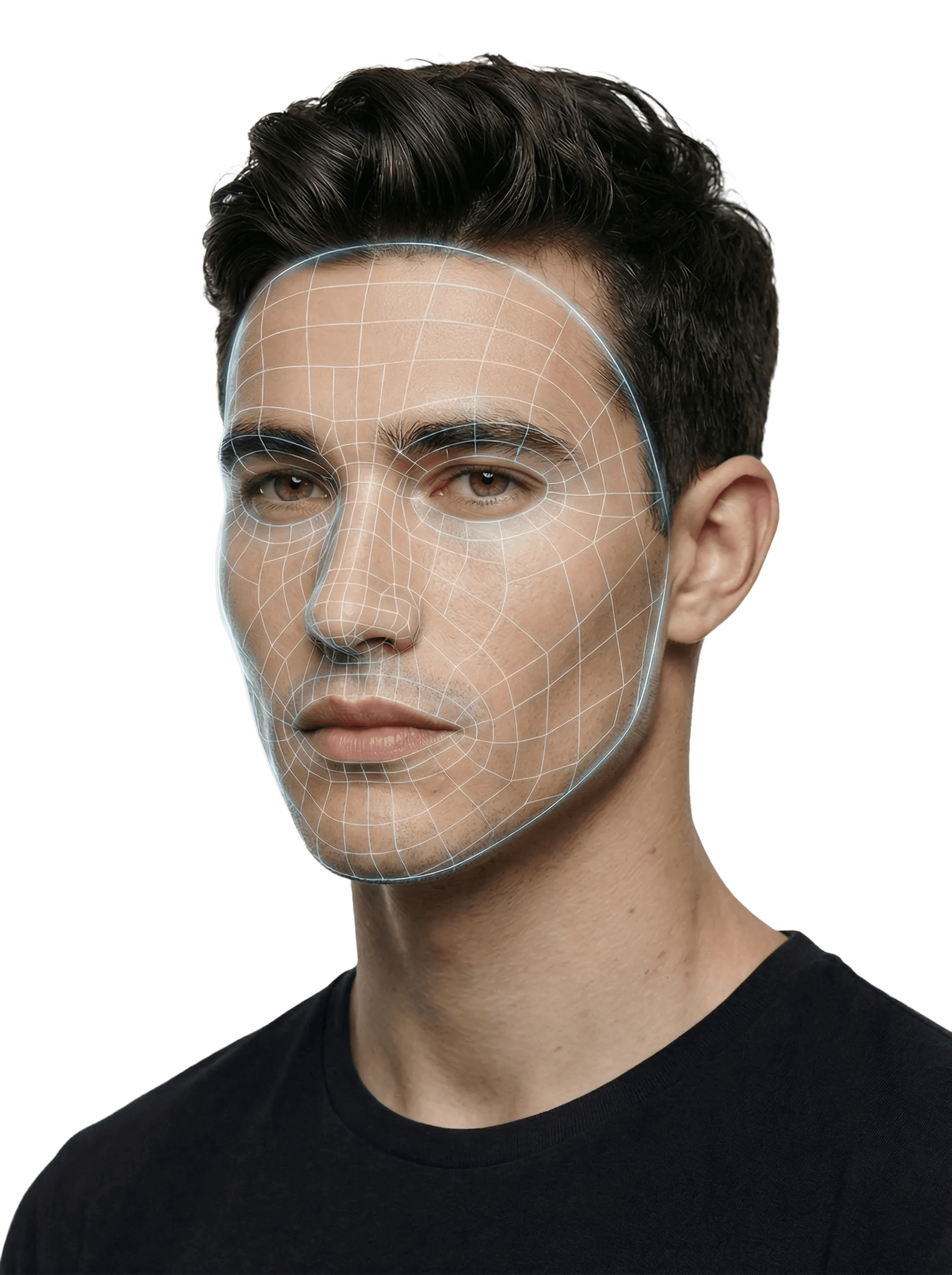
Attractiveness Calculator: How AI Ratings Work and What They Mean
An attractiveness calculator is a tool that estimates how appealing your face appears to others by converting facial cues into a numerical rating. It usually delivers a 1–10 or percentage score and sometimes breaks down sub‑scores for features like symmetry, skin quality or jawline definition. This page explains what these tools measure, how they work, why their results should be interpreted carefully and how you can use them intelligently to understand and improve your appearance. Research shows that attractive people are often judged as more intelligent, trustworthy and successful — a phenomenon called the “halo effect”. That social bias is one reason people turn to facial rating tools in the first place — our looks affect how others treat us.
If you want a quick baseline of how you’re perceived, try our AI‑powered evaluation first. Try Maxxing for a personalized assessment and recommendations. After receiving your score, come back to this guide to learn how to interpret it and what to do next.
What Does an Attractiveness Calculator Measure?
An attractiveness calculator tries to quantify visual cues that influence attractiveness judgments. It generally analyzes:
Facial proportions and feature balance. Distances between eyes, nose, mouth and jawline determine how balanced a face appears. Proportion norms vary slightly across populations, but moderate symmetry and averageness are generally favored.
Skin quality and tone. Even skin with fewer blemishes or wrinkles is associated with health and youthfulness. Research on the attractiveness halo effect notes that physically attractive people are perceived as happier and more trustworthy, which is partly driven by clear skin.
Facial adiposity. A lean or defined face often scores higher than a puffy or bloated face because excess facial fat signals lower fitness. Observers can infer body mass index from facial cues fairly accurately (r ≈ 0.71) and prefer faces corresponding to healthy BMI ranges.
Symmetry and harmony. Perfect symmetry is rare, but moderate symmetry and proportions close to the average of many faces are typically rated as more attractive. The halo effect literature shows that attractiveness bias generalizes across diverse stimuli and cultures, reinforcing that certain patterns hold broadly.
Expression and presentation. Neutral or slight smile expressions usually yield higher scores; extreme expressions can alter perceived attractiveness. A 2024 study comparing AI models trained on uncontrolled social media photos versus standardized images found that the standardized model produced higher average scores (56.4 vs 40.9 out of 100) and less variability. Neutral expressions were rated most attractive, while expressive faces generally scored lower.
These calculators do not measure charisma, voice, humor or personal style — nor do they capture the unique preferences of individuals you know. They offer a standardized, population‑level estimate of facial appeal, which can be helpful for spotting obvious issues but should never define your self‑worth.
How AI Attractiveness Calculators Work
Most AI‑based beauty calculators follow a similar pipeline:
Face detection and alignment — the algorithm locates your face and standardizes its position and scale.
Facial landmark mapping — key points (eyes, nose, mouth, chin) are identified to calculate distances and ratios.
Feature extraction — the model analyzes texture, symmetry, proportions and skin color to create a feature vector representing your face.
Score prediction — based on training data, the model maps your feature vector to a score reflecting how a crowd might rate your face. In the study above, a standardized model trained on neutral, controlled photographs produced higher scores with less variance and emphasized neutral expressions over smiling or other expressions.
Output and optional sub‑scores — some tools break down your result by facial regions or suggest improvements.
AI can approximate human judgments but it is not perfect. The training set heavily influences what is considered attractive; for example, if the model is trained on Western faces it may undervalue other ethnic features. The halo effect research warns that attractiveness judgments have cultural nuance and mixed evidence about whether they generalize across ethnicities. Therefore, treat AI scores as directional guidance rather than objective truth.
Do Rating Scales Matter?
Online beauty calculators may use 1–5, 1–10 or 0–100 scales. Is one better than another? A recent psychometric study compared a binary choice, a 0–100 slider, a visual analogue scale and several Likert scales (1–3, 1–5, 1–7, 1–8, 1–9, 1–10). The researchers found little evidence that one scale is significantly more reliable than the others. Measures of inter‑rater agreement and within‑person consistency were similar across scales, though the 1–3 scale had slightly lower agreement. Participants found 5‑point, 7‑point and 10‑point scales easiest to use and these scales aligned more evenly with the underlying 0–100 continuum.
Because different scales rarely change outcomes in meaningful ways, you should focus less on the absolute number and more on relative feedback: which elements score lower, and how your score changes over time. In fact, that same study found that nearly half of the variance in attractiveness judgements came from private taste rather than shared preferences. This means there is plenty of disagreement among raters even when using standardized methods.
Limitations and Biases of Attractiveness Calculators
Training data bias: AI models are only as fair as their training sets. If they rely on data from social media where certain genders or ethnicities are overrepresented, the model might systematically prefer those features. A standardized training set improved scoring stability, but it still reflects normative preferences.
Cultural differences: Although there is a broad halo effect across cultures, local norms shape what counts as “beautiful.” Large-scale studies across 45 countries found attractiveness correlated with positive traits like confidence and sociability across populations, but evidence for ethnicity‑specific differences is mixed. An AI calculator trained mainly on Western faces might misinterpret features like skin tone, eye shape or nose structure from other populations.
Expression and conditions: Lighting, camera angle and facial expression greatly affect your score. Neutral expressions generally yield higher scores, whereas extreme smiling or frowning can reduce ratings. Poor lighting or low‑resolution photos also lower the result because the model cannot accurately read cues.
Private taste: Roughly half of attractiveness judgements come from private taste. Two people might disagree on whether a face is attractive even when using the same rating scale. This variance increases when stimuli are homogeneous (e.g., standardized headshots) and reduces when there is more diversity.
Because of these limitations, use attractiveness calculators as one data point among many. They can highlight broad issues (excess facial puffiness, skin unevenness, asymmetry) but cannot capture subjective tastes or your personal qualities. Avoid overreacting to a low score or treating a high score as justification to stop improving.
Tips to Use an Attractiveness Calculator Smartly
Use neutral, high‑quality photos. Take your picture in natural, even lighting facing the camera with a neutral or slight smile. Neutral expressions tend to yield higher, more stable scores.
Avoid filters and heavy makeup. Filters may distort your features, leading to misleading scores. Makeup can boost ratings (studies show cosmetically enhanced faces are perceived as more confident and competent), but it also hides the areas you need to improve.
Try multiple photos. Because private taste accounts for considerable variance, using several photos helps average out random factors. Changing hair style, angle and lighting can reveal which aspects consistently influence your score.
Focus on patterns, not single numbers. Look for repeated feedback such as “low symmetry” or “jawline needs definition” rather than obsessing over a single score. Use this information as a starting point for targeted improvements.
Compare to yourself over time. The best use of an attractiveness calculator is to measure progress. Track how your score changes as you implement improvements rather than comparing yourself to others.
You’ll find that the steps above align with broader attractiveness assessment frameworks. For a more comprehensive approach, read our pretty scale article that explains how people categorize looks or explore the how pretty am I discussion to understand perception versus reality.
How to Improve Your Attractiveness Score
Getting a number is one thing; improving it is another. Research on appearance suggests that addressing high‑impact factors first yields the biggest jump in perceived attractiveness. Here’s a priority‑based roadmap:
Skin quality. Uneven tone and blemishes immediately lower ratings. Basic habits like proper cleansing, hydration and sun protection can dramatically improve your skin. Smooth, homogeneous skin boosts health and attractiveness perceptions.
Facial adiposity. Reducing excess facial fat sharpens jawline and cheekbones. Because people infer body weight from facial cues, a leaner face appears healthier and more attractive. Focus on sustainable nutrition and cardio rather than crash diets.
Hair and grooming. Hair frames your face and influences attractiveness judgments. Choose cuts that suit your face shape and keep facial hair neat. Even small grooming tweaks can move you up the beauty analyzer scale.
Style and posture. Fitted clothing, good posture and confident body language amplify facial attractiveness by communicating self‑care and competence. You don’t need designer brands; you need clean, intentional presentation.
Facial harmony. If structural imbalances are identified (e.g., asymmetry, misaligned teeth), consult professionals. However, many “flaws” can be mitigated through weight management, grooming and style without invasive procedures.
Our attractiveness test and beauty test offer structured assessments beyond a single score. For deeper insights, the facial feature analyzer breaks down your face into specific regions and ranks which improvements would most influence your rating. These tools provide a roadmap rather than a rough guess.
Why Use Maxxing Instead of a Simple Attractiveness Calculator?
Most online calculators offer a single number without context. Maxxing goes further by combining facial analysis with guidance on skin care, body composition, hair, style and confidence. It answers the question, “What should I fix first?” and shows how each improvement affects your overall score. It also acknowledges that appearance drives real‑life outcomes — from dating success to social confidence — as highlighted by halo effect research.
If you want more than a vanity score, start with a personalized glow‑up roadmap that prioritizes impactful changes and tracks your progress. Try Maxxing today to discover your current strengths, identify your bottlenecks, and see how small adjustments can make you look — and feel — better.
Key Takeaways
Attractiveness calculators convert facial cues into a rating by comparing your features to large datasets. They consider proportions, skin quality, symmetry, facial fat and expression.
The halo effect means attractive individuals are seen as more intelligent, trustworthy and successful; that’s why improving attractiveness has real social benefits.
AI calculators trained on standardized, neutral photos give higher and more stable scores than those trained on uncontrolled images and emphasize neutral expressions.
A psychometric study found little evidence that one rating scale (e.g., 1–5, 1–7, 0–100) is inherently better than another; private taste accounts for about half of rating variance.
Use calculators as a guide, not a verdict. Focus on patterns and improvement over time, and address high‑impact factors like skin, facial fat, grooming and style.
To get actionable insights and a personalized improvement plan, explore our attractiveness assessment tools and maximize your results with Maxxing.
Sources: