

Facial Thirds: What They Are, How to Measure Them, and What's Normal
Facial thirds divide your face into three vertical sections: hairline to brows, brows to the base of the nose, and base of the nose to the chin. The classic rule says all three should be equal — a 1:1:1 ratio. In real faces, they rarely are, and that's normal.
Facial thirds are one of the vertical proportions a facial feature analyzer looks at. They're also one small piece of how people read a face overall — the kind of whole-face impression an attractiveness test tries to score.
What the research shows:
In most adults, the middle third is the shortest.
The lower third is longer than the middle third in roughly 9 out of 10 people in measurement studies.
Perfectly equal thirds are the exception, not the norm.
What Are Facial Thirds?
Facial thirds are a proportion guideline that splits the face into three horizontal bands of height: the upper third (hairline to brows), the middle third (brows to the base of the nose), and the lower third (base of the nose to the bottom of the chin). Equal thirds — a 1:1:1 ratio — are the classical reference point.
Third | Runs from → to | Landmarks | What it includes |
Upper | Hairline → between the brows | Trichion → glabella | Forehead |
Middle | Between the brows → base of the nose | Glabella → subnasale | Eyes, cheekbones, nose |
Lower | Base of the nose → bottom of the chin | Subnasale → menton | Lips, chin, jawline |

The Four Landmarks That Define the Thirds
Trichion — the midpoint of the hairline on the forehead.
Glabella — the smooth spot between the eyebrows, just above the nose.
Subnasale — the point where the base of the nose meets the upper lip.
Menton — the lowest point of the chin.
Not every source uses the same points. Some studies measure from the nasion — the deepest point of the nasal bridge, between the eyes — instead of the glabella, and end the lower third at the gnathion, a point on the front of the chin rather than its bottom. That's one reason facial thirds calculators often give different results for the same photo.
Where the 1/3 Face Rule Comes From
The rule of thirds is one of the "neoclassical canons" — proportion rules artists used to draw idealized faces:
Ancient Greek sculptors built their statues on fixed proportion rules.
Leonardo da Vinci described facial and body canons in the late 1400s.
Albrecht Dürer defined the face as three equal lengths in the 1500s: forehead, nose, and mouth with chin.
Today, orthodontists, plastic surgeons, and orthognathic (jaw) surgeons still use facial thirds as a reference point when planning treatment (Al-Sebaei, 2015). A reference point is not a description of how most faces actually measure, though. That's where the research gets interesting.
What Is the Ideal Facial Thirds Ratio?
The ideal facial thirds ratio is 1:1:1 — upper, middle, and lower thirds of equal height, each about 33% of the face. It's a reference point from art and treatment planning, not a measured average. Studies that measure real adult faces find equal thirds are uncommon.
To compare your own facial thirds ratio, convert each third into a share of total face height (hairline to chin) instead of comparing raw numbers.
Equal Facial Thirds Are Rare
Measurement studies keep reaching the same conclusion:
153 young adults in North America (Farkas et al., 1985). Of nine classic proportion rules tested, the vertical ones — facial thirds among them — matched real faces the worst: no more than two sections were ever equal. The authors concluded the canons "do not represent the average facial proportions."
168 young adults in Saudi Arabia (Al-Sebaei, 2015). Participants were selected for healthy, esthetically pleasing faces. Even so:
The middle third was the shortest of the three.
The lower third was longer than the middle third in 91% of men and 88% of women.
The middle and lower thirds matched within 1 mm in only 5% of men and 11% of women.
250 adults in Kerala, India (Chitta & Malathi, 2023). The lower face was taller than the midface in 91% of people, and none of the classic proportions fit the average face.
The takeaway: if your lower third is longer than your middle third, you're in the majority. In the Al-Sebaei study, that was true of faces chosen specifically for being attractive.
Ideal Facial Thirds for Women and Men
The classic rule uses the same 1:1:1 ratio for everyone. Average measurements do differ by sex, though — mostly in the lower third:
Measure (Al-Sebaei, 2015) | Men | Women |
Average lower third height | 65.0 mm | 60.3 mm |
Upper third longer than lower third | 40% | 72% |
Lower third longer than middle third | 91% | 88% |
The upper and middle thirds showed no significant difference between men and women. Averages also vary between populations and even more within them, so no single study sets a norm that fits every face.
How to Measure Facial Thirds
To measure facial thirds, mark four points on a straight-on photo — the hairline, the spot between your brows, the base of your nose, and the bottom of your chin. Measure the three distances between them, then compare each one to the total face height.
Take the right photo.
Face the camera straight on, with the lens at eye level. A side-profile photo works too.
Have someone shoot from about 5 feet away. An arm's-length selfie makes the nose look about 30% wider than it is (Ward et al., 2018), which skews the middle third.
Keep a neutral expression, lips closed, teeth together.
Pull your hair off your forehead so the hairline is visible.
Mark the four landmarks. Draw a horizontal line through the trichion (hairline), glabella (between the brows), subnasale (base of the nose), and menton (bottom of the chin). Any photo editor works, or a printout and a pen.
Measure the three distances in pixels, or in millimeters on a printout.
Calculate each third's share: third ÷ total height × 100. For example, thirds of 62, 58, and 65 pixels (185 total) come out to about 34%, 31%, and 35%.
Read the result. There's no standard cutoff for "balanced" facial thirds. Researchers count two thirds as equal only when they match within about 1 mm, in person — a bar most faces don't meet. Use your numbers to see which third is longest and which is shortest, not to grade your face.

Measuring Facial Thirds in Person
Measure the straight-line distance between points, not along the curve of your skin. Hold a ruler or calipers flat in front of your face instead of pressing a tape measure against it. Researchers use sliding calipers for this (Al-Sebaei, 2015).
Sit upright in front of a mirror and look straight ahead.
Measure each third twice and average the results.
Why Your Result Might Be Off
Hairline. A receding hairline, a widow's peak, or bangs make the trichion hard to place. The upper third is the least reliable of the three.
Head tilt. Tilting your head up or down changes how long each third looks in a photo.
Lens distortion. Close-up phone shots enlarge features nearest the camera, mainly the nose.
Expression. A smile or parted lips shift the lower third.
One angle only. A flat photo can't capture depth, so front and profile shots of the same face can give slightly different numbers.
Facial Thirds Calculators and Filters
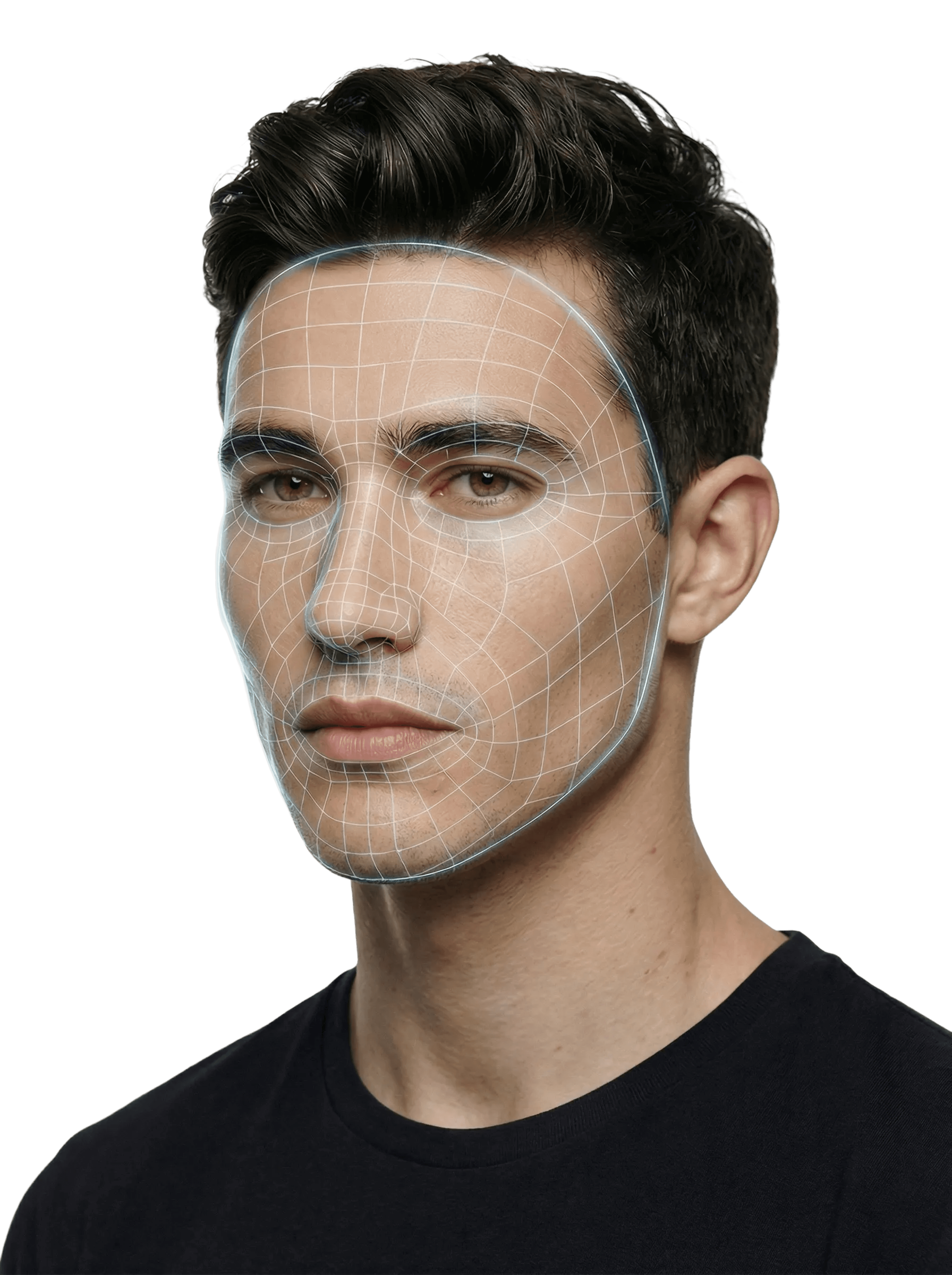
A facial thirds calculator, test, or filter places the landmarks for you and returns the three percentages. It's faster than measuring by hand, with a few limits:
Many tools skip or estimate the upper third, because AI landmark models struggle to find the hairline.
Tools don't all use the same landmarks, so the same photo can score differently on two sites.
The photo rules above still apply — a calculator can't fix a close-up selfie or a tilted head.
Facial thirds are one of several proportion checks. A golden ratio face test compares different measurements, and AI face analysis looks at features one by one.
Want a full read on your proportions? The Maxxing face test analyzes your facial proportions and scores the features that shape each third — jawline, chin, lips, cheekbones, and nose — plus face symmetry, with a short explanation for every score. Like any AI rating, the results are a model's estimate, not an objective measurement.
What Uneven Facial Thirds Look Like
Uneven facial thirds means one section of the face is noticeably taller or shorter than the others. It's the norm, not a defect: most adults have a shorter middle third and a longer lower third. Uneven thirds change the overall impression of a face — longer, shorter, more compact — rather than whether it's attractive.
Pattern | How it can read | Common contributors |
Long upper third | Tall forehead | High or receding hairline, forehead shape |
Short upper third | Low forehead, features sit higher | Low hairline |
Long middle third | Longer midface | Nose length, cheekbone and eye position |
Short middle third | Compact midface | The most common pattern in adults |
Long lower third | Longer face, prominent chin area | Chin height, jaw growth, bite, lips apart at rest |
Short lower third | Shorter, rounder lower face | Small chin, deep bite, worn or missing teeth |
A few notes on specific thirds:
Middle third. How long the midface reads also depends on its width.
Lower third. It's the part most shaped by the chin and jaw — see how a jawline rating looks at that area. On average, it's slightly longer in men.
A very long lower face is sometimes linked to how the jaws developed. If it comes with bite problems, jaw pain, or trouble chewing or breathing through the nose, an orthodontist or oral and maxillofacial surgeon can assess it.
What Counts as "Bad" Facial Thirds?
There's no medical definition of "bad" facial thirds. In looksmaxxing forums, the term usually means a large gap from 1:1:1 — most often a long midface or a long lower third.
The research doesn't support treating that gap as a flaw. In the Al-Sebaei study, faces selected for being esthetically pleasing still had unequal thirds in almost every case. How a face reads depends on all its features together — proportions, individual features, skin, and hair.
Symmetry is a separate measure: it compares the left and right sides of the face rather than top to bottom. Our face symmetry test guide covers it.
Can You Change Your Facial Thirds?
You can't change the bone structure behind your facial thirds without medical treatment. You can change how your thirds read — hair, facial hair, and brows shift where the eye places each boundary. Surgery and orthodontics can change the measurements themselves, while mewing and face exercises have no evidence behind them.
What Changes How Your Thirds Read
Haircut and bangs. Bangs or a side-swept fringe cover part of the forehead, so a long upper third reads shorter. Height and volume at the crown make the whole face look longer. This is what people usually mean by a "facial thirds haircut."
Hairline. Showing or hiding the hairline changes where the upper third seems to start.
Beard. Facial hair can add visual length and definition to a short lower third, or break up a long one.
Brows. Brow shape and height move the visual line between the upper and middle thirds.
Makeup. Contour and highlight can shift attention up or down the face.
Not sure which of these fits your face? Your Maxxing report includes personalized advice based on your photos — haircut, brow, and skin care suggestions you can add to a daily routine.
Medical Options
These change the actual proportions. Each carries real risks, cost, and recovery time, and should start with a consultation with a board-certified specialist:
Orthodontics and orthognathic (jaw) surgery — used to correct how the jaws and bite are positioned, which affects the lower and middle thirds (American Association of Orthodontists).
Chin surgery or a chin implant — changes the height and projection of the chin, and so the lower third.
Dermal fillers — a temporary way to add volume to the chin or other areas.
Hairline procedures — hair transplants or hairline-lowering surgery change where the upper third begins.
Under 18? Your face is still growing, and facial proportions keep changing through the teen years (Farkas et al., 1985). Don't make decisions based on your facial thirds now — if your bite or jaw bothers you, start with an orthodontist.
What Doesn't Have Solid Evidence
Mewing (resting the tongue against the roof of the mouth). The American Association of Orthodontists says there is "no current research that suggests the technique provides any benefit to your jawline or oral health," and that pressing too hard can disrupt tooth alignment and the bite (AAO).
Facial exercises. They aren't shown to change bone proportions.
Bone smashing (tapping the face with hard objects to "reshape" bone). It's dangerous: surgeons warn of microfractures, fractures that need surgery, nerve damage, damage to the teeth and bite, and permanent disfigurement (Mater, 2026). Don't try it.
Facial Thirds vs. Golden Ratio vs. Facial Fifths
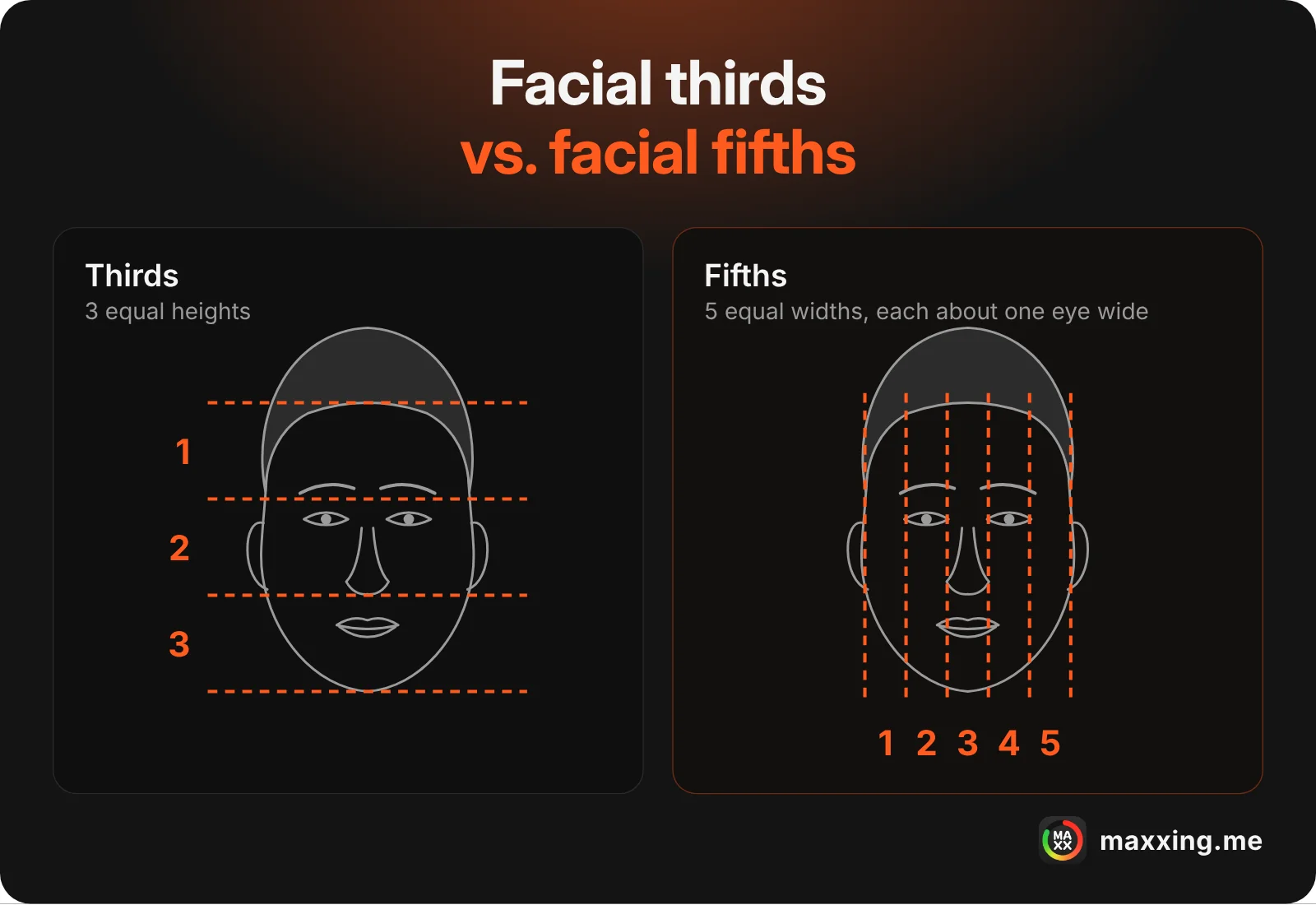
Facial thirds measure the face top to bottom, facial fifths measure it side to side, and the golden ratio compares many distances against one number, 1.618. They're often bundled into the same calculators, but they answer different questions.
Facial thirds | Facial fifths | Golden ratio | |
What it measures | Height, in three horizontal bands | Width, in five vertical strips | Ratios between many facial distances |
Classic ideal | 1:1:1 | Five equal widths, each about one eye wide | About 1.618 for each ratio |
What it tells you | Which section of the face is longer or shorter | How eyes, nose, and face width are spaced | An overall "harmony" estimate |
How well it fits real faces | Poorly — vertical rules fit worst of all classic canons | Somewhat better, but still a minority of faces | Depends on which ratios a tool picks |
In the Farkas study, the best-fitting classic rules were horizontal ones: the space between the eyes matched the width of the nose in 40% of people. For a full breakdown of the golden ratio and how calculators use it, see our golden ratio face test guide. Height and width together also decide your face shape.
FAQ
What is the 1/3 face rule?
The 1/3 face rule says a face divides into three equal vertical sections: hairline to brows, brows to the base of the nose, and base of the nose to the chin. It comes from Renaissance art and is still used as a reference in orthodontics and plastic surgery, but most real faces don't follow it exactly.
Is a long lower third bad?
No. A lower third that's longer than the middle third is the most common pattern — about 9 in 10 adults in measurement studies — and it's slightly longer in men on average. It's worth seeing an orthodontist only if it comes with bite problems, jaw pain, or trouble chewing.
Do facial thirds change with age?
Yes. Facial proportions keep developing through childhood and the teen years (Farkas et al., 1985). In adults, a receding hairline can lengthen the upper third, and worn or missing teeth can shorten the lower third. For how age shows in a face overall, see how old do I look.
Can I do a facial thirds test online?
Yes. Online facial thirds calculators place the landmarks on your photo and return the three percentages. Results depend on the photo — take it straight on from about 5 feet away, with your hairline visible — and different tools may give different numbers for the same face.
Can ChatGPT analyze my facial thirds?
AI chatbots like ChatGPT can describe a face in a photo, but they estimate proportions by eye instead of placing landmarks and measuring distances, and they may give different answers for the same photo. For actual numbers, measure the thirds yourself or use a landmark-based tool.
Can you measure facial thirds without seeing the hairline?
Only partly. Without the hairline, you can still compare the middle and lower thirds, which is what many calculators do. The upper third needs a visible hairline — pull your hair back or wear a headband for the photo.