



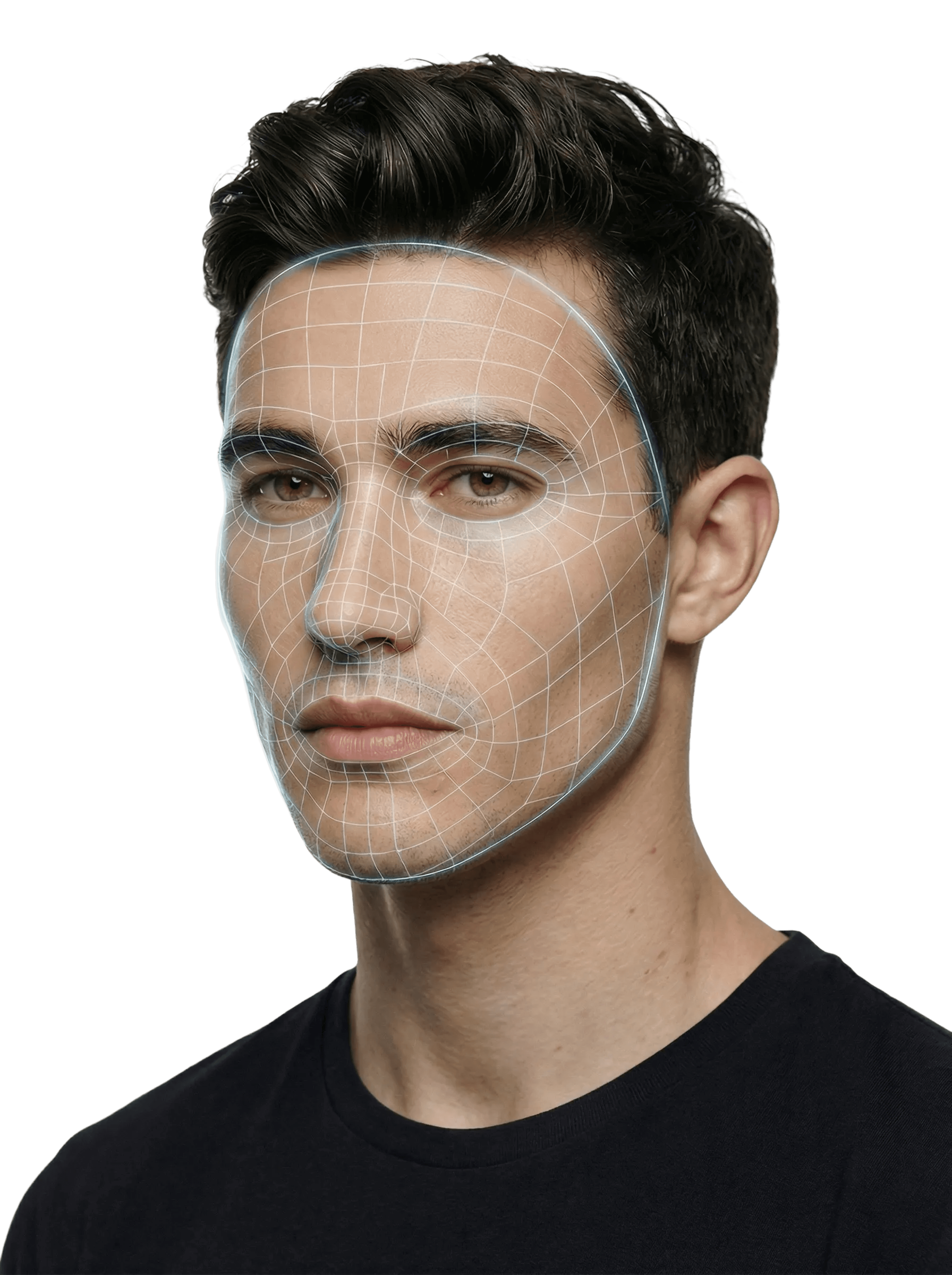
Facial Asymmetry: What's Normal, What Causes It, and How to Fix It
Facial asymmetry means the left and right sides of your face don't mirror each other exactly — one eye sits a little higher, the jaw tilts slightly, or one cheek looks fuller. Almost everyone has some: in 3D scans of 191 people, the difference between the two sides of a typical face was 0.4–1.3 mm (Taylor et al., 2018). Whether it can be fixed depends on what's behind it — soft tissue and habits, teeth and bone, or nerves. If the change in your face is new or sudden, skip to When to See a Doctor.
Most fixes are softmaxxing — grooming, styling, and habits. Hardmaxxing, meaning procedures or surgery, only comes in when the asymmetry is in the bone or bite (our looksmaxxing guide covers both). Before you change anything, see how uneven your face actually is — our face symmetry test guide shows how to measure it from a photo. And symmetry is just one part of how a face reads: an attractiveness test looks at proportions, skin, and features together.
Is Facial Asymmetry Normal?
Yes. Slight differences between the left and right sides of the face are normal. In a study of 314 healthy people aged 12 to 56, mild soft-tissue asymmetry was a normal finding, with no meaningful differences by sex or age (Ferrario et al., 2001).
Can a face be 100% symmetrical? No. 3D studies find some difference between the two sides even in people with no facial conditions.
Natural vs. extreme asymmetry. Natural asymmetry is what you spot in close-ups. Extreme asymmetry is a chin that sits clearly off-center, a visibly uneven jaw, or a bite that doesn't line up — and it's usually tied to jaw and bite problems.
Where it shows most. Among orthodontic patients with jaw and bite problems and visible asymmetry, it involved the lower third of the face — usually a chin that deviates to one side — in 75% of cases, the middle third in 36%, and the upper third in 5% (PMC review).

Is Facial Asymmetry Noticeable in Real Life?
Usually not. A review of perception studies found that people start to notice a difference between the sides at about 2 mm for eyelid height, 3 mm for the corners of the mouth, 3.5 mm for the brows, 4 mm for the tip of the nose, and 6 mm for the chin (Wang et al., 2017). That's well above the 0.4–1.3 mm of a typical face.
You notice your asymmetry more than anyone else because you study your face up close, frozen, and flipped. Other people see it from a normal distance, in motion, and with expression.
How to Check Your Facial Asymmetry
The mirror and the front camera are the two most misleading ways to judge your symmetry:
The mirror flips your face. You're used to your reversed reflection, so a true photo can look "off." In a classic study, people preferred mirror-image photos of themselves, while their friends preferred the true image (Mita, Dermer & Knight, 1977, as described in Amestoy et al., 2010). That's the idea behind the TikTok "inverted filter" — it shows the unflipped version of your face, which is how others see you.
Close-up selfies distort. In a selfie taken about 12 inches away, the base of the nose looks roughly 30% wider than in a photo taken from 5 feet (Ward et al., 2018). Whatever is closest to the lens gets exaggerated — including small differences between the sides.
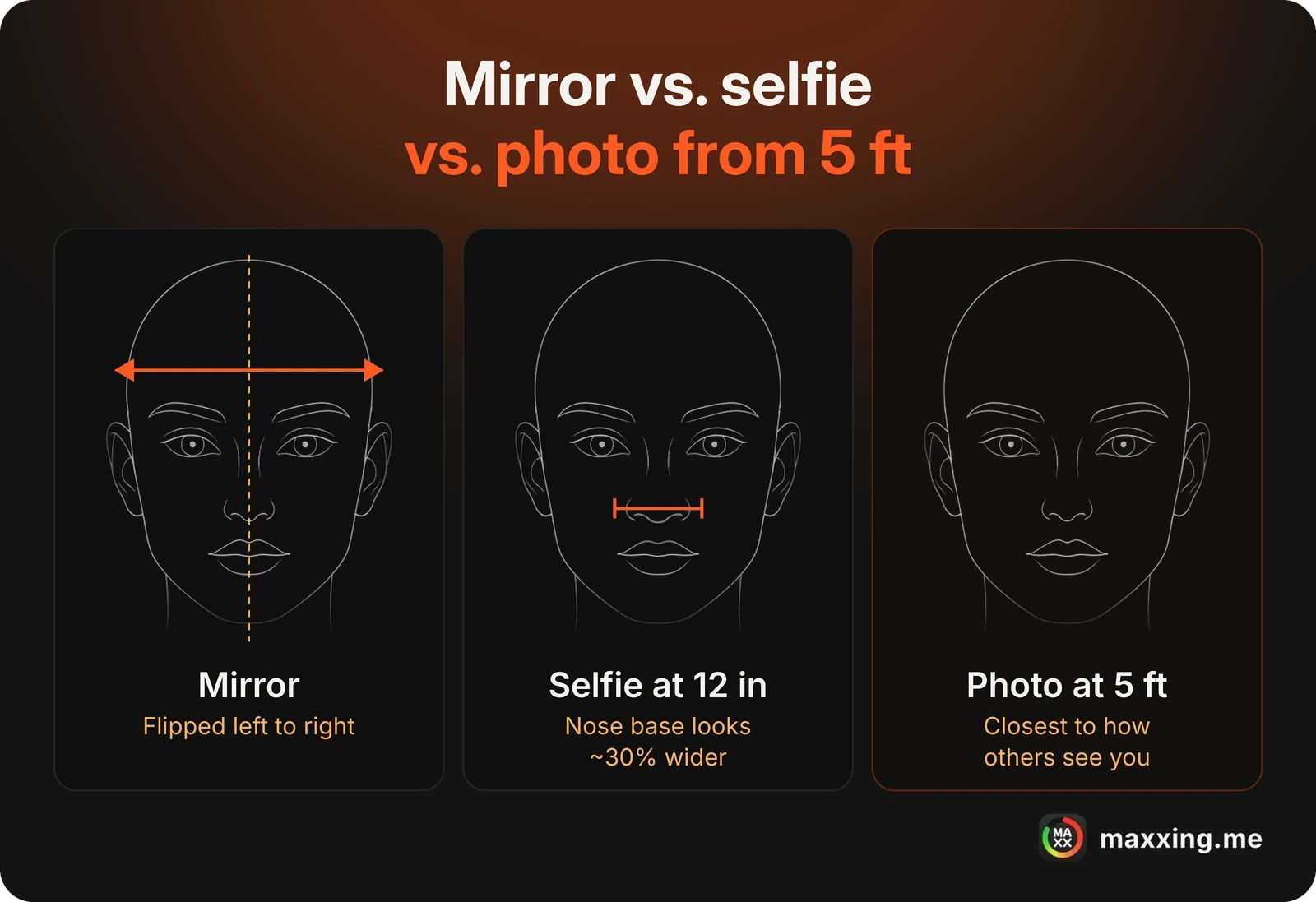
To check your asymmetry fairly:
Have someone take the photo from about 5 feet away, or use a timer.
Keep the camera at eye level.
Use even light from the front, with no harsh shadows on one side.
Keep your head straight and your face relaxed — no tilt, no smile.
Imagine a vertical line through the middle of your nose and check three things: are your pupils level, are the corners of your mouth level, and does your chin sit on the line?

What Does a Facial Symmetry Score Mean?
A facial symmetry score is an app's estimate of how closely the two halves of your face match, based on landmarks like the corners of the eyes, the nostrils, and the corners of the mouth. It's a model's estimate, not a medical measurement, and there's no standard that makes 90% or 94% "good" or "bad." The same face can score differently in different apps, since each uses its own landmarks and formula (here's how a facial feature analyzer compares paired features), or in the same app after a slight head tilt, a shadow, or a close-up lens.
Want a personal read? The Maxxing facial report includes a Face Symmetry score out of 100 with a short explanation of what's driving it, alongside scores for features like jawline, cheekbones, and nose. Treat it as a model's estimate, not a verdict. Check your face symmetry
What Causes Facial Asymmetry?
Most facial asymmetry comes from how your face grew — genetics, jaw growth, and your teeth and bite. Less often it's caused by an injury, a sinus or nerve problem, or aging. In many cases there's no single cause you can point to (Cheong & Lo, 2011).
Cause | What it can look like | Can it change? |
|---|---|---|
Genetics and normal growth | Small differences in eye height, brows, cheeks | Stable; grooming can balance how it looks |
Teeth and bite, including crossbite | Jaw or chin slightly off-center | Often treatable by an orthodontist, especially in kids and teens |
Uneven jaw growth | Chin off to one side, uneven jawline | Needs a specialist; sometimes surgery |
Old injury | Flattened area, crooked nose | Depends on the injury |
Aging | More visible differences in the lower face | Slowly increases |
Nerve problems (Bell's palsy, stroke) | Drooping mouth or eyelid, uneven smile | Needs prompt medical care |
Silent sinus syndrome | One eye slowly sinks or sits lower | Treated by specialists |
Habits (chewing, sleep) | Debated — see below | Evidence is limited |
A crossbite is when some upper teeth sit inside the lower teeth instead of outside; left untreated in a growing child, a one-sided crossbite can shift the lower jaw and lead to facial asymmetry (Caroccia et al., 2021). Silent sinus syndrome is a rare condition in which the sinus behind the cheek slowly collapses, so one eye gradually sinks or sits lower without pain (Monos et al., 2005) — if you notice that happening over months, see a doctor.
If your jaw is what bothers you, our jawline rating guide shows how jaw width and angles are judged in photos.
Can Chewing on One Side Cause Facial Asymmetry?
Possibly a little, but the evidence is mixed, and the largest study found no significant effect.
Largest study, no effect: in 748 adults from a Finnish birth cohort, the preferred chewing side had no statistically significant effect on facial asymmetry. What did make people chew on one side was missing teeth on the other side (Heikkinen et al., 2024).
Smaller studies, some link: in 106 pairs of twins, the chin was fuller on the side opposite the habitual chewing side (Heikkinen et al., 2022). In 76 students, chewing side preference was linked to lateral facial asymmetry and to effects on the jaw joint on that side (Tiwari et al., 2017).
So if you've always chewed on one side and your jaw looks a bit uneven, the habit may play a small role — but it's rarely the whole story. Teeth, bite, and jaw growth usually matter more.
Does Sleeping on One Side Cause Facial Asymmetry?
There's no evidence that sleeping on one side reshapes your bones. What it can affect is skin and soft tissue:
Eyelids: in a study of 71 patients, those who slept mostly on one side had a lower upper eyelid on that side, but no differences in brow position or the lower eyelid (Ophthalmic Plastic and Reconstructive Surgery, 2022).
Sleep wrinkles: pressing your face into a pillow in side or stomach sleeping compresses and stretches the skin, which can create sleep wrinkles over the years (Anson et al., 2016).

If you wake up with one side puffier or creased, that's temporary. No study shows that switching sides or sleeping on your back reverses existing asymmetry.
Does Facial Asymmetry Get Worse With Age?
Slightly. In 3D scans of 191 people aged 4 months to 88 years, asymmetry increased with age by about 0.06 mm per decade, mostly in the lower two-thirds of the face (Taylor et al., 2018). Not every study agrees: in 300 adults aged 20 to 80, the overall pattern of asymmetry was similar across age groups (Harnádková et al., 2023). Either way, the change is small — natural asymmetry doesn't suddenly get worse.
How to Fix Facial Asymmetry Naturally at Home
You can't make the bones of your face more symmetrical at home — no exercise, tool, or habit has been shown to do that. But you can make asymmetry a lot less noticeable with grooming, styling, and better photos.
What Actually Changes How Symmetrical You Look
Haircut and part: a side part or extra volume on the flatter side can balance a fuller cheek, a higher brow, or a jaw that sits off-center. Ask your barber or stylist to work with the uneven side, not against it.
Brows: shaping or filling one brow to match the other's height and arch evens out the upper face — and people notice uneven brows sooner than an uneven chin.
Beard: for men, a beard line trimmed a little fuller on one side can even out the outline of an uneven jaw or chin.
Makeup: contour and highlight can add or take away visual volume on one cheek or one side of the jaw.
Glasses: adjust the nose pads and arms so frames sit level — tilted frames make asymmetry more obvious.
Head position: in photos, keep your head level. A small tilt or a dropped shoulder makes the two sides look more different than they are.
Your "good side": most people prefer one side of their face in photos. Turning that side slightly toward the camera is a simple way to make asymmetry less noticeable.
Low-Risk Habits Worth Keeping
These won't fix existing asymmetry, but they're low-risk and make sense:
Chew on both sides. If you can't because of a missing tooth, pain, or a bite that feels off, see a dentist.
Limit pillow pressure on one side. Sleeping on your back avoids pressing one side of your face into the pillow every night, which is linked to sleep wrinkles over the years (Anson et al., 2016).
How to Fix Facial Asymmetry From Chewing on One Side
If you think one-sided chewing made your face uneven, here's what you can realistically do:
Find out why you chew on one side. In the largest study, the main reason was missing teeth on the other side (Heikkinen et al., 2024). Pain, a cavity, or a bite that doesn't line up can also be reasons — all of them are a dentist's job.
Start using both sides. Once nothing hurts, split your chewing between both sides on purpose until it becomes automatic.
Don't "train" the weaker side with gum. There's no evidence that extra chewing evens out the face, and if your jaw starts to hurt or click, stop (see Looksmaxxing Myths below).
Set realistic expectations. Changing the habit is good for your teeth and jaw, but no study shows it reverses asymmetry that's already there. If the difference comes from your bite or jaw growth, an orthodontist can tell you what's actually fixable.
Not sure which features are behind the asymmetry you see? The Maxxing test breaks your face down feature by feature — face symmetry, jawline, cheekbones, nose, lips, chin — and suggests changes for your daily routine, like skin care, haircut, and brow tips. Get your facial analysis
Facial Asymmetry Exercises: Do They Work?
Not for fixing asymmetry. No study has shown that facial exercises or facial yoga — face workouts for the muscles of the cheeks, mouth, and brows — make a healthy face more symmetrical. The research that exists measured other things:
Cheek fullness, not symmetry: in a JAMA Dermatology study, women aged 40 to 65 did 30 minutes of facial exercises daily for 8 weeks, then every other day until week 20. Their upper and lower cheeks looked fuller. Symmetry wasn't measured, and only 16 of the 27 women who enrolled finished (Alam et al., 2018).
Recovery after facial nerve paralysis: a Cochrane review found low-quality evidence that exercises tailored by a therapist can improve facial function in people with facial palsy, mainly in moderate and long-lasting cases (Teixeira et al., 2011). That's rehab for a nerve problem, not a looksmaxxing routine.
Facial exercises can | Facial exercises can't |
|---|---|
Add some muscle fullness over months of consistent work | Move bone or change your bite |
Help with function after nerve injury when guided by a therapist | Fix asymmetry caused by the jaw or teeth |
Help you control your expressions | Make one side "catch up" with the other |
If You Still Want to Do Facial Exercises
If face workouts are part of your routine, keep them gentle and focus on expression, not on building one side:
Practice an even smile. If your smile pulls more to one side, practicing a more even smile in front of a mirror can change how it looks in photos. It's a skill, not a muscle fix.
Relax your face at rest. Notice whether you raise one brow or tense one side of your mouth out of habit, and let it go.
Skip jaw clenching and hard chewing devices. There's no evidence they even out the face, and they can strain the jaw.
Stop if it hurts. Pain, clicking, or locking in the jaw is a reason to stop and see a dentist.
Gua Sha and Massage for Facial Asymmetry
Gua sha — scraping a smooth stone tool along the face — and facial massage can make your face look less puffy for a while, but there's no evidence they change asymmetry.
The best study so far is small: 34 women used gua sha or a facial roller for 8 weeks, and the gua sha group showed facial contour reductions of about 2.2–2.4 mm. Asymmetry wasn't studied (Ahn et al., 2025).
Most claims are untested: a dermatology review found that most claimed benefits of gua sha, jade rollers, and facial massage haven't been shown in research (Hamp et al., 2023).
If one side of your face looks puffier in the morning, a few minutes of gua sha or massage can make that less visible. It won't move bone or make one side smaller for good. Use light pressure: pressing hard can leave bruises.
Looksmaxxing Myths: Mewing, Bone Smashing, Jawline Gum
The most popular looksmaxxing "fixes" for an uneven face either have no evidence behind them or can do real damage.
Can Mewing Fix Facial Asymmetry?
No. Mewing means holding your tongue pressed flat against the roof of your mouth, with the idea that it reshapes the jaw over time. There's no scientific evidence that it does. The American Association of Orthodontists doesn't recommend trying to move teeth or align the jaws without professional supervision, and warns that forcing the tongue into unnatural positions can affect tooth alignment, bite, and speech (American Association of Orthodontists).
Why Bone Smashing Is Dangerous
Bone smashing means hitting your cheekbones, jaw, or chin on purpose, on the theory that the bone will "remodel" bigger or more even. It has no scientific basis. Oral and maxillofacial surgeons have published warnings about the trend because it can cause fractures and lasting facial injuries (Grillo, 2024). An injury is one of the known causes of facial asymmetry — not a fix for it.
Jawline Gum and Jaw Trainers
Jawline gum is extra-hard gum, and jaw trainers are silicone devices you bite on — both sold as a way to build the jaw muscles. There's no evidence they even out the face. Research on heavy gum chewing and jaw joint problems is mixed: one study in teenage girls linked intensive gum chewing to jaw joint noise and pain (Winocur et al., 2001), while a 2025 study of young adults found no link (Yushchenko et al., 2025). There's also no evidence that chewing harder on one side makes it "catch up" with the other. If your jaw hurts or clicks, stop.
DIY Injections and Procedures
Fillers, Botox, and other injectables bought online and used at home are a hardmaxxing shortcut that can go badly wrong. They belong with a licensed, board-certified professional (see Facial Asymmetry Correction below).
If you're under 18 and your asymmetry bothers you, talk to a parent and your dentist or doctor before trying anything beyond grooming. Your face is still growing, and some asymmetry tied to the bite is easier to treat now than later.
Facial Asymmetry Correction: What a Doctor Can Do
If grooming isn't enough and the asymmetry really bothers you, the next step is hardmaxxing. Correction starts with finding the cause, because treatment aims at the underlying problem first (Cheong & Lo, 2011). The right option depends on your age, the cause, and how noticeable the asymmetry is (Thiesen et al., 2015).
Option | What it's for | What it changes |
|---|---|---|
Orthodontic treatment (braces, aligners, jaw expansion in kids) | Asymmetry tied to the teeth and bite | Teeth and bite; in growing kids, jaw position too |
Orthognathic (jaw) surgery | Skeletal asymmetry, like a chin clearly off to one side | Repositions the jaws; usually combined with braces |
Botox in the masseter (jaw muscle) | One side of the jaw looks bulkier because the chewing muscle is bigger | Shrinks the muscle for a while; doesn't move bone |
Fillers and other non-surgical treatments | A flatter cheek, chin, or jaw on one side | Soft-tissue volume, not bone |
Botox (botulinum toxin) for an uneven jaw has been tested only in small studies. In 16 adults, botulinum toxin injected into the masseter on the bulkier side reduced lower-face volume over 12 weeks, and it worked better when the chin wasn't off to one side — a sign that it helps with muscle bulk, not with skeletal asymmetry. The study was small, followed people for only 12 weeks, and was funded by a botulinum toxin manufacturer; the authors note that longer follow-up is needed because the muscle may recover (Kim et al., 2020).
Research on non-surgical treatments comes mostly from reviews and case examples rather than large trials (Lee et al., 2025). For any of these, see a board-certified specialist — an orthodontist, an oral and maxillofacial surgeon, a plastic surgeon, or a dermatologist, depending on the cause. They'll examine you and usually take imaging before recommending anything.
What a realistic "before and after" looks like. Fillers camouflage soft-tissue differences; they don't move bone. Jaw surgery can change skeletal asymmetry, but it's major surgery with a long recovery. When you look at before-and-after photos, ask to see the specialist's own patients with a cause similar to yours.
When Facial Asymmetry Means You Should See a Doctor
Asymmetry you've had for years is usually just how your face is built. Asymmetry that's new is different — it's a symptom, and sometimes an urgent one.
Why Is One Side of My Face Suddenly Droopy?
Call 911 right away if one side of your face suddenly droops or goes numb — especially with arm weakness, trouble speaking, vision changes, or loss of balance. These can be signs of a stroke. The CDC uses B.E. F.A.S.T. to spot them (CDC):
B — Balance: sudden dizziness or loss of balance.
E — Eyes: sudden trouble seeing.
F — Face: ask the person to smile. Does one side droop?
A — Arms: ask them to raise both arms. Does one drift down?
S — Speech: is speech slurred or strange?
T — Time: call 911 right away and note when symptoms started.

Speed matters: the most effective stroke treatments are available only if a stroke is recognized and diagnosed within 3 hours of the first symptoms (CDC). Don't drive to the hospital — call for an ambulance. Don't wait to see if it passes, and don't try to tell a stroke from Bell's palsy yourself.
Bell's palsy is sudden weakness on one side of the face caused by a problem with the facial nerve. It often improves on its own: about 85% of people see clinically important improvement within 3 weeks, and most of the rest within 3–5 months. Up to 30% recover more slowly or not completely (BMJ Clinical Evidence). A doctor needs to confirm the diagnosis.
When to Book a Regular Appointment
Your asymmetry is new or has been getting worse over weeks or months.
One eye seems to be sinking or sitting lower than before.
You have jaw pain, clicking, or trouble chewing or opening your mouth.
There's a lump or swelling that doesn't go away.
The asymmetry appeared after a fall, a sports injury, or another blow to the face.
FAQ
Is facial asymmetry attractive?
Slight asymmetry is normal, and symmetry is only one of several traits linked to how attractive a face is judged to be — alongside averageness, masculine or feminine features, skin color and texture, and cues to personality (Little, Jones & DeBruine, 2011). Most people have it (Ferrario et al., 2001).
Can you fix facial asymmetry without surgery?
You can make it less noticeable. Grooming and styling balance mild asymmetry, orthodontics often treats asymmetry tied to the bite, and fillers or botulinum toxin can camouflage soft-tissue and muscle differences for a while. Asymmetry in the bone itself can only be changed with surgery.
How long does it take to fix facial asymmetry?
It depends on the method. A new haircut, brow shape, or photo setup works right away. Botulinum toxin takes weeks to show and wears off over months. Orthodontic treatment takes months to years, and jaw surgery comes with a longer treatment plan. Exercises, gua sha, and mewing haven't been shown to fix asymmetry at all.
What is the ICD-10 code for facial asymmetry?
In ICD-10-CM, Q67.0 is the code for congenital facial asymmetry — asymmetry present from birth. Acquired facial deformity is indexed under M95.2 (other acquired deformity of head), and asymmetry related to the jaws and bite is coded under dentofacial anomalies (M26.-). The code is assigned by a clinician based on the diagnosis. You can look up any code in the official ICD-10-CM Browser Tool from CDC's National Center for Health Statistics.
Sources
Ahn et al. (2025). Facial roller vs. gua sha massage. Journal of Cosmetic Dermatology
Alam et al. (2018). Facial exercise and the appearance of aging. JAMA Dermatology
American Association of Orthodontists. Is mewing bad for you?
Anson et al. (2016). Sleep wrinkles. Aesthetic Surgery Journal
Harnádková et al. (2023). Sex, age, and facial asymmetry in adults. PLoS ONE
Heikkinen et al. (2022). Facial asymmetry and chewing sides in twins. Acta Odontologica Scandinavica
Kim et al. (2020). Botulinum toxin injection on an asymmetric lower face with chin deviation. Toxins
Lee et al. (2025). Non-surgical correction of facial asymmetry. Journal of Clinical Medicine
Severt & Proffit (1997). Where facial asymmetry occurs, as cited in a PMC review
Sleep position and eyelid symmetry (2022). Ophthalmic Plastic and Reconstructive Surgery
Taylor et al. (2018). Age and facial asymmetry. Plastic and Reconstructive Surgery
Teixeira et al. (2011). Physical therapy for Bell's palsy. Cochrane Database of Systematic Reviews
Thiesen et al. (2015). Facial asymmetry: a current review. Dental Press Journal of Orthodontics
Tiwari et al. (2017). Chewing side preference and facial symmetry. Journal of Orofacial Sciences
Wang et al. (2017). Discriminative thresholds in facial asymmetry. Aesthetic Surgery Journal
Ward et al. (2018). Nasal distortion in selfies. JAMA Facial Plastic Surgery
Yushchenko et al. (2025). Gum chewing and temporomandibular disorders. Journal of Clinical Medicine