



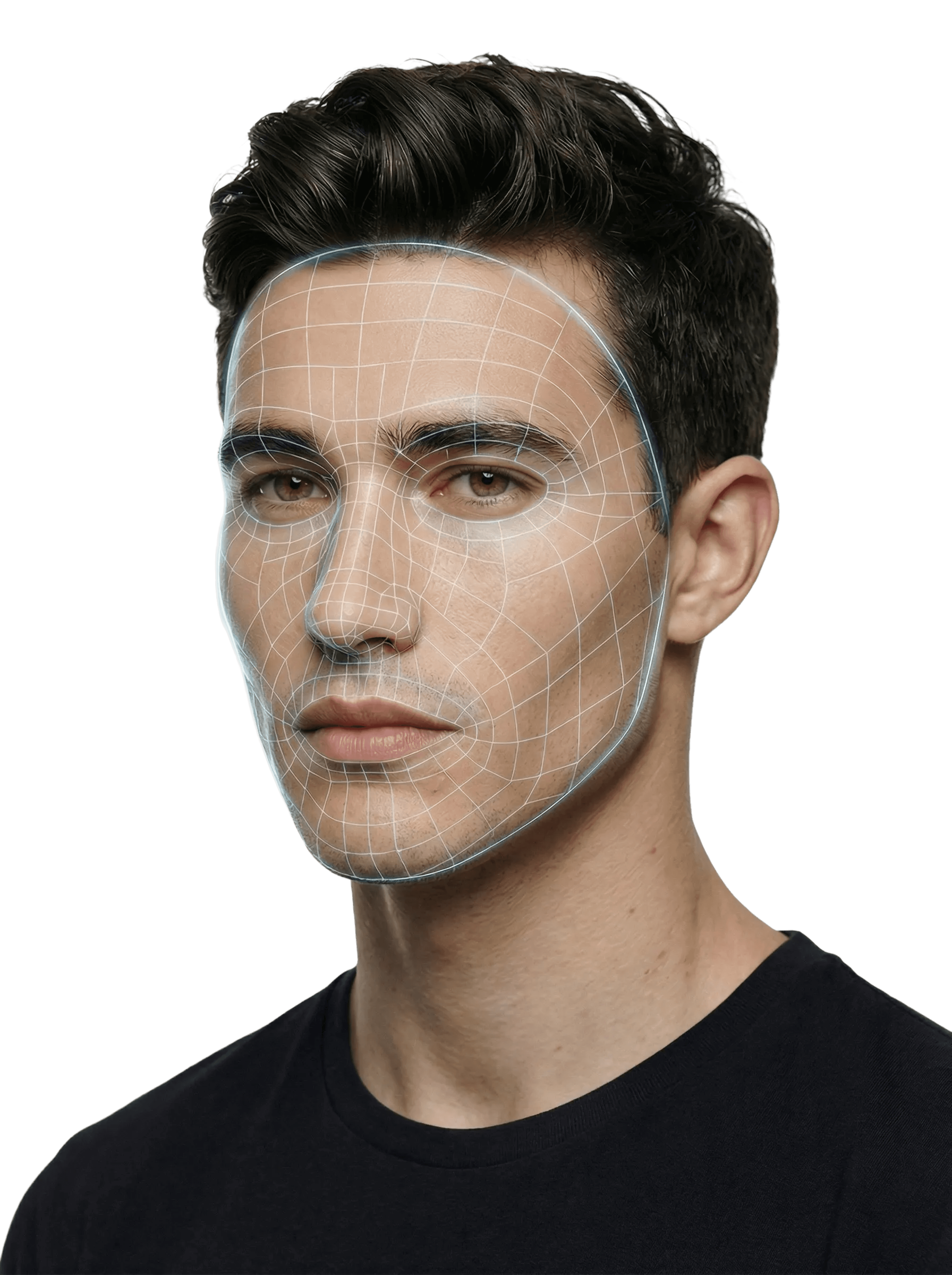
Roman Nose (Aquiline Nose): What It Looks Like and How to Tell If You Have One
A Roman nose is a nose with a convex profile: the bridge curves outward or has a visible bump, and the tip often points slightly down. It is also called an aquiline nose, from the Latin word for "eagle-like." It is one of the easiest shapes in our guide to nose types to spot from the side, and one of the easiest to confuse with a Greek or hawk nose.
Shape is only part of how a nose fits a face. Size, length and the angle of the tip matter just as much, and the Maxxing attractiveness test looks at your face as a whole, nose included.
What Is a Roman Nose?
A Roman nose is a nose whose bridge is convex when seen from the side: it arches outward instead of running in a straight line, often with a small bump partway down. Dictionary.com defines it as a nose with a prominent bridge, and Oxford Learner's Dictionaries as a nose that curves out at the top.
Roman Nose Shape: Key Signs
Convex profile: the bridge bows outward rather than running straight or dipping in.
A possible bump: some Roman noses have a visible hump on the bridge, called a dorsal hump.
A prominent bridge: the upper part of the nose stands out in profile.
A tip that often points down: this varies from person to person.
Size is not part of the definition. A Roman nose can be short or long, narrow or wide.
Where the name comes from
"Aquiline" comes from the Latin aquilinus, meaning eagle-like, a comparison to the curved beak of an eagle (Wikipedia). "Roman" is a cultural label rather than an anatomical one: ancient Roman portraits often show a prominent, hooked nose.
The old idea that a nose reveals character comes from physiognomy, a pseudoscience. Nose shape says nothing about personality. In clinical papers, the same feature is usually described as a convex dorsum or dorsal hump.
Roman Nose vs Aquiline Nose vs Hawk Nose
Roman nose and aquiline nose usually mean the same thing: a nose with a convex bridge. Some people reserve "Roman" for a nose with a distinct bump, "aquiline" for a smooth, longer curve and "hawk nose" for a sharper, thinner version, but no formal standard exists. If you need to be precise, describe the profile instead of the label.
Term | How it is often used | What to look for |
|---|---|---|
Roman nose | Convex bridge, often with a visible bump | An angular bend or hump |
Aquiline nose | Same family; sometimes a longer, smoother curve | A flowing arc from top to tip |
Hawk nose | A sharper version | A thinner bridge and a pointed tip |
The table shows how these words are often used on beauty and surgery sites, not an official classification. Treat the finer distinctions as rough guides.
Practical rule: when you talk to a makeup artist or a surgeon, say "convex bridge" or "dorsal hump" and show a side photo. The label alone can mean different things to different people.
Roman Nose vs Greek Nose: How to Tell the Difference
The difference is the bridge line in profile. A Greek nose runs straight from the forehead to the tip with no bump, while a Roman nose arches outward or has a hump. You can only tell them apart from a true side view, because a front photo hides the bridge line.

Greek nose | Roman nose | |
|---|---|---|
Bridge line in profile | Straight | Convex, arching outward |
Bump on the bridge | None | Often present |
Best view for checking | Side | Side |
Common mix-up | Straight nose | Aquiline nose |
Greek and Roman are art-history labels for these profiles, not medical diagnoses, and both are normal variation. Researchers who measure noses sort profiles the same way: straight, convex and concave. The concave one is the upturned shape. You can compare all of them in our guide to other nose profiles and shapes.
What Does a Roman Nose Look Like?
From the side, a Roman nose has a bridge that bows outward, sometimes with a bump and a tip that angles slightly down. From the front it is harder to spot, because the curve is hidden head-on and the bridge may simply look prominent.

Side view
The bridge arches outward instead of running straight.
A bump may show partway down the bridge.
The tip may angle down, but not always.
Front view
The bridge can look higher or more defined than on a straight nose.
A front photo alone cannot confirm the shape, so use a side view.
Roman Nose Celebrities: Commonly Cited Examples
Meryl Streep and Gisele Bündchen are often given as examples of a Roman or aquiline nose in beauty media such as NewBeauty. These are examples of how the shape is described, not a verdict on anyone's face.
How to Tell If You Have a Roman Nose
You likely have a Roman nose if, in a straight side photo, the line along your bridge curves outward or has a bump instead of running straight or dipping in. Check it in a true side view, because a front photo or a close-up selfie can mislead.
Stand in even light and look straight ahead with a relaxed face.
Take a side photo at eye level from about 5 feet (1.5 m) away, using a timer or a friend. Close-up selfies distort the nose: from arm's length the base can look about 30% wider.
Trace the bridge from the point between your eyes down to the tip.
If the line bows outward or has a bump, it is Roman or aquiline. If it runs straight, it is Greek. If it dips in, it is concave.
If the curve is slight, treat it as a mild version. Noses sit on a spectrum, not in boxes.

A photo check only shows the profile, not how the nose fits the rest of your face. A facial feature analyzer looks at the nose together with other features, and an AI face analysis gives you a model's estimate of each one. Treat that estimate as a second opinion, not a diagnosis.
Roman Nose on Women and Men
A Roman nose on a woman or a man is the same shape, and how it reads depends on the rest of the face. The same bridge line looks different next to a different forehead, jawline or tip angle.
Balance matters more than the label. The nose sits in the middle of the face, so its length and projection are judged against the other thirds. See how facial thirds are measured.
Attractiveness is subjective. Tastes vary with the viewer's age, gender and background, and there is no ranking of nose shapes.
No shape is a flaw by default. Whether to change a nose is a personal decision, and it is covered in the section below.
Where a Roman Nose Comes From
Facial features are highly heritable, but there is no single "Roman nose gene." Nose shape is influenced by many genes, and a bump on the bridge can also come from an injury or appear with age.
Many genes, small effects. A large study of about 6,000 people in Latin America linked four genes to nose traits such as bridge width, nostril width and the angle of the tip. Each gene variant explains only about 1% of the variation in the trait.
Not a Roman nose study. The researchers scored nose profile too but did not find a gene for it, so the study cannot say which genes produce a Roman nose.
Injury and age. A review of dorsal augmentation rhinoplasty notes that a dorsal hump can be caused by genetics, trauma or the aging process.
Can You Change a Roman Nose?
Makeup can change how a Roman nose looks in photos. Changing its structure means changing bone and cartilage, which is a surgical question, and home methods are not a reliable way to reshape it. Whether to change it at all is a personal choice, not a necessity.
Makeup: contouring shades the sides of the bridge to make a nose look slimmer or straighter (MasterClass guide). The effect depends on light and camera angle.
Surgery: reducing a dorsal hump is a frequently performed step in cosmetic rhinoplasty, according to a review of hump reduction techniques. It is a surgical procedure with risks and a recovery period, and results depend on your anatomy.
If you are considering a procedure, see a board-certified plastic or facial plastic surgeon for an in-person assessment. This guide does not give personal medical advice.
FAQ
Why is it called a Roman nose?
The name refers to the prominent, hooked profile often seen in portraits and busts of ancient Romans. "Aquiline," the other name, comes from the Latin word for eagle-like.
Is a Roman nose the same as an aquiline nose?
Usually yes. Both describe a convex bridge, though some people use "aquiline" for a smoother, longer curve and "Roman" for a nose with a distinct bump.
Is a Roman nose attractive?
That is a matter of taste. Perception depends on the whole face, and preferences differ between people and over time.
Is a Roman nose linked to a particular ethnicity?
No. Nose shape varies a lot inside every group. Averages for some traits, such as nostril width, differ between populations, but that says little about any one person, and you cannot read someone's origin from their nose.
Does a Roman nose affect breathing?
Not necessarily. According to a review of dorsal augmentation rhinoplasty, a dorsal hump causes no functional problems for some people, while for others it can make breathing harder. If you have trouble breathing through your nose, see a doctor.
Can makeup hide a Roman nose?
Contouring can soften the look of the bridge in photos, but it does not change the shape. See the section on changing a Roman nose above.