
Facial Harmony Test: How to Analyze Your Face Balance
A facial harmony test checks how well your features work together as a whole: their proportions, symmetry, and balance, rather than how good any single feature looks. You can run one by hand on a front-facing photo (thirds, fifths, symmetry) or let an AI facial feature analysis measure it for you. Either way the result is an estimate, because there is no single scientific standard for “good” facial harmony.
What Facial Harmony Analysis Measures
Facial harmony analysis checks how your features relate to each other: how big each one is, where it sits, and whether the face reads as balanced overall. It looks at proportions and symmetry across the eyes, nose, lips, jaw, and forehead. It's a measure of the whole face, not a score for any one feature.
In practice, tests and calculators check four things:
Vertical thirds — the face split into three parts: hairline to brows, brows to the base of the nose, and the base of the nose to the chin.
Horizontal fifths — the face width split into five parts, based on the classic rule that each eye and the gap between the eyes are about one eye width.
Symmetry — how closely the left and right sides match. Some asymmetry is normal in almost every face.
Feature balance — eye spacing, nose width, lip fullness, and jaw and chin size relative to the rest of the face.
These are reference points, not rules a face has to pass. Harmony is also only one part of how a face gets judged. For the wider picture, see our attractiveness test.
What's your facial proportions score?
Upload one front-facing photo and get an estimated score in seconds.
For a better estimate
- Look straight at the camera
- Relaxed face, mouth closed
- Even light, no wide-angle selfie
- Hair off the face
Your photo is processed in your browser. This tool doesn't upload or save it.
 Example of a good photo
Facial Harmony vs Symmetry vs the Golden Ratio
Symmetry checks whether the left and right sides of your face match. The golden ratio compares specific measurements to the number 1.618. Facial harmony is the broader idea: how all your features fit together. Symmetry and golden ratio results can feed into a harmony test, but neither one is the same thing.

Facial harmony | Face symmetry | Golden ratio | |
|---|---|---|---|
Question it asks | Do my features fit together? | Do the left and right sides match? | Do my measurements match 1.618? |
What it looks at | Proportions, symmetry, feature balance | Left vs right, along a midline | Ratios like face length to width |
Typical result | A report or a score, different in every tool | A percentage or score | A score against the 1.618 target |
Agreed standard | None | None. Some asymmetry is normal | A popular benchmark that calculators use |
Each topic has its own page: how symmetry is scored in our face symmetry test, and how the ratio is applied in the guide to golden ratio and facial proportions.
What a facial harmony score means
Many online tests and facial harmony score calculators turn all of this into one number. That number is an estimate from the tool's model, based on the photo you uploaded.
What a harmony score can tell you:
How close the measurements in that photo are to the reference ratios the tool uses
Which areas of the face the tool flags as more or less balanced
What it can't tell you:
How attractive you are, or whether your face is “good” or “bad”
How you look in person, since angle, lens, and expression all change the measurements
How your score compares to another tool's, because each tool picks its own measurements and targets
Facial Harmony Calculator: How to Measure Facial Harmony Yourself
A facial harmony calculator compares measurements from a front-facing photo: three vertical sections of the face, face width against eye width, and left against right. You can do the same by hand with a photo editor or a screenshot markup tool. The result is a rough guide, not a verdict.
Most online calculators, including the ones shared in looksmax communities, work the same way. They just place the landmarks automatically.
How to Calculate Facial Harmony Step by Step
Take a straight-on photo. Put the camera at eye level, look straight into it, keep a neutral expression, and pull hair off your forehead and brows. Use even light with no strong shadows.
Shoot from a distance. Hold the phone at arm's length or farther and zoom in, or have someone shoot from a few feet away. In a model-based study, a photo taken from about 12 inches made the nose look roughly 30% wider relative to the cheekbones than at 5 feet, where the effect was negligible (Ward et al., JAMA Facial Plastic Surgery, 2018).
Draw a vertical midline. Run it from between the eyes down through the center of the chin.
Measure the three vertical sections. Mark four horizontal lines: hairline, brow line, base of the nose, and chin. Then compare the three sections. The classic canon says they should be roughly equal. In a study of 168 young adults from the Arabian Peninsula, they weren't in either sex, and the middle third was usually the smallest (Al-Sebaei, Head & Face Medicine, 2015).
Measure the fifths. Compare the width of one eye with the gap between the eyes. The classic rule of fifths splits the face width into five equal parts, with the gap between the eyes equal to one eye width. In the same study, the gap matched the eye width in about 29% of men and 25% of women.
Compare left and right. Measure from the midline to the outer corner of each eye, the corner of each side of the mouth, and each jaw angle. Small differences are normal.
Read the numbers as a range. Nobody lands exactly on every guideline. Take a second photo and repeat. If the numbers move, that's the photo, not your face.

Mistakes That Skew the Result
A tilted or turned head. Even a small tilt shifts the left–right comparison.
A smile or raised brows. Both change the brow line and the base of the nose.
A close-up selfie. The shorter the distance, the more the center of the face is exaggerated.
A hidden or unclear hairline. The top third depends on where you mark it, and for many people that edge is not clear. Mark it the same way every time.
Facial Harmony Test Online: What an AI Analyzer Can and Can't Tell You
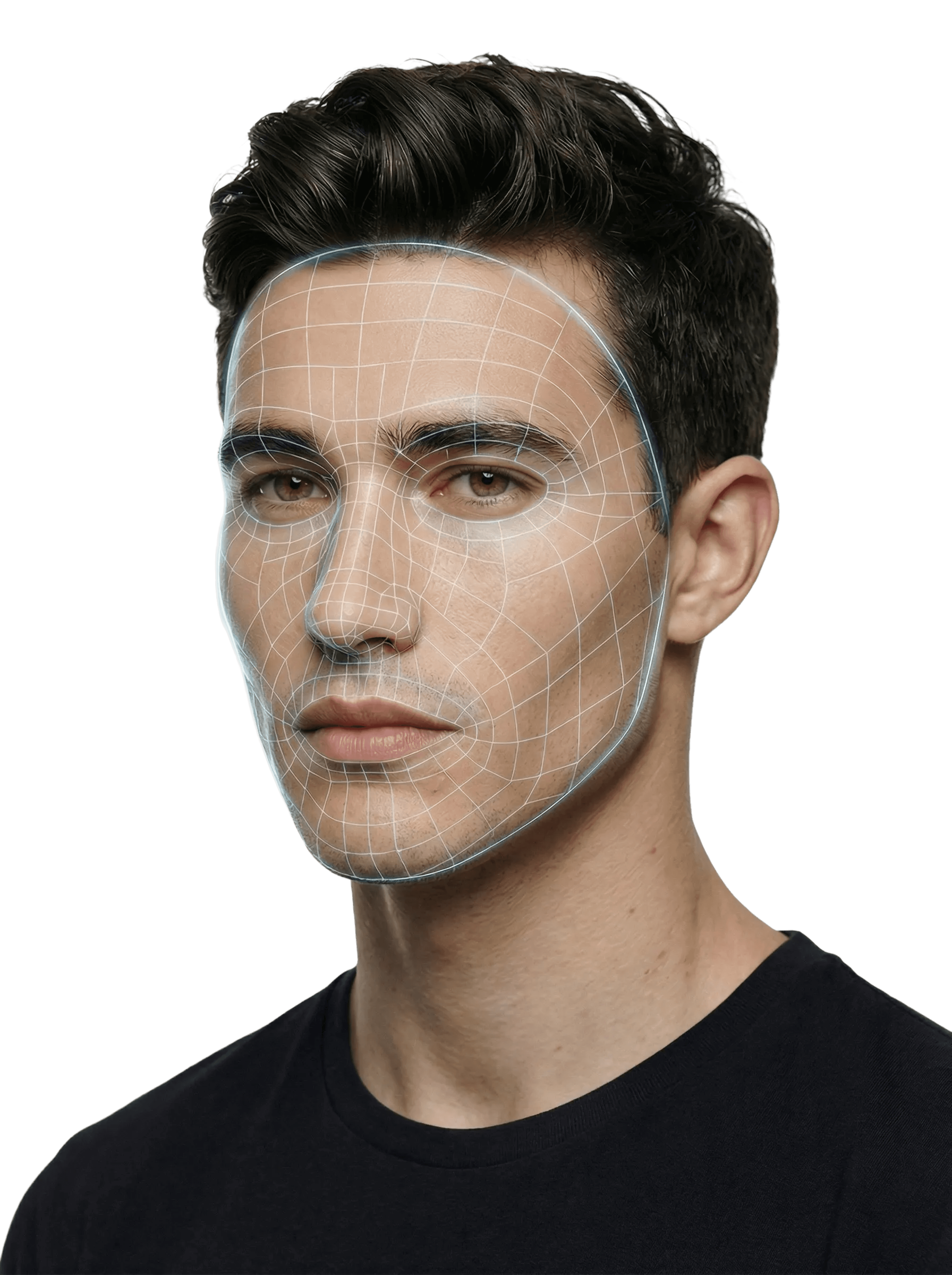
A facial harmony test online, also called a face harmony test or a facial harmony AI test, uses AI to find landmarks on your photo, such as the eyes, nose, lips, and jawline, then measures the distances and angles between them. It returns a score or a report. That output is the model's estimate from one photo, not a fact about your face.
Tools go by many names: facial harmony analyzer, facial harmony checker, facial harmony detector, facial harmony scanner, facial harmony quiz. Most of them work the same way. They find landmarks, take measurements, and compare them to reference proportions.
How the Maxxing Scan Works
If you want a facial harmony test free to take, Maxxing's free face scan runs in three steps:
Choose your gender and enter your age.
Upload two selfies: one front-facing and one from the side.
Get your report.
The report doesn't give a single “harmony score”. It gives you a Face Symmetry score out of 100, scores for individual features (jawline, cheekbones, nose, lips, chin, and more), and a written explanation for each. Like any AI result, these are estimates from a model, not objective truth.
What an AI Analyzer Can't Tell You
Whether it placed the landmarks correctly. Hair, glasses, a beard, or heavy shadows can throw off the points it measures from.
What your face looks like without filters. Beauty modes change proportions before the tool measures anything, so turn them off.
How you look in person. It sees one still photo, not your face in motion or from every angle.
Why it gave you that number. A bare score without an explanation of what was measured tells you very little.
Do I Have Good Facial Harmony?
Do I have facial harmony? Every face has some balance between its features, and there is no pass mark that a good facial harmony test could check against. What varies is how closely your measurements follow the common guidelines, and no research sets a cutoff for “good” or “bad”. Near the guidelines reads as balanced. Far from them is normal variation, not a flaw.
How to Read Your Results
Look at the pattern, not one number. A single score hides which area differs.
Find the feature that differs most. That is the only part of the result worth a second look.
Repeat with a second photo. If the result changes, the photo caused it.
Skip the pass/fail framing. Nobody matches every guideline.
What the Research Says
Studies on facial attractiveness find that symmetry and averageness do matter, but the effects are small. In a 2009 study, 114 people rated 96 faces. Averageness raised ratings for both male and female faces, while symmetry raised ratings only for male faces (Acta Psychologica, 2009). A 2015 study found that less asymmetry went with higher attractiveness ratings, but its sample was young, White, Western university women, so the results may not apply to everyone (PLoS ONE, 2015).
Classic proportion rules don't describe most faces well either. A 2019 study of 32 Miss Universe and Miss Universe Thailand winners found that 12 of the 16 golden ratios tested differed significantly from the ideal value in both groups, and 6 of the 7 neoclassical canons did too (Burusapat and Lekdaeng, Plastic and Reconstructive Surgery Global Open, 2019). The photos came from the internet, so lens and angle varied.
“Good Features, Bad Harmony”
You'll see this phrase on TikTok and Reddit, usually as a way to explain why a face with “good” individual features still looks off. We found no scientific definition of it or a way to measure it. Treat it as an opinion, not a diagnosis.
Facial Harmony vs Facial Harmonization
Facial harmony describes how your features fit together. Facial harmonization, also called facial balancing, is a different term: it refers to cosmetic procedures, including injectables, that correct age-related changes and adjust congenital features to improve the balance of the face (Sundaram et al., Plastic and Reconstructive Surgery, 2016). The American Society of Plastic Surgeons says the term is used loosely and the approach is subjective (ASPS, 2025). A harmony test describes a photo and can't tell you that you need any treatment. Any decision about a procedure belongs with a board-certified specialist.
FAQ
Is a 70% facial harmony score good?
There is no standard facial harmony rating scale, so 70% doesn't mean the same thing in every tool. A score only compares your photo to that tool's own reference measurements. Use it to see which areas the tool flags, not as a grade.
What is the average facial harmony score?
Tools use different methods, so no single average applies to all of them. Compare results only within the same tool.
Is there a free way to check my face harmony?
Yes. You can take a facial harmony test online free with Maxxing's face scan, or use the steps above as a manual face harmony calculator.
How to know if you have good facial harmony?
Look for broadly even thirds and similar left and right sides, with no single feature far out of line with the rest. Few people match every classic guideline.
Is facial harmony the same as symmetry?
No. Symmetry compares the left and right sides of the face. Facial harmony covers the whole face, including proportions and how the features balance.
How accurate is a facial harmony test?
It measures the photo you give it well enough, and little else. Angle, lighting, expression, and filters all change the result, so treat it as an estimate.
Should I ask people online to rate my facial harmony?
Opinions in a forum thread aren't measurements. Each person judges by their own taste and by whatever angle your photo shows. The steps above and a scan give you numbers you can repeat.
Can facial harmony be improved?
Hair, brows, and grooming change how a face reads in photos. Changing facial structure is a medical decision for a board-certified specialist.