



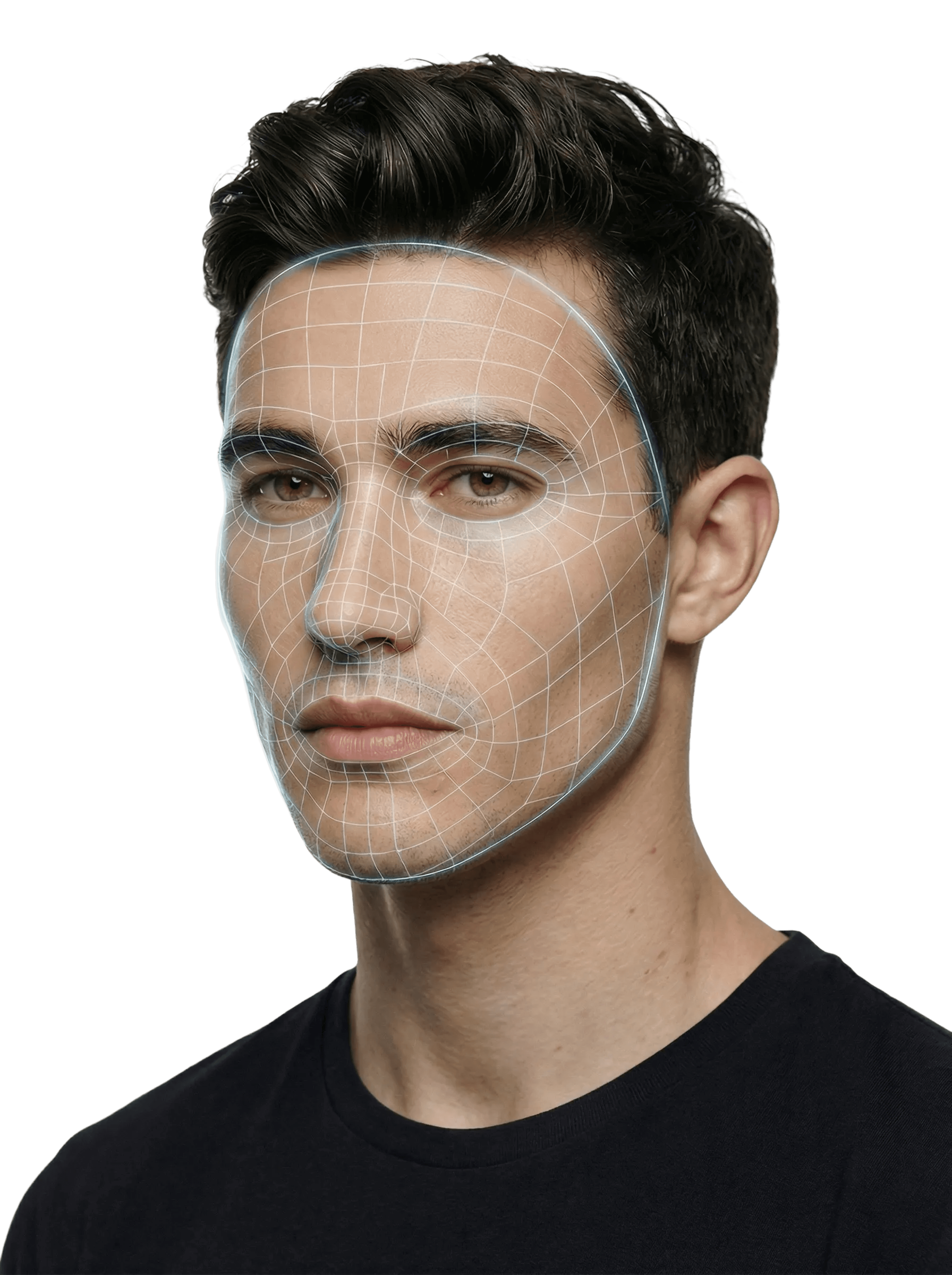
Face Shape Calculator: How to Measure Your Face Shape
A face shape calculator turns four tape-measure numbers into one of seven face shapes. You enter forehead width, cheekbone width, jaw width, and face length, and the calculator compares the other three numbers with your cheekbone width. The result is oval, round, square, rectangle, heart, diamond, or triangle. Use the calculator below with a mirror and a soft tape measure, or take a face shape test from a photo if you'd rather not measure by hand.
Every facial shape calculator works on rules of thumb, not medical categories, and different calculators draw the lines in different places. Treat your result as a starting point, not a verdict.
Face Shape Calculator Online
This face shape calculator online takes four measurements — forehead width, cheekbone width, jaw width, and face length — and compares their ratios against a set of rules. It returns the closest of seven shapes, plus a second match when your numbers fall near a boundary. Not sure where to place the tape? The steps are in the next section.
Use the same unit for all four numbers, in centimeters or inches. The calculator only needs the ratios between them, so the unit doesn't change the result.
The result is a rule of thumb. If two of your widths are almost equal, your face can sit between two shapes, which is why you may see a second match. A face shape calculator with measurements can't see jaw angle or bone structure the way a person can, so use the result as a starting point.
Face shape describes proportions, nothing more. For a broader read on your face, you can also take an attractiveness test.
How to Measure Your Face Shape
To measure your face shape, take four straight-line measurements with a soft tape measure or a small ruler: forehead width, cheekbone width, jaw width, and face length. Stand in front of a mirror with your hair pulled back and your face relaxed. These are the face measurements for face shape that the calculator above needs, and this is how to measure your face for it.
Forehead width. Measure across the forehead at its widest point, about halfway between your eyebrows and your hairline.
Cheekbone width. Measure straight across the widest point of your cheekbones, in front of your ears.
Jaw width. Measure from the tip of your chin to the corner of your jaw, just below your earlobe, then double it. This gives an estimate of the width across your jaw.
Face length. Measure from the center of your hairline to the tip of your chin. Keep the tape straight instead of letting it follow the curve of your forehead.

Write each number down and measure twice. If the two readings differ, use the average.
What Is My Face Width?
Your face width is your cheekbone measurement: the widest point straight across your face. To measure face width, follow step 2 above. In a sample of 6,068 U.S. Army personnel, average cheekbone width measured with calipers was about 143 mm (5.6 in) for men and 134 mm (5.3 in) for women, according to a 2022 study in Biology Letters. A tape measure over the skin can read differently from calipers, so don't expect to match those numbers exactly.
Common Measuring Mistakes
Hair covering the hairline or jawline. Pull it back.
Head tilted up or down. Keep your chin level and look straight ahead.
Tape sinking into the skin or following a curve. Hold it straight.
Smiling or clenching your jaw, which changes your cheeks and jawline.
Taking each measurement only once.
Face Shape Measurements Chart
The chart below turns your face measurements into a face shape, so you can find your face shape by measurements without the calculator. Widths are shown as a percentage of your cheekbone width (100%), and face length is compared to that same width. The rules are checked from top to bottom, and the first match is your shape.

Order | Face shape | Forehead width | Jaw width | Face length |
|---|---|---|---|---|
1 | Triangle | At least 10 points narrower than the jaw | 100% or more | Not used |
2 | Heart | 97% or more | At least 12 points narrower than the forehead | Not used |
3 | Diamond | 85% or less | 85% or less | Not used |
4 | Rectangle | Not used | 92% or more | 135% or more |
5 | Square | Not used | 92% or more | Under 135% |
6 | Oval | Not used | Under 92% | 125% or more |
7 | Round | Not used | Under 92% | Under 125% |
Example. Cheekbones 13.0 cm, forehead 11.5 cm, jaw 11.0 cm, face length 18.5 cm. That makes the forehead 88%, the jaw 85%, and the length 142% of cheekbone width. Rules 1 to 3 don't match, the jaw is under 92% and the length is over 125%, so rule 6 applies: oval. The forehead is within 3 points of the Diamond cutoff, so the calculator would also show Diamond as a second match.

These cutoffs are this calculator's own working rules, not a published medical classification.
Which Points Does a Face Shape Calculator Measure?
Two calculators can return different shapes for the same face because they measure different points and set their own cutoffs. Even research papers define face height in different ways, so the numbers you enter are only as comparable as the points they come from.
A 2026 Cureus study measured face height from the nasion (the root of the nose) to the gnathion (the bottom of the chin).
A 2023 study in Aesthetic Surgery Journal Open Forum measured it from the trichion (the hairline) to the menton (also the bottom of the chin), using photos.
A hairline-based length and a nose-bridge-based length are very different numbers, and hairlines vary a lot from person to person.
Anthropometry, the science of body measurements, also has its own length-to-width scale: the facial index. It divides face height by cheekbone width and multiplies by 100. The 2026 Cureus study sorted 200 medical students into five types by this index, from very broad (below 79.9) to very long (above 95.0). That scale only compares length to width, and it measures from the nose bridge, not the hairline. So it can't tell an oval face from a heart-shaped one. Its middle type is even labeled "round face" in the study, which isn't the same thing as the round face shape.
If two calculators disagree about you, check which points each one measures. Results that sit within a few points of a cutoff, like the forehead in the example above, are the ones that flip. For how the face is divided more broadly, see facial proportions and thirds.
Face Shape Calculator From Photo vs Manual Measurements
A face shape calculator from a photo estimates your shape from facial landmarks in a selfie, while a manual calculator uses numbers you measure yourself. A photo is faster. Manual measurements for face shape let you choose the exact points.
Manual measurements | Photo | |
|---|---|---|
Speed | Slower | Faster |
What can skew the result | Tape position, where you place the hairline | Camera angle, distance, head tilt, hair |
Who picks the points | You | The tool |
What you need | A soft tape measure and a mirror | One front-facing photo |
Where the hairline goes | You choose, so a receding hairline or bangs are your call | The tool estimates it from the image |
Best for | Checking your own numbers and seeing why you got a shape | A quick first answer |
If the two methods give different shapes, your face likely sits near the boundary between them. For the photo method, see our photo-based face shape detector guide.
Face Shape Calculator FAQ
How do you measure your face shape?
Take four straight-line measurements: forehead width, cheekbone width, jaw width (chin to jaw corner, doubled), and face length (hairline to chin). Enter them in the calculator or compare the ratios in the chart.
Is there a face shape calculator for women or men?
Yes, and it's the same one. You don't need a separate face shape calculator female or male: the calculator compares ratios within your own face, so the same rules apply to both. Average face sizes differ between sexes, but the ratios decide the shape.
Can I use inches instead of centimeters?
Yes. Use the same unit for all four measurements and the result stays the same.
Is there a face measurement app or tool?
Yes. The calculator on this page is a face measurement tool you can use in a browser. Face measurement apps usually work one of two ways: you type in measurements, or the app estimates them from a selfie. Selfie results depend on camera angle, distance, and lighting.
How accurate is a face shape calculator?
It's a rule of thumb. A calculator compares your ratios to cutoffs, so results near a boundary can switch between two shapes. Measure twice and keep the tape straight to reduce errors.
How do I measure my face shape at home?
You need a soft tape measure or a ruler, a mirror, and about five minutes. Pull your hair back, keep your chin level, and measure forehead width, cheekbone width, jaw width, and face length. Then enter the four numbers in the calculator or compare the ratios with the chart.
Which face shapes does the calculator show?
The face shapes calculator returns one of seven shapes: oval, round, square, rectangle, heart, diamond, or triangle. When your numbers sit close to a cutoff, it also shows a second match.