

What Is My Face Shape? A Men's Guide to Finding Your Face Type
To find your face shape as a man, compare three things: your face length, the widest part of your face, and the outline of your jaw. These clues help you narrow down seven common face shapes: oval, round, square, oblong, heart, diamond, and triangle.
You don’t need an app to get started. A mirror and a clear front-facing photo are enough for a first check. You can also try our face shape test for a guided comparison.
Want to know more than just your face shape? Try our attractiveness test to see how AI evaluates different facial features and what the results actually mean.
How to Find Your Face Shape as a Man
Compare your face’s overall length, find where it is widest, and examine your natural jaw contour. Pull your hair away from your forehead, relax your expression, and look straight ahead. Judge your face rather than the outline created by your haircut or beard.
Step 1 — Compare Your Face Length and Width
Compare the distance from your hairline to your chin with the width across your cheekbones.
About as long as it is wide: Round or square may be a match.
Moderately longer than it is wide: Check oval.
Noticeably longer than it is wide: Check oblong.
Length alone cannot identify every shape. Heart, diamond, and triangle faces can have different length-to-width proportions too.
Step 2 — Find the Widest Part of Your Face
Compare your forehead, cheekbones, and natural jaw width.
Forehead widest: Check heart, especially with a narrow chin.
Cheekbones widest: Check diamond, oval, or round.
Jaw widest: Check triangle.
All three roughly equal: Check square or oblong.
Do not count extra width from your hairstyle or beard.
Step 3 — Check Your Jawline and Chin
The jaw helps distinguish shapes with similar proportions.
Broad and angular: Often square.
Soft and rounded: Often round or oval.
Narrow and tapered: Check heart or diamond.
Wider than the forehead: Check triangle.
Straight sides on a long face: Check oblong.
A sharp jawline does not automatically make your face square. Jaw definition and overall face shape are different characteristics.
Quick Face Shape Check for Men
Your facial proportions | Likely face shape |
|---|---|
Longer than wide, gently tapered jaw | Oval |
Similar length and width, rounded outline | Round |
Broad angular jaw, similar forehead and jaw widths | Square |
Clearly longer than wide, relatively straight sides | Oblong |
Wide forehead, narrower chin | Heart |
Cheekbones widest, narrow forehead and jaw | Diamond |
Jaw wider than forehead | Triangle |
This is a visual starting point, not a precise measurement. If two descriptions match, compare them below.
The 7 male face shapes: which one matches yours?
These seven categories describe differences in facial length, width, and contour. They are broad visual descriptions, not strict anatomical diagnoses.

1. Oval Face Shape
An oval face is longer than it is wide, with a gently rounded jaw and a forehead that is usually slightly wider than the lower face.
Key clue: Moderately elongated, without a particularly broad jaw or pointed chin.
2. Round Face Shape
A round face has relatively similar length and width, softly curved sides, and a rounded jaw.
Key clue: Relatively short and wide, without strong jaw corners.
3. Square Face Shape
A square face has a broad, angular jaw. Forehead, cheekbone, and jaw widths are relatively similar.
Key clue: A jaw nearly as wide as the cheekbones, with visible corners.
4. Oblong Face Shape
An oblong face is noticeably longer than it is wide. Its sides are often relatively straight.
Key clue: A long, rectangular-looking outline rather than a soft oval taper.
5. Heart Face Shape
A heart-shaped face is broadest around the forehead and temples, narrowing toward the chin.
Key clue: An upper face that is wider than the lower face.
6. Diamond Face Shape
A diamond face is widest at the cheekbones, with a narrower forehead and jaw.
Key clue: Cheekbones extending farther outward than the temples and jaw.
7. Triangle Face Shape
A triangle face has a jaw that is wider than the forehead, giving the lower face a broader appearance.
Key clue: A face that becomes wider toward the jaw.
Male Face Shapes That Are Easy to Confuse
Some male face shapes share similar proportions. Focus on the feature that separates them rather than how sharp or attractive a feature looks.
Square vs. Round Face
Both can be relatively short and wide. Square faces have broader jaw corners and straighter sides; round faces have softer curves.
How to tell: Look at the underlying jaw corners, not just how defined the jawline appears.
Oval vs. Oblong Face
Both are longer than they are wide. Oval faces taper softly toward the chin; oblong faces are more elongated with straighter sides.
How to tell: Compare overall length, then check whether the sides narrow toward the chin.
Heart vs. Diamond Face
Both can have a narrow chin and prominent cheekbones. Heart faces are usually widest at the forehead; diamond faces are widest at the cheekbones.
How to tell: Compare temple width with cheekbone width. A widow’s peak alone does not determine face shape.
Square vs. Triangle Face
Both can have a broad jaw. A square face has similar forehead and jaw widths; a triangle face has a noticeably wider jaw.
How to tell: Compare natural forehead and jaw widths without including facial hair.
Why Your Face Shape May Be Hard to Identify
Facial hair, hairstyle, facial fullness, and camera perspective can change the visible outline of your face. These factors matter when identifying male face shapes because a beard can strongly influence the shape you perceive.
Beard and Facial Hair
A beard can make your lower face appear wider, longer, or more angular.

A squared-off beard can make an oval face appear more square.
A pointed beard can make a round face appear longer.
A full beard can hide the natural taper of a heart or diamond face.
You do not need to shave. Compare an older clean-shaven photo if you have one, or gently feel where your jaw angles sit beneath the beard. If the contour is hidden, treat your result as approximate.
Receding Hairline or Hair Covering Your Forehead
A fringe can hide your temples, while a high-volume hairstyle can make the face appear longer. A receding hairline complicates face-length measurements because the distance from the current hairline to the chin may be greater than before.
Move hair away from the forehead and focus on the width of your temples. If your hairline is difficult to identify, give more weight to forehead, cheekbone, and jaw widths. An M-shaped hairline or widow’s peak alone does not determine face shape.
Jawline Definition and Facial Fullness
A defined jawline is not the same as a square face. Definition describes how clearly the lower jaw’s edges appear; face shape describes the proportions of the entire facial outline. Fuller cheeks can soften jaw angles, while prominent cheekbones can create a tapered appearance.
See our guide to jawline shape and proportions for more on this distinction.
Camera Angle and Expression
A close selfie, tilted head, or exaggerated expression can make your face look different. In a 2018 study of selfie perspective , researchers modeled how a camera held 12 inches from the face makes the nose appear approximately 30% wider relative to the cheekbones in men. This does not mean the entire face shape changes by 30% — it illustrates how camera perspective alters visible proportions.
How to Determine Your Face Shape From a Photo (Men)
To determine your face shape from a photo, use a straight-on image that shows your forehead, cheekbones, jaw, and chin. Consistent camera position and a relaxed expression make comparisons easier.
Keep the camera at eye level.
Face the lens directly, without turning or tilting your head.
Move hair away from your forehead and temples.
Use even lighting and a neutral expression.
Avoid filters and extreme close-ups.
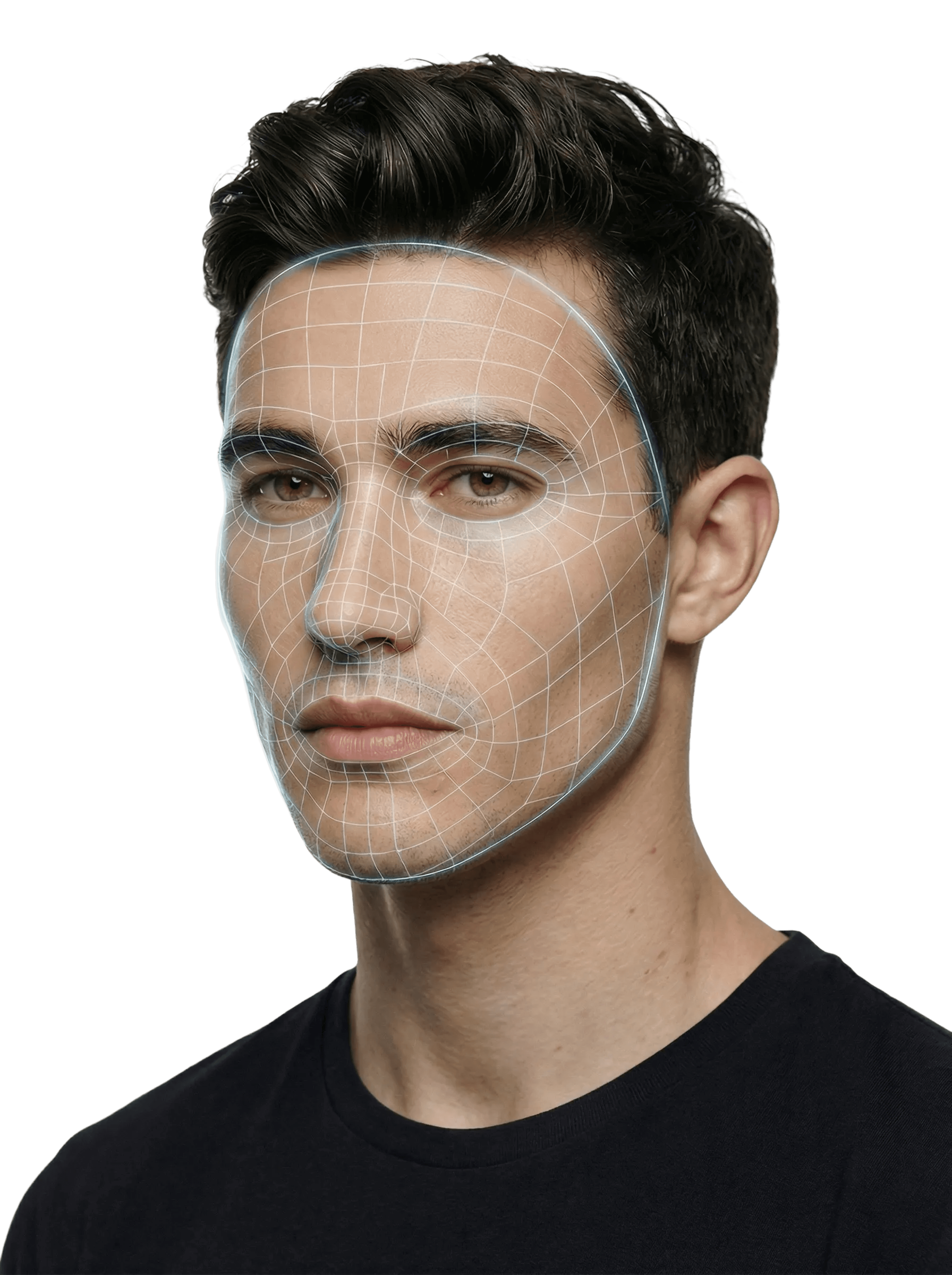
Compare the photo with the seven shapes above. Start with the widest part of your face, then check its length and jaw contour. Some AI face shape detectors estimate these proportions automatically, but different tools may classify the same face differently.
The Maxxing face scan evaluates features such as jawline, cheekbones, and symmetry; it does not currently provide a named face-shape classification.
What If You Match Two Face Shapes?
Matching two shapes does not necessarily mean you made a mistake. The categories overlap, and there is no universally accepted boundary between them.
Compare the defining difference: For oval versus oblong, focus on length; for heart versus diamond, compare forehead and cheekbone widths.
Check another photo: Use a straight-on image with similar lighting and a neutral expression.
Measure if necessary: Our face shape calculator for men compares four measurements and can return a second match near a classification boundary.
If both shapes still fit, use both as references when considering hairstyles or beard styles.
Why Face Shape Tests Can Disagree
Face-shape classification involves subjective judgments. A 2014 study by Towler, White, and Kemp reported low agreement when people assigned face-shape categories, including when the same person judged an image more than once. If one test calls your face oval and another calls it oblong, compare the actual proportions rather than assuming one result must be correct.
Does Face Shape Matter for Men’s Haircuts and Beards?
Face shape can help you choose a haircut or beard style by showing where your face naturally has more width or length. Styling changes the appearance of these proportions, not the underlying bone structure.
Face shape | Haircut ideas | Beard ideas |
|---|---|---|
Oval | Textured crop, side part, quiff, taper | Stubble, short boxed beard, or clean-shaven |
Round | Quiff, pompadour, textured top with shorter sides | Shorter sides, more length at the chin |
Square | Crew cut, Ivy League, side part, textured crop | Stubble or a rounded beard |
Oblong | Side-swept fringe, French crop, medium layers | Fuller cheeks, less length at the chin |
Heart | Medium layers, side-swept styles, textured fringe | Fuller growth around the chin |
Diamond | Textured fringe, side part, medium layers | Fuller beard styles around the jaw |
Triangle | Textured quiff, layered top, volume at temples | Short stubble without extra jaw width |
These are options, not restrictions. Hair texture, density, hairline, beard growth, and personal preference matter too.
FAQ
How Can I Identify My Face Shape as a Man?
Compare face length with width, find whether your forehead, cheekbones, or jaw is widest, and examine your chin and jaw contour. Match these features with the seven common face shapes. A clear, front-facing photo makes the comparison easier.
Can AI Tell Me My Face Shape?
Some AI face shape detectors analyze facial landmarks and estimate a category such as oval, square, or round. Results depend on the tool’s rules and photo quality. Treat them as estimates, not definitive answers.
Is There a Face Shape Calculator for Men?
Yes. A face shape calculator for men compares forehead width, cheekbone width, jaw measurements, and face length. The same broad proportional categories generally apply to men and women.
Is There a Male Face Shape Detector App?
Some apps estimate a male face shape from a photo. A face shape detector for men may struggle when a beard hides the jaw, hair covers the forehead, or the camera is too close. You can also check proportions manually without an app.
What Is the Most Attractive Face Shape for Men?
There is no single face shape that is universally considered the most attractive. Preferences vary, and overall appearance depends on more than whether your face is square, oval, or diamond.
Can a Beard Change My Face Shape?
A beard can change how your face looks, but not its underlying bone structure. A wide beard makes the jaw appear broader; extra length at the chin can make the face look longer.
Does Men’s Face Shape Change With Age?
Yes. The visible shape of the face can change as skin, facial fat, and underlying bone structure change over time. A review of facial aging research describes changes across these tissues, including gradual remodeling of the facial skeleton.
Can ChatGPT Tell Me My Face Shape From a Photo?
ChatGPT can help describe visible proportions in a photo, but a visual assessment is not a validated face-shape measurement. Use a clear frontal image and compare the forehead, cheekbone, and jaw widths.
What If My Face Shape Is Between Oval and Square?
You may have the moderate length and taper of an oval face combined with a relatively angular jaw. Compare jaw width with forehead and cheekbone widths, then consider both categories when choosing a hairstyle.