


What Head Shape Do I Have? How to Tell in 3 Steps
Wondering what head shape do I have? Start by checking three things: where your face is widest, how its length compares to its width, and whether your jawline is rounded, angular, or tapered. These clues can help you identify your closest match among seven common shapes.
Most online head shape tests actually classify face shape — the visible outline of your forehead, cheeks, jaw, and chin. They don't measure the entire skull, including the back of your head. For a more detailed comparison, try our face shape test, which includes a five-question mirror quiz.
Face shape is only one part of your overall appearance. An attractiveness test looks at how other facial features contribute to an AI-generated appearance estimate, rather than identifying your head shape.
How to Tell What Head Shape You Have in 3 Steps
You can get a reasonable idea of your head shape without an app or measuring tape. Stand in front of a mirror, pull your hair away from your forehead, and keep your head straight. Focus on your natural facial outline rather than your hairstyle.

Step 1: Find the Widest Part of Your Face
Look at your forehead, cheekbones, and jawline. Which area appears widest?
Forehead: A wider upper face that narrows toward the chin may suggest a heart shape.
Cheekbones: If your cheekbones are noticeably wider than both your forehead and jaw, diamond is a possibility.
Jawline: A jaw wider than the forehead may suggest a triangle (pear) shape.
Similar widths: If all three areas look roughly equal, your face may be square, oblong, or oval, depending on its length and jawline.
Don't judge width from your hairstyle. Hair volume around the temples can make your forehead appear wider than it is.
Step 2: Compare Your Face Length and Width
Next, compare the distance from your hairline to your chin with the width across your cheekbones. If your hairline is hidden by bangs or difficult to see, pull your hair back or use a mirror rather than estimating from the photo.
About the same length and width: Often associated with round or square faces.
Moderately longer than wide: Common in oval faces.
Noticeably longer than wide: May indicate an oblong or rectangular face.
You don't need an exact ratio for this first check. If the difference is hard to judge, use a mirror and measuring tape instead of guessing from a close-up selfie.
For a more detailed approach, see how to measure facial proportions. Facial thirds describe vertical balance, however, and don't independently determine face shape.
Step 3: Check Your Jawline and Chin
Finally, look at the outline of your lower face.
Soft, curved jawline: More common in round and oval shapes.
Broad, angular jaw: Often associated with square or rectangular shapes.
Narrow or pointed chin: May indicate heart or diamond.
Jaw wider than the forehead: A defining feature of triangle (pear) shapes.
Now combine all three observations. For example, a face that's longer than it is wide, with balanced forehead and jaw widths and a softly rounded chin, may be oval. A face with similar width and length but a broad, angular jaw may be square.
These categories are visual guidelines, not precise anatomical classifications. If your features fall between two shapes, both can be useful matches.
Which of the 7 Head Shapes Matches Yours?
The seven commonly used shapes are oval, round, square, heart, diamond, oblong, and triangle. To find your closest match, combine your observations about face length, width, and jawline. You don't need to match every feature perfectly.

Your observations | Closest head shape |
|---|---|
Longer than wide, balanced forehead and jaw, softly rounded chin | Oval |
Similar length and width, full-looking cheeks, rounded jaw | Round |
Similar length and width, broad forehead, angular jaw | Square |
Wider forehead tapering toward a narrower, sometimes pointed chin | Heart |
Widest at the cheekbones, narrower forehead and jaw | Diamond |
Noticeably longer than wide, relatively straight sides and similar widths | Oblong (rectangular) |
Jaw wider than forehead, with more width in the lower face | Triangle (pear) |
What if two shapes match? That's normal. A face can have an oval-like length and a square-like jaw, for example. Use the closest match as your primary reference and the second as a secondary description. The labels are styling conventions, not strict biological categories.
Can a Head Shape Scanner or Detector Tell You Your Shape?
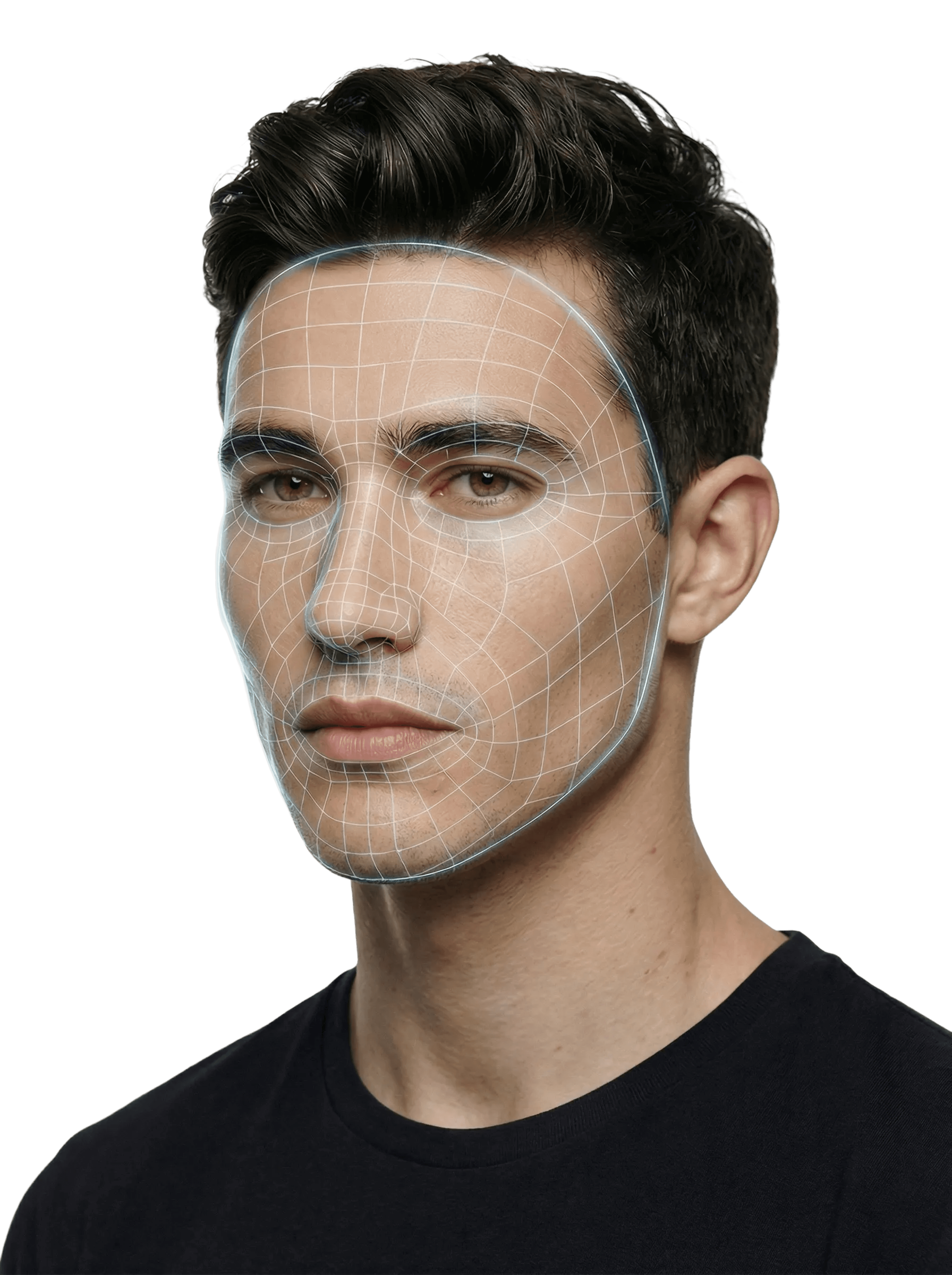
A head shape scanner or head shape detector can estimate your face shape from a front-facing photo. Many tools identify facial landmarks, compare the relative widths of your forehead, cheekbones, and jaw, and assign the closest shape category. However, a single frontal photo cannot show the full shape of your skull.
Different detectors may give different answers because they use different classification rules. Your camera angle, hairstyle, and facial expression can also affect the visible outline. Treat the result as an estimate rather than an exact measurement.
Head Shape Test, Quiz, or Calculator: Which Should You Use?
The best method depends on whether you prefer a quick visual check, answering questions, or taking measurements.
Method | How it works | Best for |
|---|---|---|
Head shape scanner or analyzer | Estimates facial proportions from an uploaded photo. | Getting a quick suggested match. |
Head shape quiz or test | Uses questions about your forehead, cheekbones, jaw, and face length. | Checking your shape without uploading a photo. |
Head shape calculator | Compares measurements you enter manually. | People who find visual comparisons difficult. |
No method provides a definitive classification. Face shape labels aren't exact measurements. In a 2014 study by Towler, White, and Kemp, researchers found very low agreement when people classified faces into shape categories, even when the same faces were shown again. A 2025 study by Valladares and colleagues also found poor agreement using a different facial shape classification system.
These studies examined human classification, not the accuracy of every AI detector. They help explain why shape labels can be subjective and why a tool's result shouldn't be treated as definitive.
If you want to check your answer more carefully, the five-question mirror quiz in our face shape guide lets you compare your features without uploading a photo.
Head Shape vs. Face Shape: What's the Difference?
Head shape describes the overall shape of your head, including the skull's contour, while face shape refers to the visible outline formed by your forehead, cheekbones, jaw, and chin. They're related, but they're not the same thing.
When someone asks, "What is my head shape?", they usually want to know whether their face looks oval, round, square, or another common shape. That's also what most online head shape detectors evaluate.
The distinction matters if you're choosing a haircut. Your face shape helps you judge how a style frames your features, while the shape of your skull — particularly the crown and back of your head — can influence how a haircut sits from different angles.
A front-facing selfie can help you estimate face shape, but it won't reveal the full contour of your head. To examine that, you would also need side and back views.
Why Your Head Shape May Look Different in Photos
Your head shape doesn't change between pictures, but its visible proportions can. Camera position, distance, lighting, and styling all affect how your face looks in a photo.
The most common reasons are:
Camera distance: Close-up selfies can distort facial proportions. A mathematical study by Ward et al. (2018) demonstrated how short camera distances exaggerate the apparent size of features closer to the lens, particularly the nose.
Head angle: Tilting your chin up or down changes the visible length of your face and the definition of your jaw.
Hair and facial hair: Volume at the temples, bangs, and beards can hide or reshape your natural outline.
Lighting: Strong shadows can make cheekbones and jaw angles appear more pronounced.
Facial expression: Smiling changes the appearance of your cheeks and lower face.
For a more consistent comparison, take a photo at eye level, keep your expression neutral, pull your hair away from your face, and avoid holding the camera very close.
If two photos suggest different shapes, compare them under similar conditions before changing your answer.
FAQ
How do I actually know my face shape?
Compare your forehead, cheekbone, and jaw widths, then check your face length and chin shape. These features help narrow your closest match among the seven common face shapes. If you're unsure, use a mirror quiz or take measurements to compare the results.
Can ChatGPT tell me my face shape?
ChatGPT can help you compare visible facial features in a photo and suggest a possible face shape. However, it isn't a validated face shape detector, and its answer may differ from a dedicated tool. Treat the result as an estimate, especially if your face fits more than one category.
Do I Have a Big Head or Just a Round Face?
A round face doesn't necessarily mean you have a large head. Head size refers to physical dimensions, while face shape describes proportions. A face can appear round because its visible length and width are similar, regardless of overall head size. You can't reliably determine head size from a selfie alone.
Can your face fit two different shapes?
Yes. Face shape categories overlap, and many people have features associated with more than one type. For example, you might have an oval face length but a square jawline. Use the closest match as your primary description rather than forcing an exact category.
Can I identify my head shape from one photo?
A clear, front-facing photo can help you estimate your face shape, but it cannot show the full shape of your head. If you want to assess your skull's overall contour, including the crown and back, you'll also need side and rear views. Even then, visual classification remains approximate.