



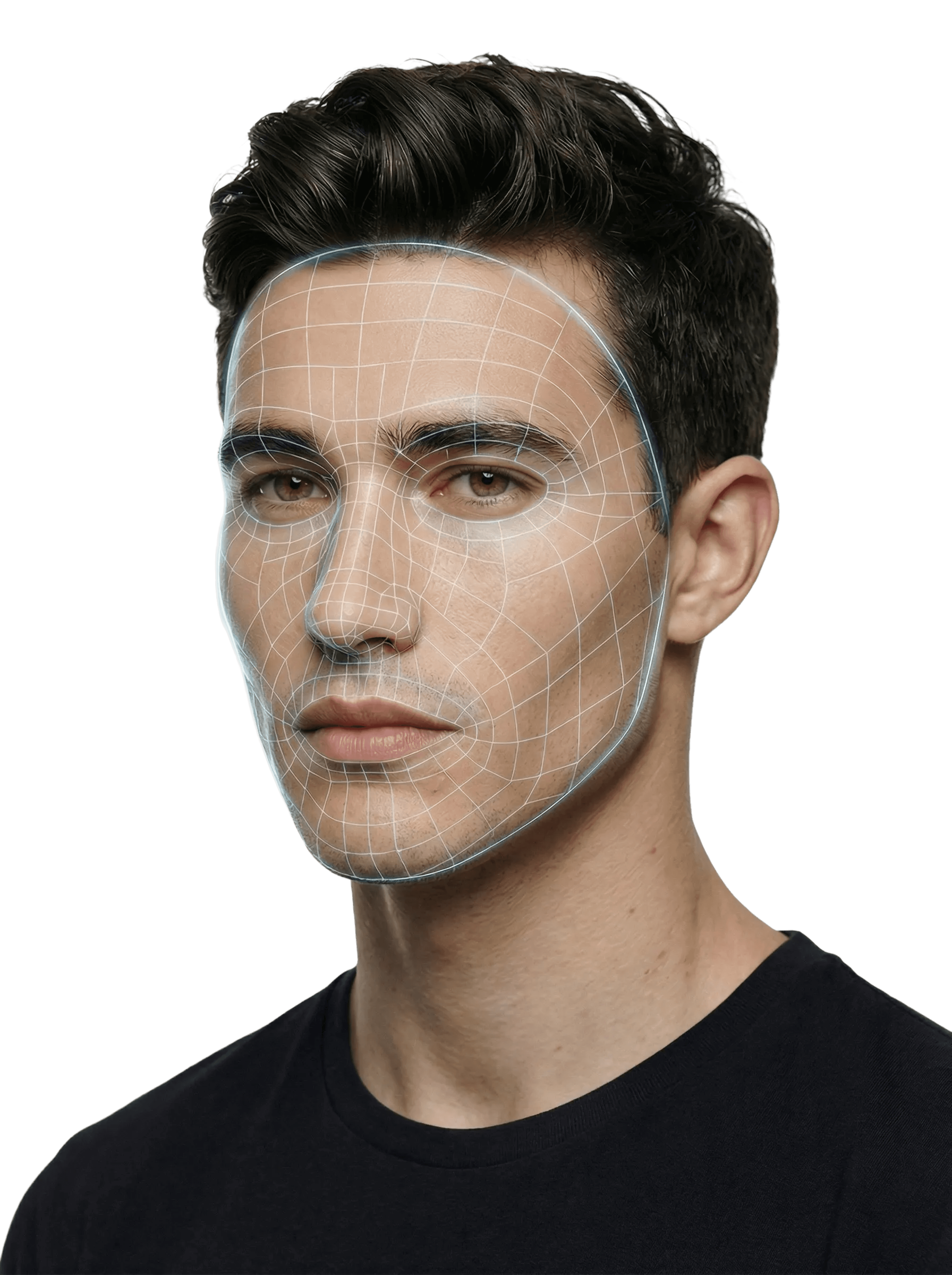
What Is My Lip Shape? Take the Quiz or Upload a Photo
Your lip shape depends on several features: fullness, the curve of your Cupid's bow, the balance between your upper and lower lips, and the width of your mouth. To find out what lip shape you have, take a quick quiz, upload a photo for an AI-based estimate, or compare your lips in the mirror.
Your lips can also combine features from different categories. For example, you might have full lips with a defined Cupid's bow and a slightly fuller lower lip. These details are part of your overall facial features and proportions, rather than one fixed lip type.
To explore how facial features contribute to an overall AI estimate, see our attractiveness test.
What Lip Shape Do I Have? Find Out Here
There are three ways to identify your lip shape:
Take the lip shape quiz. Answer a few questions about your lip fullness, Cupid's bow, and upper-to-lower lip balance to find your closest match.
Use the AI lip shape detector. Upload a clear, front-facing photo to get an estimated lip type based on visible features and proportions.
Check your lips in the mirror. Compare your natural lip outline with the descriptions and examples below.
Your result is an estimate, not an exact anatomical classification. Lip shape categories overlap, and lighting, facial expression, and camera angle can affect how your lips appear.
Lip Shape Quiz: Find Your Type
A lip shape quiz helps you identify your lip type by comparing visible features rather than relying on a single label. It looks at how full your lips are, which lip is fuller, how defined your Cupid's bow is, and how wide your mouth appears. This quick lips test is useful if you are asking “what is my lip type?” but prefer not to upload a photo.
You don't need to upload a photo. Just look in the mirror with your face relaxed and answer the questions based on your natural lip shape, without lipstick or lip liner changing the outline.
The quiz may describe your lips as full, thin, top-heavy, or bottom-heavy, with additional details such as a defined Cupid's bow. These features can overlap — having full lips doesn't mean your upper and lower lips must be equally full.
AI Lip Shape Detector: Analyze Your Photo
An AI lip shape detector estimates your lip type from a photo by examining visible landmarks and proportions around your mouth. Unlike a manual lip shape test, you don't need to select descriptions yourself — the tool analyzes the image and suggests a closest match. You can use the online lip shape detector without choosing answers from the quiz, although its result remains an estimate.
For a more consistent result, use a clear, front-facing photo:
Keep your face relaxed, with your lips gently closed.
Look straight at the camera without tilting your head.
Use even lighting and avoid heavy filters.
Make sure your entire mouth is visible.
Depending on the tool’s implementation, a lip shape analyzer may estimate features such as lip fullness, upper-to-lower lip balance, and the outline of your Cupid’s bow. These estimates are not definitive classifications and can change with expression, angle, and image quality.
How to Identify Your Lip Shape in the Mirror

If you are wondering “what shape are my lips?”, start with four visible features: fullness, upper-to-lower lip balance, Cupid's bow, and mouth width. A mirror check describes your natural lip outline without forcing it into one category.
Stand in front of a mirror at eye level, keep your face relaxed, and follow these steps.
1. Check Your Lip Fullness
Look at the visible pink part of your upper and lower lips, known anatomically as the vermilion. Standard anatomical terminology also distinguishes the vermilion border and the Cupid’s bow (Carey et al., 2009).
Full lips: Both lips have noticeable vertical fullness.
Thin lips: The visible pink area is relatively narrow.
Medium lips: Your lips fall somewhere between these descriptions.
Fullness is a spectrum, so there's no universal measurement that separates these categories.
2. Compare Your Upper and Lower Lips
Look at which lip has more visible height when your mouth is relaxed.
Top-heavy lips: Your upper lip appears fuller than your lower lip.
Bottom-heavy lips: Your lower lip is noticeably fuller.
Balanced lips: Both lips have similar visible fullness.
A fuller lower lip is a common natural variation. Neither lip needs to be a particular size or proportion.
3. Look at Your Cupid's Bow
Your Cupid's bow is the curved outline at the center of your upper lip, where two small peaks meet above the middle.
Defined Cupid's bow: Two distinct peaks form a noticeable central dip.
Soft Cupid's bow: The peaks and dip are present but less pronounced.
Nearly flat upper lip: The central contour has little visible definition.
A defined Cupid's bow can appear on both full and thin lips. It's a separate feature, not a complete lip shape on its own.
4. Check Your Mouth Width
Compare the distance between the corners of your mouth with the rest of your face.
Wide lips: Your mouth appears relatively broad across your face.
Narrow lips: The corners sit closer together.
Average-width lips: Your mouth falls between these visual descriptions.
Mouth width is relative to your facial proportions. A wider mouth doesn't necessarily mean fuller lips.
Lip width is only one part of your overall facial proportions. While a golden ratio face test explores how facial measurements compare, no single ideal ratio determines your lip shape.
Once you've checked all four features, combine your observations. For example, you might have medium-full lips, a fuller lower lip, a soft Cupid's bow, and a relatively wide mouth. That's a more useful description than choosing a single label that doesn't quite fit.
9 Types of Lip Shapes Explained
Lip shapes are commonly described using nine categories, including full, thin, heart-shaped, and bow-shaped lips. These are visual descriptions rather than nine mutually exclusive anatomical types. Your lips may match more than one category depending on their fullness, outline, and proportions.
Use this lip shape chart to compare the most recognizable features.

Lip Shape | How to Recognize It |
|---|---|
Full lips | Both upper and lower lips have noticeable volume and height. |
Thin lips | The visible pink area of one or both lips is relatively narrow. |
Heart-shaped lips | A pronounced Cupid's bow creates a heart-like outline, often with a fuller lower lip. |
Bow-shaped lips | The upper lip has a distinct, curved Cupid's bow with two visible peaks. |
Round lips | The lips look relatively compact and full, with a rounded outline. |
Wide lips | The mouth extends relatively far horizontally compared with its height. |
Top-heavy lips | The upper lip has more visible fullness than the lower lip. |
Bottom-heavy lips | The lower lip is noticeably fuller than the upper lip. |
Downturned lips | The corners of the mouth naturally angle slightly downward when relaxed. |
Heart-Shaped vs. Bow-Shaped Lips
Heart-shaped and bow-shaped lips both have a noticeable Cupid's bow, but the terms emphasize slightly different features.
Heart-shaped lips describe the overall outline, particularly the combination of upper-lip peaks and a rounded lower lip. Bow-shaped lips focus more specifically on the curved contour of the upper lip.
Because these descriptions overlap, the same lips may reasonably fit both categories.
Full vs. Round Lips
Full lips are defined mainly by their visible volume, while round lips are described by their overall outline and proportions.
You can have full lips that are wide, narrow, or rounded. Likewise, a rounded lip outline doesn't automatically mean your lips are exceptionally full.
Top-Heavy vs. Bottom-Heavy Lips
These terms describe the balance between the upper and lower lips rather than a completely separate shape.
These labels can overlap, so use the chart as a visual guide rather than a strict classification.
The most useful way to identify your lip type is to compare several features together rather than looking for an exact match with a single illustration.
Can You Have More Than One Lip Shape?
Yes. Lip-shape labels describe overlapping traits, not mutually exclusive categories. For example, someone can have full, heart-shaped lips with a fuller lower lip.
Think of your lip shape as a combination of features:
Fullness: Full, medium, or thin lips.
Proportions: Top-heavy, bottom-heavy, or balanced lips.
Upper lip contour: Defined, soft, or nearly flat Cupid's bow.
Overall outline: Round, wide, or relatively narrow lips.
Mouth corners: Level, upturned, or downturned.
If your lip shape quiz and photo analysis give slightly different descriptions, compare the individual features rather than focusing on a single label. Neither method provides an exact anatomical classification.
FAQ
What Type of Lips Do I Have?
If you are asking “what lips do I have?” or “what kind of lips do I have?”, start with fullness, Cupid's bow, and upper-to-lower lip proportions. The quiz gives you a descriptive match, while the photo tool provides an estimate and the chart lets you compare shapes yourself. The question “what lip type do I have?” has the same practical answer: compare several features rather than choosing a label from fullness alone.
Can I Identify My Lip Shape Without a Photo?
Yes. A mirror and good lighting are enough to identify your main lip features. Keep your mouth relaxed and compare the fullness, width, and natural outline of your lips. You can also take the quiz without uploading an image.
Should My Upper or Lower Lip Be Fuller?
There is no required proportion between your upper and lower lips. Some people naturally have fuller lower lips, while others have balanced or fuller upper lips. These are normal variations in lip anatomy, not signs that one shape is better.
Are Heart-Shaped and Bow-Shaped Lips Different?
The terms overlap. Heart-shaped lips describe the overall outline, often including a pronounced Cupid's bow and rounded lower lip. Bow-shaped lips emphasize the two peaks and central dip of the upper lip. The same lips can fit both descriptions.
Can an AI Lip Shape Detector Identify My Lips Accurately?
An AI lip shape detector can estimate visible features such as fullness, width, and upper-to-lower lip balance. However, the result depends on the photo, the model, and how lip types are defined. Treat it as a visual estimate rather than a definitive measurement.
Sources
Carey JC et al. (2009). Elements of Morphology: Standard Terminology for the Lips, Mouth, and Oral Region. PubMed