



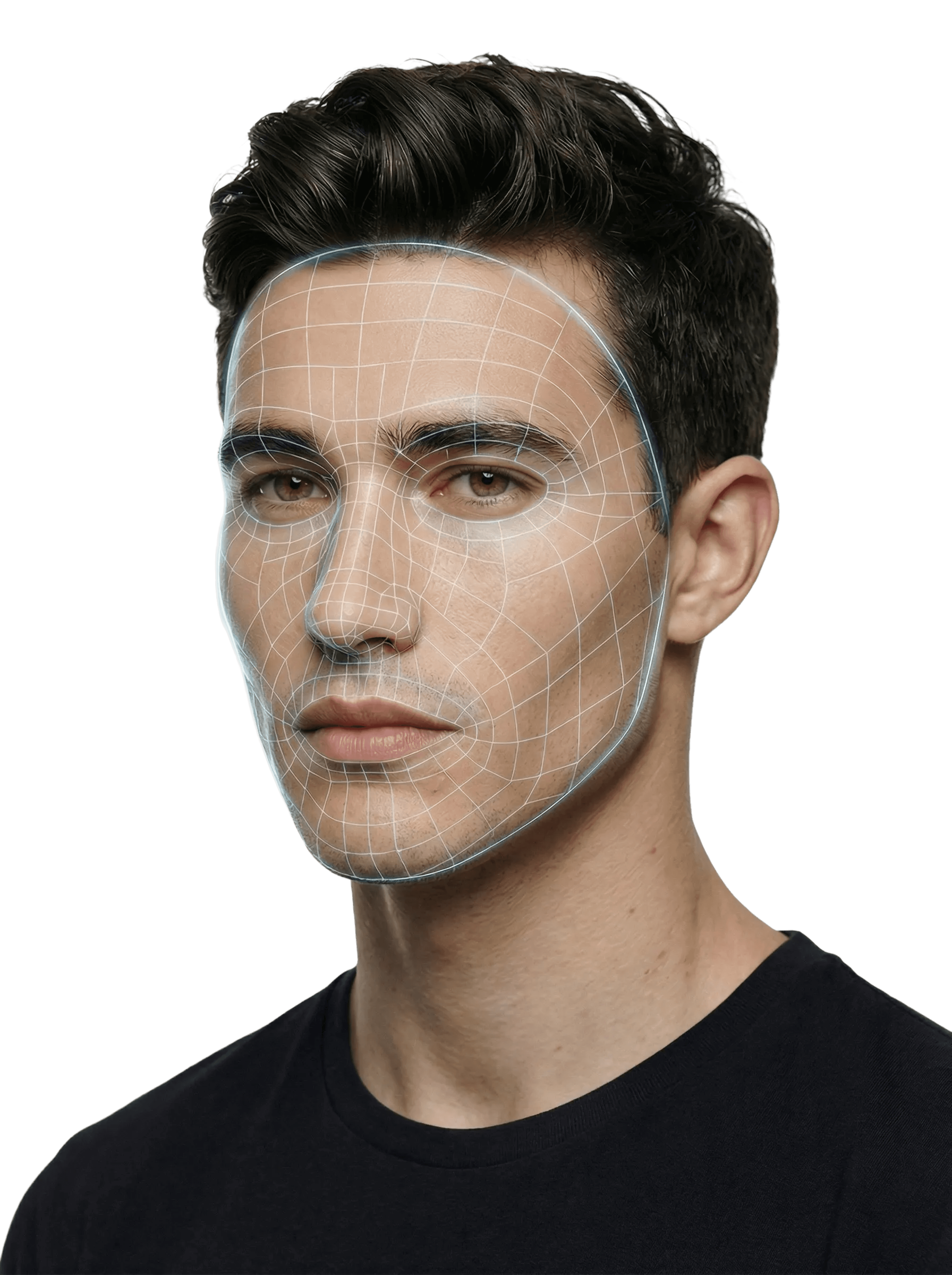
Ethnicity Percentage Calculator: Estimate Your Ancestry
An ethnicity percentage calculator estimates how much of your family background comes from different ancestral groups based on what you know about your parents, grandparents, and earlier generations. Enter your family's ancestry information to calculate an expected percentage breakdown.
These percentages describe your family tree — they aren't DNA test results or proof of your ethnicity. For more context, see DNA ancestry vs ethnicity guesses from photos
Ethnicity Percentage Calculator — Calculate Your Results
Use the calculator to estimate your ancestry percentages from known family information. Each parent contributes half of your family-tree ancestry, each grandparent contributes one-quarter, and each great-grandparent contributes one-eighth.
Choose the generation you know most about, enter the ancestry information for your relatives, and calculate your expected breakdown. The result is a genealogical estimate, not a measurement of the DNA you inherited from each ancestral population.
How to Calculate Your Ethnicity Percentage
To figure out your ethnicity percentage as a family-tree estimate, start with a specific ancestry category and identify how much of it appears in each parent's family tree. Average the two parental percentages. If you know only your grandparents' backgrounds, assign each grandparent an expected 25% contribution and add the shares belonging to that category.
From Your Parents
Suppose one parent has an entirely Irish family background and the other has an entirely Italian family background. Your expected family-tree breakdown is 50% Irish and 50% Italian.
If Parent 1 has a family-tree estimate of 50% Irish and Parent 2 has 0% Irish, your expected Irish share is:
(50% + 0%) ÷ 2 = 25% Irish
Repeat the calculation for each category you want to include. These are estimates based on family information, not a way to establish someone's ethnic identity.
From Your Grandparents and Great-Grandparents
If all four grandparents have different recorded ancestral backgrounds, a simplified family-tree calculation assigns 25% to each. For example, one Irish, one Italian, one Polish, and one German grandparent would produce an expected 25% share for each category.
Each of eight great-grandparents contributes an expected 12.5% to the family tree. Two great-grandparents recorded with the same ancestry would therefore account for an expected 25% of that background.
Relative | Expected genealogical share |
|---|---|
One parent | 50% |
One grandparent | 25% |
One great-grandparent | 12.5% |
One great-great-grandparent | 6.25% |
These fractions describe positions in a family tree. They do not guarantee that a DNA test will report matching percentages for any population.

How to Find Out Your Ethnicity Percentage for Free
If you're wondering how to find out your ethnicity percentage free, you can start by building a family tree and recording what you know about your relatives' backgrounds. A percentage ethnicity calculator can then turn those family-tree details into expected shares. This method requires no DNA sample, but its reliability depends on the information you enter.
Start with your parents and grandparents. Ask relatives how they describe their family origins, and record the places and communities connected to each branch.
Check available records. Birth, marriage, immigration, and census records can help trace relatives and locations. A recorded birthplace is not automatically an ethnicity.
Separate known facts from guesses. If a relative's background is unknown, leave that portion unknown rather than assigning a country or group based on a surname or appearance.
Calculate the expected shares. Use the known family-tree information in an ancestry percentage calculator and keep any uncertain categories labeled as estimates.
Can You Find Your Ethnicity Percentage Without a DNA Test?
Yes — you can figure out an expected family-tree percentage without a DNA test if you have enough information about your ancestors. But you cannot derive a verified genetic ancestry breakdown from family stories alone.
A DNA ancestry service takes a different approach: it compares selected genetic markers with reference datasets to estimate genetic similarity to populations. Those estimates can change as reference panels and methods are updated, as MedlinePlus Genetics explains. Neither method determines your personal ethnic identity for you. Understanding ethnicity and ancestry helps clarify the distinction.
If you're unsure how to find out your ethnicity percentage, begin with the relatives you can document. An honest “unknown” is more useful than a precise-looking number based on a guess.
Ethnicity Percentage Calculator vs. DNA Ancestry Test
An ethnicity percentage calculator based on a family tree, a DNA ancestry test, and an AI appearance estimate answer different questions. A family-tree calculator estimates ancestral shares from information you provide. A DNA test estimates genetic similarity to reference populations. An appearance-based tool identifies visual patterns; it cannot verify ancestry or ethnicity.
Method | What it uses | What the percentage means | Main limitation |
|---|---|---|---|
Family-tree calculator | Reported or documented relatives' backgrounds | Expected genealogical share | Depends on accurate family information and simplified categories |
DNA ancestry test | Genetic markers compared with reference populations | Estimated genetic ancestry relative to a company's datasets | Results depend on reference samples and methods |
AI appearance estimate | Facial appearance, sometimes alongside family-background answers | Approximate regional appearance match | Facial features cannot establish DNA, ethnicity, or family origin |

Why Your Family-Tree and DNA Percentages May Differ
Your family tree counts ancestors in fixed fractions, but DNA is inherited through recombination. You receive roughly half your autosomal DNA from each parent, yet you do not necessarily inherit exactly one-quarter from each grandparent. Over more generations, some genealogical ancestors may contribute no detectable DNA. The distinction between expected and actual inheritance is reflected in observed DNA-sharing ranges among relatives.
DNA ancestry percentages also depend on which reference populations a company uses and how it groups them. As the NHGRI explains, a result labeled with a country or region is a statistical estimate, not a definitive statement of nationality or ethnic identity.
Can AI Calculate Your Ethnicity Percentage From a Photo?
No photo can establish your genetic ancestry percentages. Some AI tools offer approximate regional appearance matches, but people from different backgrounds can share facial features, and appearance varies substantially within populations.
Maxxing offers a separate AI ancestry experience that includes family-background questions and an appearance-based estimate. Treat its regional matches as exploratory suggestions, not a DNA test or proof of where your ancestors came from.


Ethnicity Percentage Calculator FAQ
How do I calculate my ethnicity percentages?
For a family-tree estimate, assign each parent a 50% contribution and each grandparent a 25% contribution. Add the shares associated with each known ancestral background. The result is an expected genealogical breakdown, not a DNA measurement.
How far back is 25% ethnicity?
In a simplified family-tree calculation, 25% corresponds to one grandparent, or to multiple more distant ancestors whose expected shares add up to one-quarter. A 25% DNA ancestry estimate does not identify one particular grandparent.
How far back is 1% ethnicity?
There is no reliable one-to-one conversion from a 1% DNA ancestry estimate to a specific ancestor. In a simplified family tree, one ancestor nine generations back contributes an expected 1/512, or about 0.2%, while one ancestor six generations back contributes about 1.6%. Actual inherited DNA varies, and small ancestry estimates can be uncertain.
What does 6% ethnicity mean?
A 6% result from a DNA ancestry service means its model assigned roughly that share of your analyzed DNA to a reference population. It does not prove that one specific ancestor belonged to that group. In a family-tree calculator, one great-great-grandparent represents an expected 6.25% genealogical share.
Can DNA tell you what ethnicity you are?
A DNA test can estimate genetic ancestry by comparing markers with reference populations. It cannot determine your ethnic identity, which also involves family history, culture, community, and self-identification, as explained by NHGRI.
Is a race percentage calculator the same as an ethnicity percentage test?
No. Race and ethnicity are distinct social concepts, and neither can be calculated as an objective biological percentage, as emphasized by the National Academies' guidance on population descriptors. A family-tree tool estimates recorded ancestral shares; a DNA ancestry test estimates genetic similarity to reference populations.
Can I use an ethnicity percentage calculator for free?
Yes. You can use known family-tree information to calculate expected shares without buying a DNA test. If some branches are unknown, keep them marked as unknown rather than inventing percentages.
Sources
MedlinePlus Genetics — What Do Direct-to-Consumer Genetic Testing Results Mean?
National Human Genome Research Institute — Use of Population Descriptors in Genomics
National Academies — Using Population Descriptors in Genetics and Genomics Research
Guidelines for Genetic Ancestry Inference Created Through Roundtable Discussions
23andMe — DNA Relatives: Detecting Relatives and Predicting Relationships