



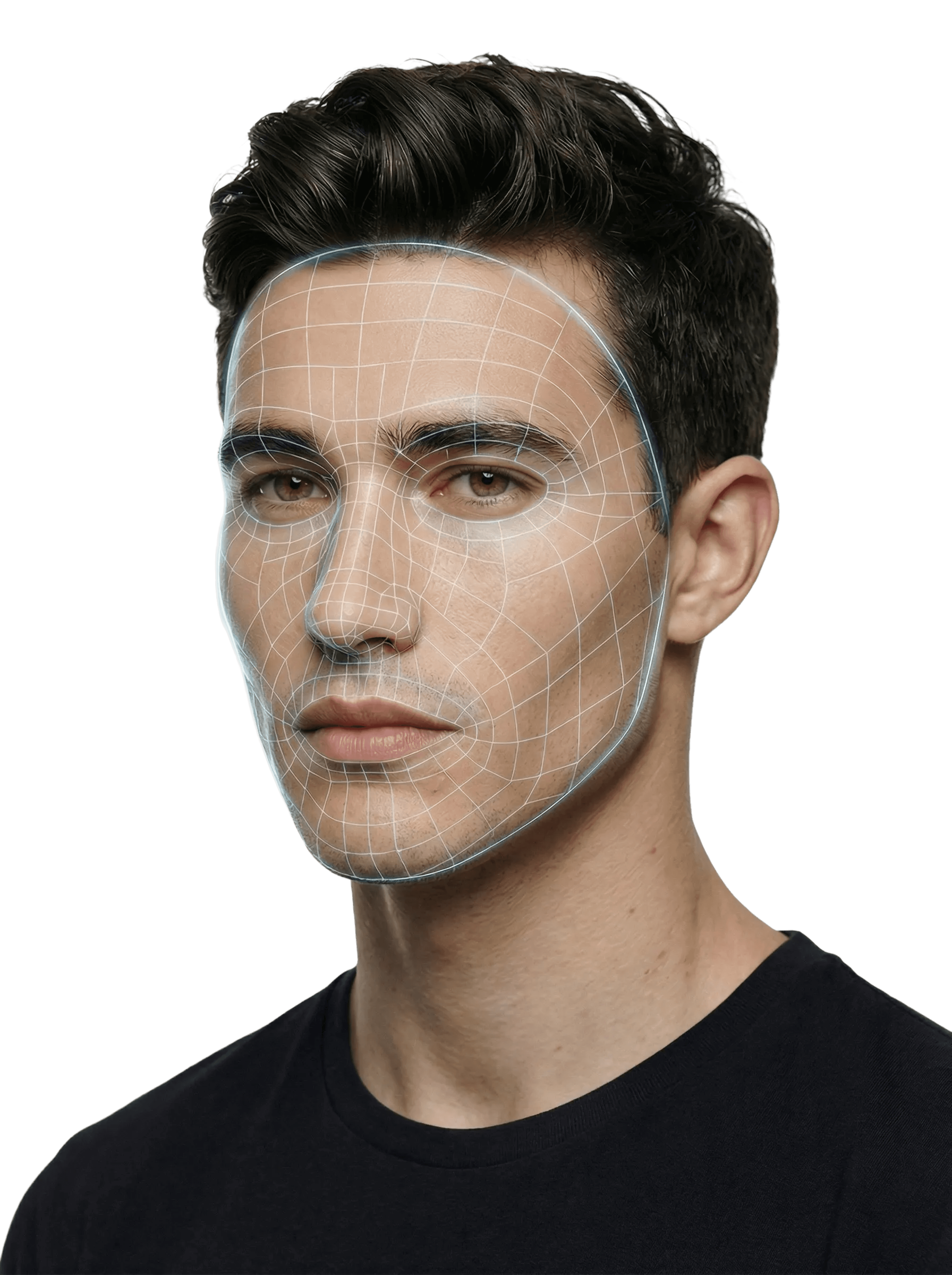
What Is My Phenotype? AI Photo Test & Facial Analysis
Your phenotype is the collection of observable traits you have, including eye color, hair texture, skin tone, facial features, and even characteristics that aren't visible in a photo. If you're wondering "what is my phenotype?", you can start by examining your physical traits or using AI facial analysis to describe them. But a photo can't reveal your complete phenotype or prove your genetic ancestry.
According to the National Human Genome Research Institute (NHGRI), your phenotype is shaped by both your genes and your environment. For a separate AI estimate of how your visible features score, see our attractiveness test; it does not identify ancestry or a definitive phenotype type.
How to Find Out Your Phenotype From a Photo
You can explore your visible phenotype by looking at your facial features, eye and hair characteristics, and overall proportions. A photo-based analysis can help describe selected features, although it cannot classify your complete biological phenotype.
Here's how to get started:
Choose a clear photo. Use a front-facing picture with your entire face visible, even lighting, and a neutral expression.
Examine your facial features. Look at your face shape, eye shape, nose, jawline, cheekbones, and facial proportions.
Consider other visible traits. Eye color, natural hair color, hair texture, and skin pigmentation are also part of your phenotype.
Use AI facial analysis. A photo-based tool can help describe facial features and proportions that may be difficult to assess yourself.
Interpret the results carefully. A facial analysis is a description or estimate based on an image, not a DNA test or proof of ethnicity.
What Can AI Analyze in Your Face?
AI facial analysis tools can examine visible characteristics and estimate facial proportions using information from a photograph.
Maxxing provides an AI-based facial report covering features such as:
Face symmetry: how the left and right sides of your face compare.
Jawline and chin: the visible shape and definition of your lower face.
Cheekbones: the appearance and prominence of your cheekbone area.
Nose and lips: visible characteristics of individual facial features.
Facial proportions: how different areas of your face relate to one another.
These observations can help you understand your facial characteristics, but they aren't a complete phenotype classification. They also shouldn't be treated as objective measures of attractiveness or genetic background.


How to Take a Photo for Facial Analysis
The photo you choose affects how your features appear. A tilted head, close camera distance, strong shadows, or a wide smile can change the apparent proportions of your face.
For a more consistent facial analysis:
Face the camera directly, keeping your head level.
Use soft, even lighting without strong shadows.
Keep a relaxed, neutral expression.
Move the camera far enough away to avoid exaggerated close-up perspective.
Keep your eyes, eyebrows, jawline, and facial outline visible.

If you compare results from multiple photos, try to keep the camera angle, distance, lighting, and expression consistent.
A photograph records how your features appear under specific conditions, so use comparable images when checking changes.
AI Phenotype Guesser: What Can It Actually Tell You?
An AI phenotype guesser uses a photograph to describe visible traits or compare them with reference images. Depending on the tool, the result might be a list of facial characteristics, a similarity score, or a named category. Searching for phenotype AI tools does not guarantee that any of those results has been scientifically validated.
Some tools invite you to “guess my phenotype” and return labels from historical anthropological classification systems. Those labels should not be treated as scientifically established biological types. Different tools may give different results because they use different reference images and methods.
Phenotype Analyzer vs. Calculator vs. Detector
You may see similar services described as a phenotype analyzer, phenotype calculator, phenotype detector, phenotype checker, or phenotype scanner. The names don't guarantee a particular technology or level of accuracy.
Tool label | What it may actually do |
|---|---|
AI phenotype guesser | Compare a face photo with reference examples and suggest similarities |
Phenotype analyzer or scanner | Describe or measure selected visible features |
Phenotype calculator | Apply a set of rules or scores to measurements or answers |
Phenotype quiz or online test | Ask questions about traits, sometimes without analyzing a photo |
Before using an online phenotype test from a photo, check what its result actually represents. A visual similarity match is not a genetic test.
How Accurate Is an AI Phenotype Test?
There is no single accuracy figure that applies to every AI phenotype test. Accuracy depends on what a tool claims to measure, its training or reference data, the quality of the photo, and whether its results have been independently validated.
For example, software may estimate the positions of facial landmarks, but that does not validate a claim that the same photo reveals someone's ancestry. If a phenotype detector AI gives regional percentages or a specific historical type, treat the result as a model-generated comparison rather than a verified biological finding.
For a useful result, look for a clear explanation of which traits were analyzed, how the comparison was made, and what the tool cannot determine.
What Physical Traits Make Up Your Phenotype?
Your phenotype includes characteristics such as eye color, hair color and texture, skin pigmentation, height, and facial features. It also includes traits a selfie cannot show, such as blood type. The National Human Genome Research Institute describes phenotype as the observable expression of genetic and environmental influences.
If you're checking your visible traits, these are useful starting points:
Eyes: iris color, eye shape, eyelid appearance, and spacing.
Hair: natural color, texture, and curl pattern.
Skin: pigmentation and other observable characteristics.
Face: the visible shape of your nose, lips, chin, jawline, and cheekbones.
Body: height and other measurable physical characteristics.
These are individual traits, not a checklist that assigns everyone to one fixed human category. The same feature can occur in people with many different family backgrounds.
Some traits are genetically complex. For example, MedlinePlus Genetics explains that eye color is influenced by multiple genes, including OCA2 and HERC2, rather than a simple one-gene rule. That is one reason a photo cannot reveal which genetic variants someone carries.
Environment matters, too. The NHGRI's explanation of gene–environment interactions describes how factors such as nutrition and ultraviolet exposure can influence traits. A phenotype is therefore more than the appearance of a face in one image.
Can Your Phenotype Tell You Your Ethnicity or Ancestry?
Your visible phenotype can resemble traits found in people from many regions, but it cannot establish your ethnicity or genetic ancestry. Ethnicity involves shared culture, history, and identity, while genetic ancestry concerns inherited DNA and relationships to earlier populations. A facial resemblance is not evidence that you belong to a particular ethnic group.
The National Human Genome Research Institute (NHGRI) explains that genetic ancestry is estimated by comparing DNA variants with reference populations, while race and ethnicity are not reliable substitutes for genetic ancestry. Human genetic variation also overlaps across populations, so individual facial traits do not map neatly onto national or ethnic labels.
What About AI Ancestry Estimates From a Photo?
A face-based ancestry quiz can offer an exploratory comparison, but it cannot read your DNA. Maxxing's ancestry quiz asks about your family background and uses a photo-based analysis before offering access to a report with estimated regional appearance matches and percentages.
Those percentages are model-generated estimates, not measured shares of your genetic ancestry. They should not be used to verify family history, nationality, or ethnicity. Learn more about the limits of ethnicity guesses from photos.
For actual family-history research, documented records and information from relatives can provide context that facial comparisons cannot. DNA-based ancestry testing uses genetic data rather than appearance, although its estimates also depend on the reference populations and methods used, as NHGRI notes.
Phenotype vs. Genotype: What's the Difference?

Your genotype is your genetic makeup, while your phenotype is the set of observable characteristics that result from your genes interacting with environmental influences. A photo can show some aspects of your phenotype, but it cannot reveal your genotype. The NHGRI genetics glossary explains this distinction.
Phenotype | Genotype | |
|---|---|---|
Meaning | Observable traits and characteristics | An individual's genetic makeup |
Examples | Eye color, hair texture, height, blood type | Genetic variants inherited from parents |
Can a selfie reveal it? | Some visible traits only | No |
Does it equal ethnicity? | No | No |
For example, two people may have similar eye colors but different combinations of genetic variants associated with pigmentation. Conversely, the appearance of a trait can be influenced by multiple genes and environmental factors. The MedlinePlus Genetics explanation of eye color illustrates why outward appearance does not provide a complete genetic profile.
A photo-based phenotype test examines selected visible traits; genetic testing answers different questions. Our guide to phenotype vs genotype explains how inherited DNA relates to observable characteristics.
FAQ About Phenotype Tests
What phenotype am I based on my photo?
A photo can show eye color, hair characteristics, and facial proportions, but it cannot assign you to one definitive human phenotype category.
How do I determine my phenotype?
Start by identifying specific observable traits rather than looking for a single label. You can examine features yourself or use facial analysis for a description of visible characteristics. For inherited traits that are not apparent in a photo, other information or testing may be needed.
Can AI identify my phenotype accurately?
AI can estimate selected facial features, but accuracy depends on the specific measurement and its validation. A facial measurement is not evidence of genetic ancestry.
Is eye color a phenotype?
Yes. Eye color is an observable phenotype trait. It is influenced by multiple genes, including OCA2 and HERC2, as described by MedlinePlus Genetics.
What are the four types of phenotypes?
There are no four universal types of human phenotype. Phenotype describes observable characteristics, not a standard set of four categories that every person belongs to. A quiz that offers four options is using its own classification system.
Can you tell my ethnicity by my face?
No. Facial appearance alone cannot reliably establish someone's ethnicity, nationality, or genetic ancestry. People with different backgrounds can share visible traits. Photo-based regional matches should be treated as speculative comparisons, not proof of identity or family origin.
Sources
National Human Genome Research Institute (NHGRI). Phenotype.
National Human Genome Research Institute (NHGRI). Genotype.
National Library of Medicine, MedlinePlus Genetics. Is eye color determined by genetics?.
National Human Genome Research Institute (NHGRI). Gene–Environment Interaction.
National Human Genome Research Institute (NHGRI). Use of Population Descriptors in Genomics.