



Deep Set Eyes: What They Are and How to Tell If You Have Them
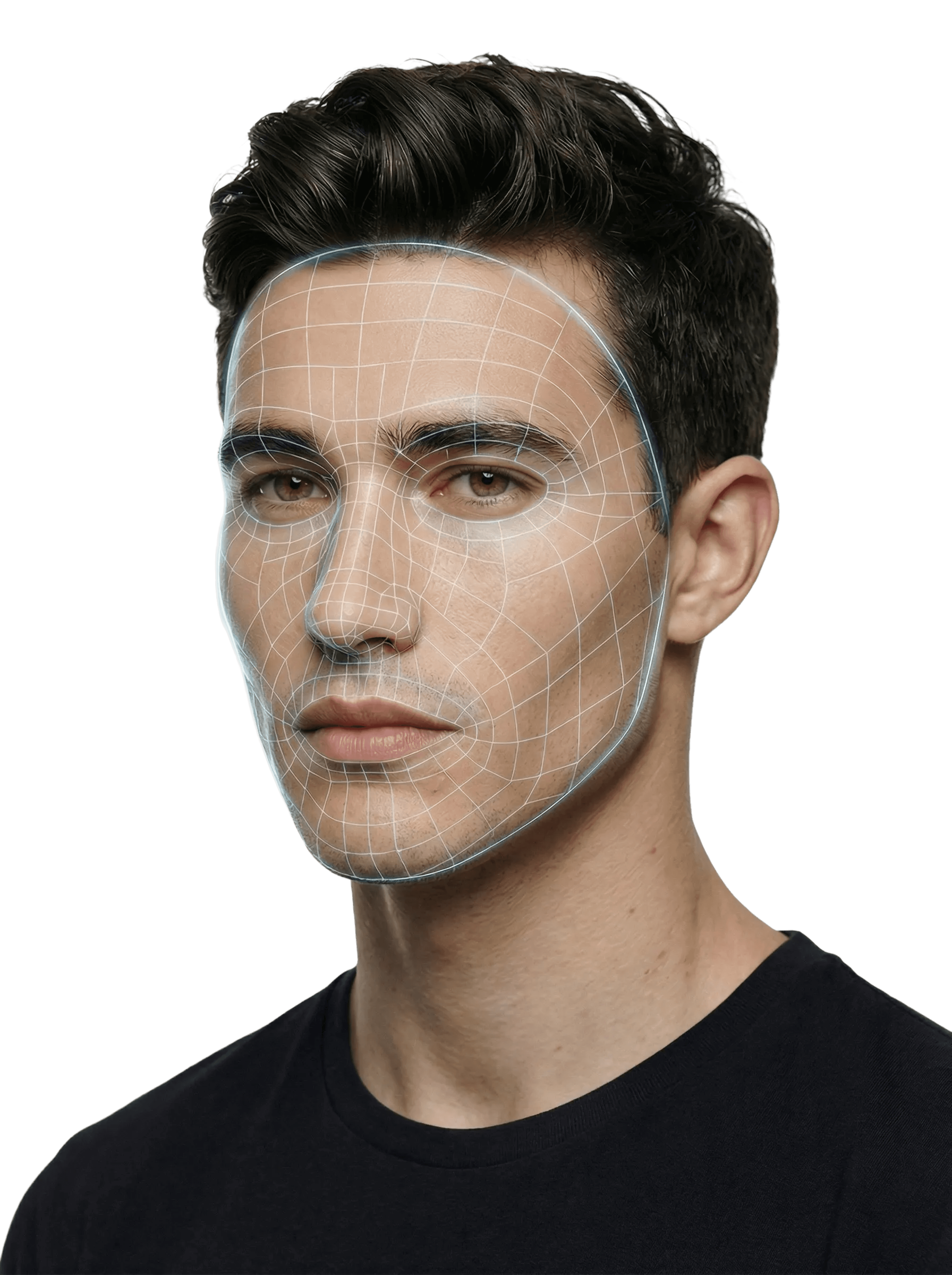
Deep set eyes sit farther back in the eye socket than average, so the brow bone above them (and often the cheekbone below) projects past the eyeball. The result is a shadow over the upper lid and eyes that can look smaller or more recessed.
The deep set of eyes is about depth, not outline: almond, round and narrow eyes can all be deep-set. It's also not the same as hooded eyes, which are about an extra fold of skin, or sunken eyes, which can sometimes point to a medical cause.
Below: how to check yours from the side, how deep-set differs from other eye shapes, and what is and isn't known about ethnicity, rarity and attractiveness. For how all your features add up, see the attractiveness test.
What Are Deep Set Eyes?
Deep set eyes are eyes positioned farther back in the eye socket than average, so the brow bone projects forward over them and casts a natural shadow on the upper lid. The opposite is protruding eyes, which sit closer to the front of the socket.
Depth is judged by comparing the eyeball with the brow bone and cheekbone, which is why a side view shows it best.
What Deep-Set Eyes Look Like
The brow bone sits in front of the eyeball, so a shadow falls across the eye area
The visible part of the upper lid can look short or partly hidden
The crease is often still visible, unlike hooded eyes, where a skin fold covers it
There can be a hollow between the eye and the brow bone
Any eye shape, size or color can be deep-set, because depth and outline are separate traits

What Do Deep Set Eyes Mean?
In anatomy, "deep set" just describes position: how far the eyeball sits behind the brow bone and cheekbone. It's a bone-structure trait, not a personality trait.
Most of what's written about "intense" or "mysterious" deep-set eyes describes a look, the shadow and the shorter visible lid, not a measured link to character.
One exception is worth knowing: if one eye starts to look deeper than the other, or the change is sudden, that can have a medical cause (see the sunken eyes section below).
How to Tell If You Have Deep Set Eyes
Look at your face from the side: the farther back your eyeball sits behind your brow bone and cheekbone, the more deep-set your eyes are. It's a comparison, not a score. Eye and brow traits are one part of a full facial feature analysis, and depth is the one you can't judge head-on.
Take a side-profile photo or stand sideways to a mirror. Keep your head level, your face relaxed and your brow down (raising it changes the shadow).
Find two reference points: the ridge under your eyebrow (the brow bone) and the top of your cheekbone.
See where the eyeball sits against them. Well behind both points means deep-set. Roughly level with them or in front means closer to protruding.
Check from the front. Does the brow bone shadow your upper lid? How much lid shows when your eyes are open and relaxed?
Look for the crease. A visible crease with the eye still tucked under the brow points to deep-set. A skin fold covering the crease points to hooded (see below).

Use the same light and head position every time you compare photos. Overhead light and a tilted chin both exaggerate the shadow.
There's no official measurement or cutoff for "deep-set": MyVision notes there is no objectively clear way to measure it medically. Treat the result as where you fall on a range, not a yes or no.
Deep Set vs Normal vs Protruding Eyes
The three differ in how far the eyeball sits from the brow bone and cheekbone. "Normal" here just means average: all three are ordinary variation, and none is better or worse.
Side view | Deep-set | Average | Protruding |
|---|---|---|---|
Eyeball vs brow bone and cheekbone | Well behind | Slightly behind | Level with or in front |
Shadow from the brow bone | Strong | Light | Weaker |
Visible upper lid | Often short | Moderate | Often more visible |
Overall look | Recessed, shadowed | Neutral | Prominent, often larger-looking |
Very Deep-Set Eyes
Very deep set eyes are the same trait further along the range: a stronger brow shadow and less visible lid. If the depth is new, uneven between the two eyes, or comes with double vision, it's no longer just an eye shape (see the sunken eyes section below).
Deep-Set Eyes Come in Every Shape
Depth describes position, not outline. A deep-set eye can be round, narrow or almond-shaped, so "round deep set eyes" and similar combinations are just depth plus an outline. For the outline side, see our guide to almond eyes.
Hooded vs Deep Set Eyes
Deep-set eyes are about position: how far back the eyeball sits. Hooded eyes are about skin: a fold that comes down from under the brow bone and covers part or all of the crease. They're easy to mix up because both can make the upper lid look smaller.
Deep-set | Hooded | |
|---|---|---|
What it describes | Eyeball position in the socket | Extra skin over the upper lid |
Crease with eyes open | Usually visible | Partly or fully covered |
Best view to spot it | Side view | Front view |

Can You Have Both?
Yes. The two traits are independent, so deep-set eyes can be hooded, and hooded eyes can sit at average depth. With both, the brow bone shadow and the skin fold stack, and the crease can disappear when your eyes are open.
A quick test: relax your eyes and look straight ahead. If you can see the crease, any lid shortness is coming from depth. If the crease is covered, there's a hood. For hooded eyes on their own, see our guide to hooded eyes.
Deep Set vs Sunken Eyes: When to See a Doctor
Deep-set eyes are a lifelong structural trait, usually similar on both sides. Sunken eyes (enophthalmos) mean an eyeball has moved backward in the socket, and it can show up in just one eye or as a change over time.
Get it checked by an eye doctor if:
One eye looks deeper than the other and that's new
The change started after a blow to the face or eye socket
You have double vision or trouble focusing
The most common cause of enophthalmos is a fracture of the orbit, most often its floor, according to StatPearls. All About Vision also lists double vision and eye-socket injuries as reasons to see a doctor promptly.
This isn't a diagnosis. Only an eye doctor can tell whether a change in eye depth is just how your face is built.
What Makes Eyes Look Deep-Set?
How deep-set eyes look depends on the bony socket and brow ridge around the eyeball, plus the fat and skin around it. That balance shifts with age.
Do Eyes Get More Deep-Set With Age?
They can look deeper, though researchers describe the mechanism differently:
StatPearls describes age-related loss of orbital fat that deepens the hollow above the eye (senile sunken eye syndrome)
A 2025 MRI study of 118 patients found the eye socket getting larger and the eyeball getting smaller with age, which contributed to a more sunken look
Both point the same way: age changes the area around the eye, so eyes that looked average at 20 can look more recessed later. It doesn't tell you what your own eyes will do.
Deep Set Eyes in Men and Women
Deep-set eyes aren't a male or female trait: they show up in everyone. What differs on average between the sexes is the brow ridge above the eye, and a stronger brow ridge makes eyes read as deeper-set. Skull studies find the brow region is among the most sexually dimorphic parts of the skull, for example a morphometric study of Brazilian adult skulls.
Deep Set Eyes in Men
A heavier brow ridge is more common in men, so deep-set eyes in men often come with a more visible brow shadow. In looksmaxxing communities, deep-set eyes under a low brow, with little visible upper lid and a level or slightly upturned tilt, are called hunter eyes. It's a community term, not an anatomical one. Our guide to hunter eyes breaks down what the term includes.
Deep Set Eyes in Women
It's the same trait: the eyeball sits farther back relative to the brow bone and cheekbone. Nothing about the definition or the side-view check changes with sex.
Celebrities With Deep Set Eyes
These are the names that come up most often in search results and published lists of celebrities with deep-set eyes:
Angelina Jolie
Cate Blanchett
Natalie Portman
Taylor Swift
Treat this as a list of names people cite, not a measurement. The lists don't measure eye depth. They're judgments from photos, and photos are unreliable for this:
Camera angle and lighting change how much shadow the brow bone casts
Makeup and age at the time of the photo change how deep the eye looks
Deep-set and hooded eyes get mixed up, so the same person can appear on both kinds of list
To judge a photo of anyone, including yourself, use the side-view check above.
Are Deep Set Eyes Attractive?
It depends on the whole face and on who's looking. As far as we could find, no study has tested eye depth on its own, so there's no evidence that deep-set eyes make a face more or less attractive in general.
What research does test: in a 2018 study of 922 participants, eyebrow thickness and jawbone prominence mattered more than cheekbone prominence and eye size for attractiveness ratings, and many differences were small to moderate. Eye depth wasn't one of the features tested.
Why deep-set eyes get praised: online, the shadow and brow definition they create are the usual reasons. That's taste, and taste varies.
The takeaway: deep-set is one of several normal eye variations. No eye shape is good or bad on its own.
Are Deep Set Eyes Rare? Do They Belong to an Ethnicity?
Are Deep Set Eyes Rare?
There's no reliable statistic. Because "deep-set" has no official cutoff, any percentage depends on where someone draws the line, and the numbers you see online usually come with no source.
What Ethnicity Has Deep Set Eyes?
None in particular. We found no study that ties deep-set eyes to an ethnicity, race or nationality, and you can't tell someone's origin from their eyes.
What research does show is narrower. A 2013 study of skulls from Asian, African and European populations found that eye socket outline differs on average between regions, but individuals from different regions overlap. It measured the outline of the socket, not how deep the eye sits, so it doesn't make deep-set eyes a group trait.
Ethnicity, race and ancestry are also different things. Our ethnicity guide explains the difference.
Can You Change Deep Set Eyes?
Not by yourself. Eye depth follows the bone and soft tissue around the eye, and no home method has been shown to change it.
How to Get Deep Set Eyes
Our guide to getting hunter eyes covers what people try and what the evidence says. One thing to avoid: dehydration. It can make eyes look sunken for a while, but it isn't a recognized cause of true enophthalmos, and severe dehydration is a medical problem, not a look.
How to Fix Deep Set Eyes
Natural deep-set eyes don't need fixing: they're a normal variation. If the depth comes from a medical cause (see above), treating the cause is a doctor's job.
Makeup and brow shaping change how deep your eyes look, not where they sit. Our guide to deep set eyes makeup shows where to place each shade and how to line the eye. Surgical options for the eye area exist, but they carry risks and are a conversation only for a board-certified surgeon.
FAQ
What does it mean to have deep-set eyes?
It means your eyes sit farther back in the eye socket than average, so the brow bone and cheekbone project past the eyeball. It's a normal variation in how faces are built.
How do I know if my eyes are deep set?
Check from the side. If the eyeball sits well behind your brow bone and cheekbone and the brow bone shadows your upper lid, your eyes are deep-set. There's no official cutoff, so it's a comparison, not a score.
Are deep-set eyes rare?
There's no reliable statistic. With no official cutoff, any percentage depends on where the line is drawn.
What ethnicity has deep-set eyes?
None in particular. We found no study tying deep-set eyes to an ethnicity, race or nationality, and eyes can't show someone's origin.
Are deep-set eyes attractive?
That depends on the whole face and on the viewer. As far as we could find, no study has tested eye depth on its own.
Are deep-set eyes a masculine trait?
No. They occur in everyone. What differs on average between the sexes is the brow ridge above the eye, which affects how deep the eyes look.
What is the opposite of deep-set eyes?
Protruding eyes, which sit closer to the front of the socket and show more of the upper lid.
Can you have deep-set and hooded eyes at the same time?
Yes. Deep-set describes eye position and hooded describes a skin fold over the crease, so the two traits are independent.
What do deep-set eyes say about a person?
Nothing about character. Deep-set is a description of anatomy: how far back the eye sits.