


Negative Canthal Tilt: What It Means, What Causes It, and Is It Bad?
A negative canthal tilt means the outer corners of your eyes sit lower than the inner corners, so your eyes slope slightly downward toward your temples. It's a normal variation in eye shape — not a defect, not a health problem, and not something that decides on its own whether a face is attractive.
The term spread from looksmaxxing forums and TikTok, where canthal tilt often gets treated as a make-or-break feature. This guide covers what a negative tilt actually is, how to check yours without being fooled by a selfie, what causes it, when it's worth seeing a doctor, and what makeup and grooming can and can't change.
For the bigger picture — positive, neutral, and negative tilt side by side, plus normal ranges — see our full guide to canthal tilt.
Canthal tilt is one feature out of many that shape how a face reads. If you want to see how a whole face is rated rather than a single angle, here's how an attractiveness test scores your features.
What Is a Negative Canthal Tilt?
A negative canthal tilt is an eye shape in which the outer corner of the eye (the lateral canthus) sits lower than the inner corner (the medial canthus). If a line drawn from the inner corner to the outer corner slopes down toward the temple, the tilt is negative — an angle below 0° from horizontal.
The basics:
Inner corner — the medial canthus, where the upper and lower lids meet near your nose.
Outer corner — the lateral canthus, where the lids meet at the side of your eye.
How it's measured — the angle between the corner-to-corner line and a horizontal line through the inner corner.
Other names — downturned eyes, downslanting eyes, or, in medical terms, a downward palpebral slant.

A slight negative tilt mostly makes the eyes look softer and more relaxed. A pronounced one, especially with a sagging lower lid, is more likely to read as tired.
How It Differs From Positive and Neutral Tilt
Tilt | Outer corner vs. inner corner | Angle | How it tends to look |
|---|---|---|---|
Positive | Higher | Above 0° | Lifted, alert |
Neutral | About level | Around 0° | Straight, even |
Negative | Lower | Below 0° | Softer, downturned |
There's no official cutoff between the three — a reading of −1° and one of +1° look almost the same in real life. For which tilt people tend to rate higher and why, see our comparison of positive vs. negative canthal tilt.
How to Tell If You Have a Negative Canthal Tilt
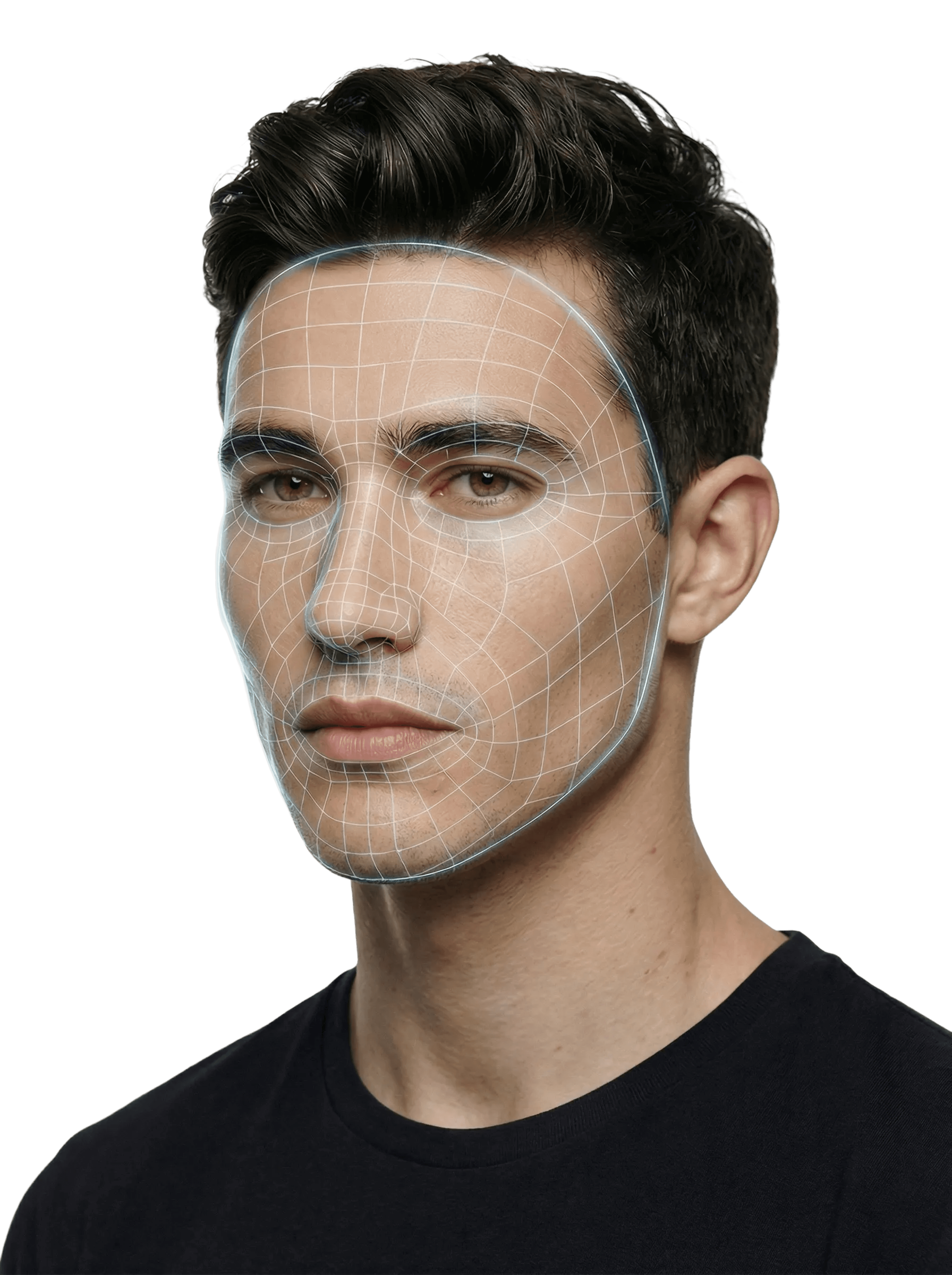
To check your canthal tilt, take a straight-on photo at eye level with a relaxed face, mark the inner and outer corner of each eye, and compare them against a level line. If the outer corner sits below the line through the inner corner, that eye has a negative tilt.
Take the photo right. Hold the phone at eye level, at arm's length or farther. Look straight into the lens with a neutral face, hair off your forehead, and even light from the front.
Level the photo. Rotate it in any photo editor until both inner corners sit on the same horizontal line. This removes any sideways head tilt.
Mark the inner corner. It's the point where the upper and lower lids meet near your nose.
Mark the outer corner. It's where the lids meet at the side of your eye — not the end of your eyeliner, lashes, or crease.
Compare. Outer corner above the line: positive. About on it: neutral. Below it: negative.
Check both eyes. Small differences between the left and right side are normal.
Want an actual number in degrees? Our canthal tilt guide walks through measuring your tilt step by step, including the simple formula that turns the photo into an angle.
Why Your Selfie Can Show the Wrong Tilt
Most "I just found out I have a negative canthal tilt" moments come from a bad photo, not from the face itself. Common culprits:
Head tipped forward or back. It changes how the lids and their corners line up in a photo (study on head tilt in clinical photography).
Head tilted to one side. One eye looks lifted and the other downturned. Leveling the photo fixes this.
Camera below eye level. Shooting from below, as with a phone held at chest height, distorts the eye area.
Front camera held too close. Wide-angle selfie lenses stretch whatever sits near the edges of the frame.
Smiling or squinting. Your cheeks push the lower lids up and change the shape of the outer corners.
The mirror. You can't hold your head level and judge a 2–3° angle at the same time.

If two careful photos taken on different days give you the same result, trust that over any single selfie or filter.
Is a Negative Canthal Tilt Rare?
A negative canthal tilt is less common than a positive one, but it isn't rare or unusual. In published measurements, the average adult tilt is slightly positive — roughly +1° to +9° depending on the group — and individual eyes vary by a few degrees either way, so many people land near zero or just below it.
What the studies show:
Young European adults averaged about +1° (men) and +2° (women) in a 3D study of eyelid shape. With averages that close to zero, a mildly negative reading is common.
Young Chinese adults in the same study averaged about +5° to +6°.
South Indian adults aged 18–26 averaged +5.1° (men) and +6.1° (women) in standardized front photos.
Korean adults averaged +7.9° (men) and +8.8° (women) in a study of 498 people.
No study we found reports what share of people have a negative tilt, so any exact percentage you see online is a guess.
If You're a Teenager
If you're still in your teens, your current tilt isn't final. In a study of 540 people aged 0 to 79, men aged 10–19 had a tilt about 1.6° lower on average than men in their 20s, and the angle stayed fairly stable after age 20 (Shao et al., 2024). A negative tilt at 14 is a normal variation, not a verdict on how your face will look.
What Causes a Negative Canthal Tilt?
A negative canthal tilt is mostly built into your anatomy: it depends on where the tendons that anchor your eyelid corners attach to the bone of the eye socket. Age, the support under your lower lid, and eyelid surgery can also make the outer corner sit or look lower over time.
The main factors:
Bone and tendon anatomy. The outer corner is held by a tendon attached to the bony rim of the eye socket (eyelid anatomy study). Where that attachment sits largely sets your baseline tilt.
Genetics. Face shape is strongly inherited overall (heritability maps of the face), but no study has measured the heritability of canthal tilt on its own.
Lower lid support. When the cheekbone and the lower rim of the eye socket sit behind the eyeball — called a negative orbital vector — the lower lid has less to rest on. In a study of 123 adults, people whose lower lid sat low enough to show white below the iris had an average orbital vector of −13.65°, versus +9.76° in people without it (Rajabi et al., 2020). A lower, rounder lid makes the outer corner look lower even if the corner itself hasn't moved.
Midface development. A negative orbital vector may go along with an underdeveloped upper jaw, or maxillary hypoplasia (review on eyelid malposition). That's the grain of truth behind forum claims linking a narrow palate to downturned eyes — but it doesn't mean exercises can rebuild that support.
Age. The lower lid tends to sag with age, more in men (eyelid anatomy study), and the eye's slant decreased slowly with age in a Korean study, more in women.
Eyelid surgery. Blepharoplasty can loosen or reposition the outer corner, which may need surgical revision (review on eyelid malposition).
Why Did My Canthal Tilt Become Negative?
If your tilt seems to have changed, check these explanations in order:
The photo changed, not your face. A different camera, angle, or expression is by far the most common reason. Retake the photo using the steps above.
Puffiness or tiredness. Swollen lids after poor sleep can change how the outer corner looks for a day or two.
Gradual aging. Over years, a looser lower lid can make the outer corner look lower. In one study of Caucasian adults, the outer corner's position didn't change with age, but the lower lid sagged (age-related periocular changes).
After eyelid surgery. A change in the outer corner after blepharoplasty is a known complication — talk to the surgeon who did it or an oculoplastic surgeon.
A real tilt doesn't flip from clearly positive to clearly negative in weeks. A fast change usually has another cause.
Extreme Negative Canthal Tilt: When to See a Doctor
A strongly downturned outer corner on its own is usually just anatomy. See an ophthalmologist or a board-certified oculoplastic surgeon if the change comes with any of these:
It appeared suddenly or over a few weeks.
It affects one eye much more than the other.
The lower lid pulls away from the eye or shows a lot of white below the iris.
You have tearing, dryness, irritation, or trouble fully closing the eye.
It started after eyelid surgery or an injury.
Lower lid retraction can come with thyroid eye disease, chronic facial nerve palsy, or previous eyelid surgery (review on eyelid malposition).
In rare cases, downward-slanting eyes are one of several features of a genetic condition. For example, Treacher Collins syndrome, which affects about 1 in 50,000 people, also involves underdeveloped cheekbones, a small jaw, and often ear differences. A downturned tilt alone is not a sign of a syndrome.
Is a Negative Canthal Tilt Bad?
No. A negative canthal tilt is a normal anatomical variation, not a medical problem or a flaw. On its own it doesn't affect your vision or eye health, and it's only one of many features that shape how a face looks. The exceptions are the warning signs in the section above.
Where the "negative tilt is bad" idea comes from:
Looksmaxxing rankings. Forums score faces trait by trait and treat canthal tilt as a pass/fail test. Research doesn't back a single "correct" angle.
Filters and apps. TikTok canthal tilt filters made the angle easy to measure — and easy to obsess over.
Tired-eye associations. A strongly downturned corner with a sagging lower lid can read as tired. A mild negative tilt usually doesn't.
For how one feature fits into the bigger picture of facial attractiveness, see our guide to looksmaxxing.
Is a Negative Canthal Tilt Attractive?
It can be. No study has set an ideal canthal tilt, and many people widely considered attractive have a neutral or slightly negative one. Experiments do suggest that a slight upward tilt is often preferred — but "more lift" isn't better, and these studies edit photos rather than compare real faces.
What the research actually found:
A small lift at the inner corner was preferred. In a forced-choice experiment, female faces with a digitally accentuated tilt at the inner corner were picked over unedited faces 93% of the time (Bashour & Geist, 2007). Only female faces were tested.
Lifting the outer corner backfired. In a study with 2,081 raters, digitally raising the outer corner of the eye on an edited face lowered its attractiveness ratings (Kempa et al., 2025).
Real faces vary more than edited ones. Brows, lid shape, under-eye area, skin, and overall facial harmony all change how a tilt reads.
Why Downturned Eyes Can Look Attractive
A negative tilt gives the eyes a softer, more relaxed look — often described as "puppy eyes." On many faces that reads as approachable, gentle, or a little melancholic rather than tired. Whether a downturned tilt works for you depends far more on the rest of your face than on the angle itself.
Curious how your face reads as a whole? The Maxxing face scan gives you an overall attractiveness score and a breakdown of individual features like symmetry, jawline, and cheekbones. It doesn't measure canthal tilt as a separate number — it looks at your face as a whole.
Negative Canthal Tilt and Hunter Eyes
Hunter eyes usually have a neutral to slightly positive canthal tilt, so a clearly negative tilt is the one trait that doesn't match the classic description. But hunter eyes are a combination of traits, not one angle — you can have most of them with a downturned corner.
The traits forums group under hunter eyes:
Deep-set eyes that sit back under the brow
A low brow, close to the eye
Little or no visible upper lid
A long, narrow eye shape
A level or upturned outer corner
A negative tilt with deep-set eyes and a low brow still reads as intense, just softer at the outer corner. The opposite label, "prey eyes," usually means rounder eyes, a clearly visible upper lid, and a higher brow — a negative tilt often gets lumped in, but it isn't required. Our guide to hunter eyes breaks down each trait and what actually changes it.
Negative Canthal Tilt in Men vs. Women
On average, women have a slightly more positive canthal tilt than men — by about 1° in the studies listed above (3D study of eyelid shape). The gap is small, and not every study found it significant, so a negative tilt is common in both.
What differs more is what each group can realistically adjust:
Women have more tools that change how the corner reads: eyeliner placement, lash direction, and brow shape. See the eyeliner steps below.
Men who don't wear makeup mostly work with brows, under-eye puffiness, sleep, and skin. A neutral to slightly negative tilt is a very common male pattern and rarely looks off on its own.
For both, a sagging or puffy lower lid makes a negative tilt look stronger than the angle alone would.
Eyeliner for Negative Canthal Tilt
The best eyeliner for a negative canthal tilt is a wing angled slightly up and out toward the tail of the brow, instead of one that follows the downward curve of your lash line. Keep the outer lower lash line light, because dark liner there pulls the eye down even more.
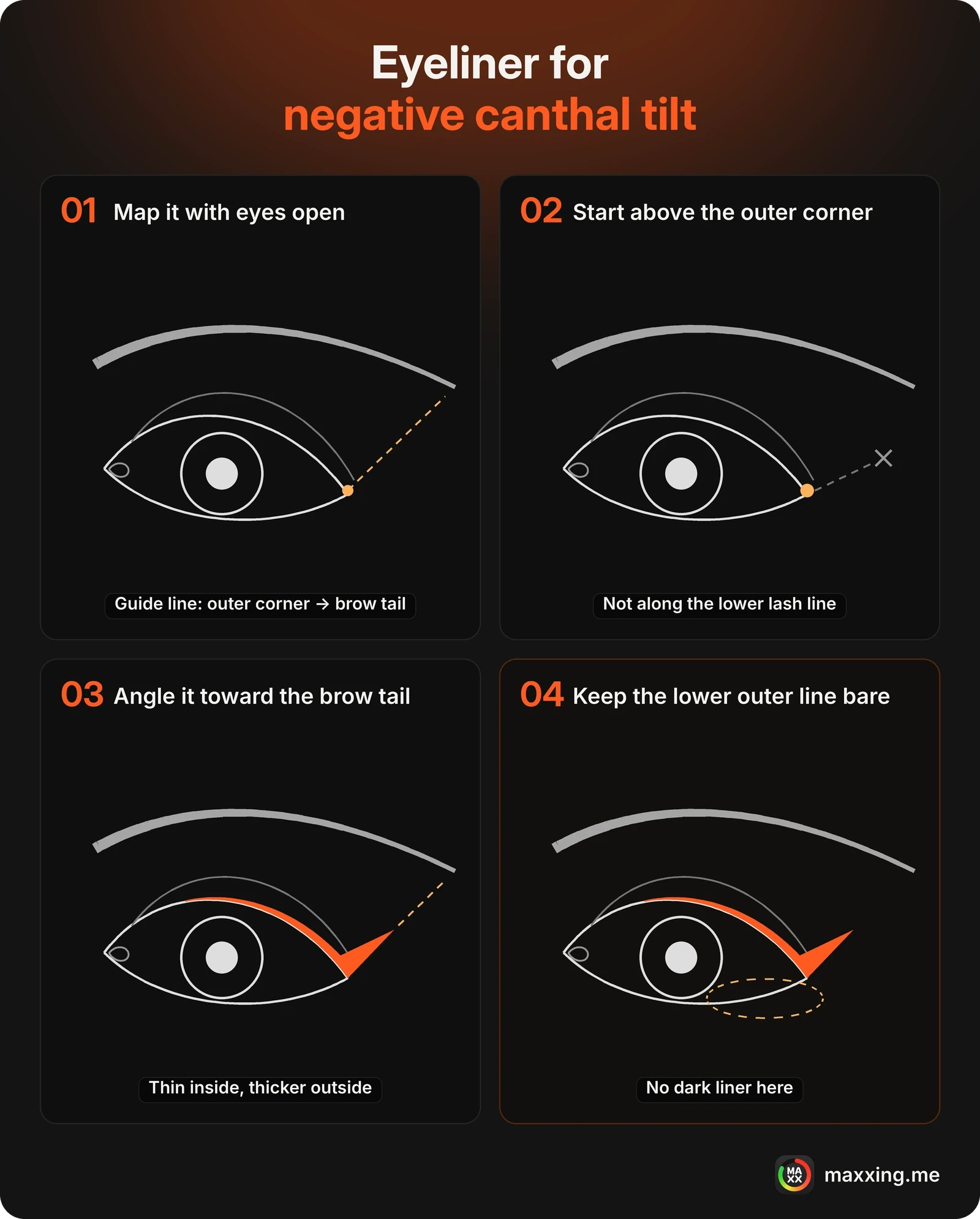
Map the wing with your eyes open. Look straight into the mirror with a relaxed face. A wing drawn with the eye closed often points down once you open it.
Pick the starting point above the outer corner. Start the flick slightly above where your lower lash line ends, not as an extension of it.
Aim toward the brow tail. Draw a thin line from that point up and out, roughly toward the end of your brow. Keep it short at first.
Connect it to the upper lash line. Fill in from the wing back toward the middle of the lid, staying thin near the inner corner and thicker at the outer third.
Leave the outer lower lash line almost bare. Skip liner there or use a soft, light shadow only along the inner two-thirds.
Lift the outer lashes. Curl the lashes and focus mascara, or a half strip of lashes, on the outer upper corner, brushing them up and out.
Clean up the edge. A little concealer on a flat brush under the wing sharpens the angle.
Winged eyeliner for almond eyes extends your upper lash line upward and outward in a straight flick, starting about two-thirds of the way across. Almond eyes often have a slight lift at the outer corner, which makes the wing easier to place. If your outer corners slope down instead, see eyeliner for a negative canthal tilt for how to angle the wing.
Brows and Other Non-Makeup Fixes
If you don't wear eyeliner, a few things still change how a negative tilt reads:
Keep the brow tail from dropping. A tail that slopes well below the start of the brow exaggerates a downturned look. Shaping by threading or waxing, or filling the tail with a pencil, can level it.
Don't over-thin the outer brow. A sparse tail makes the outer eye look heavier.
Reduce morning puffiness. Swollen lower lids make the outer corner look lower. Consistent sleep and a cool compress in the morning help how the area looks day to day.
Watch your photo angle. Camera at eye level or slightly above, chin level — see the selfie mistakes above.
Can You Get Rid of a Negative Canthal Tilt?
Not without surgery. The angle is set by the tendon at the outer corner of the eye and the bone it’s anchored to, so exercises and mewing don’t move it. Brows, eyeliner, and less under-eye puffiness can make it look more neutral — here’s what can and can’t change your canthal tilt, including what canthoplasty involves.
Popular looksmaxxing methods and what they actually do:
Mewing. Tongue posture is promoted for midface growth, but no study has shown it changes the eye socket or lifts the eye corners in adults.
Eye “exercises” and pulling the corners. Squinting drills and stretching the skin at the temples don’t reposition the tendon.
Taping. Tape at the temples lifts the skin only while it's on.
Bone smashing. Hitting your face to "remodel" bone doesn't lift the eye corner and can injure you. Don't do it.
The surgical options are canthoplasty and canthopexy, procedures that reshape or reposition the corner of the eye. Their documented risks include ectropion (an outward-turning lower lid), scarring, bleeding, asymmetry, a misaligned corner, damage to the tear drainage system, and trouble closing the eye (EyeWiki, American Academy of Ophthalmology). The same procedure is also used in the opposite direction — to angle the corner downward and make the eye look larger.
If you're considering surgery, see a board-certified oculoplastic surgeon, and keep in mind that the procedure changes your eye shape permanently.
FAQ
Does canthal tilt change with age?
Somewhat. The eye corners themselves stay fairly stable, but the lower lid loosens and sags over the years, which can make the outer corner look lower. Studies disagree on the angle itself: one found the eye's slant decreases slowly with age, more in women (Park et al., 2008).
Another found no significant change in the angle after age 20 (Shao et al., 2024).
Can canthal tilt change during puberty?
Yes. The eye area is still developing through your teens, so a tilt measured at 13 or 14 isn't final. A dramatic flip from negative to clearly positive isn't typical, though.
Can you fix a negative canthal tilt without surgery?
You can't move the eye corners without surgery. You can change how the tilt looks with a lifted eyeliner wing, brow shaping, less puffiness, and better photo angles.
What canthal tilt is hunter eyes?
Hunter eyes usually have a neutral to slightly positive canthal tilt, combined with deep-set eyes, a low brow, and little visible upper lid.
Does the Maxxing scan measure canthal tilt?
No. The scan doesn't report canthal tilt as a separate number. It gives an overall attractiveness score and scores for individual features such as symmetry, jawline, cheekbones, nose, lips, skin, and hair, with an explanation for each.
Want to see how your features add up, beyond a single angle? Start your Maxxing face scan — it takes a front and a side selfie.
Sources
Bashour M, Geist C. Is medial canthal tilt a powerful cue for facial attractiveness? Ophthalmic Plastic and Reconstructive Surgery, 2007.
Kempa et al. Understanding the impact of eyebrow and lateral canthal height on the perception of character traits: a rating-based analysis of 2081 participants. Journal of Plastic, Reconstructive & Aesthetic Surgery, 2025.
Rajabi MT et al. A comparison of lower eyelid retraction in normal individuals with positive versus negative orbital vector. Middle East African Journal of Ophthalmology, 2020.
Williams KJ, Allen RC. Eyelid malposition after blepharoplasty: an ounce of prevention. Seminars in Plastic Surgery, 2021.
Vaca EE et al. The influence of sagittal head tilt on periorbital appearance: implications for clinical photography and the evaluation of postoperative results. Aesthetic Surgery Journal Open Forum, 2021.
Gao et al. Racial and sexual differences of eyebrow and eyelid morphology: three-dimensional analysis in young Caucasian and Chinese populations. 2025.
Vasanthakumar et al. Anthropometric analysis of palpebral fissure dimensions and its position in South Indian ethnic adults. 2013.
Park DH et al. Anthropometry of Asian eyelids by age. Plastic and Reconstructive Surgery, 2008.
van den Bosch WA et al. Topographic anatomy of the eyelids, and the effects of sex and age. British Journal of Ophthalmology, 1999.
Tsagkrasoulis D et al. Heritability maps of human face morphology through large-scale automated three-dimensional phenotyping. Scientific Reports, 2017.
Liu et al. Age-related changes of periocular morphology in Caucasians. Graefe's Archive for Clinical and Experimental Ophthalmology, 2023.
Shao J et al. Automatic measurement and comparison of normal eyelid contour by age and gender using image-based deep learning. Ophthalmology Science, 2024.
American Academy of Ophthalmology. Canthoplasty. EyeWiki.
MedlinePlus Genetics. Treacher Collins syndrome. National Library of Medicine.
MedlinePlus. Palpebral slant. National Library of Medicine.