



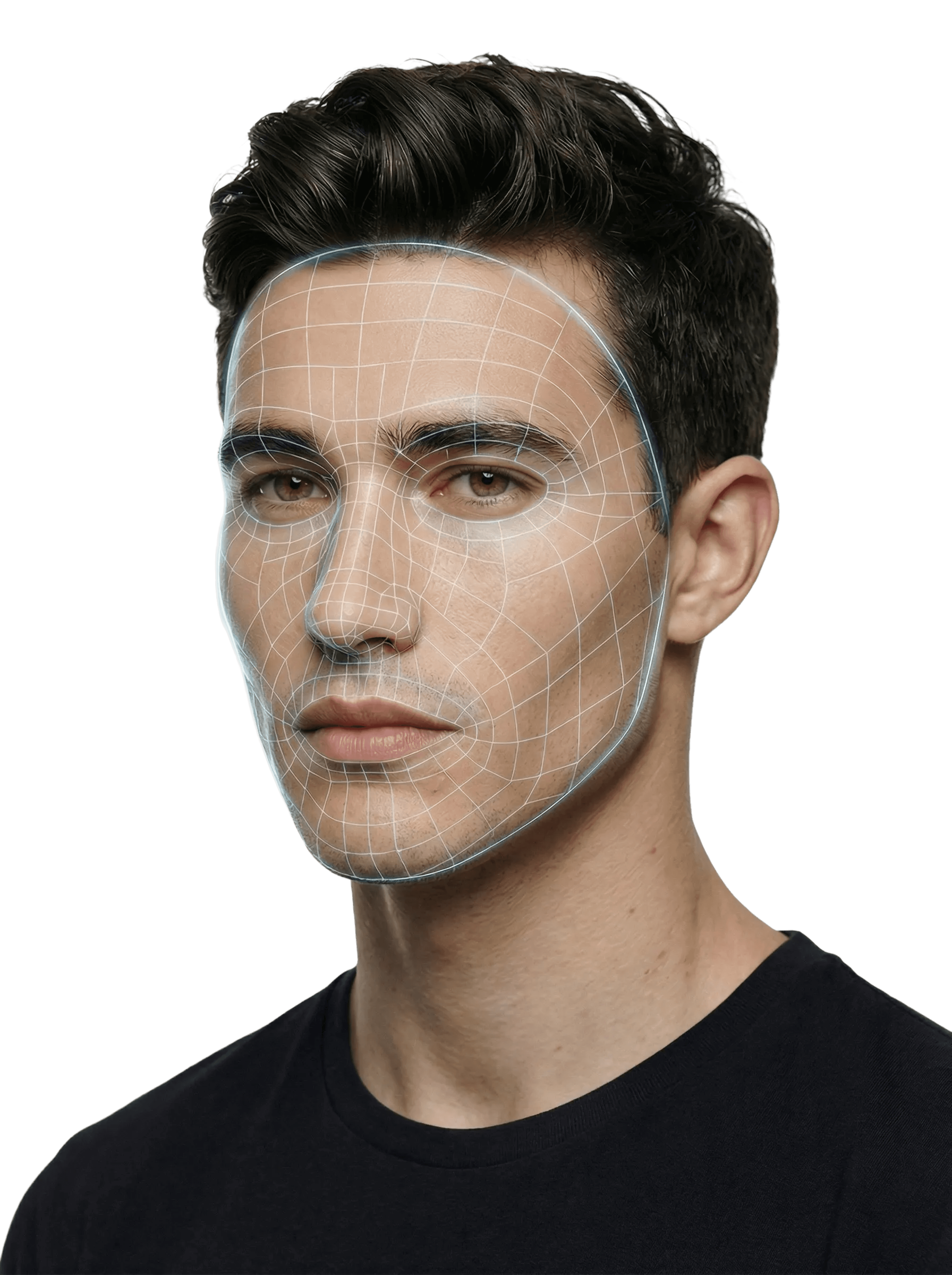
Canthal Tilt: What It Is, Positive vs. Negative, and How to Measure Yours
Canthal tilt is the angle of the line that runs from the inner corner of your eye to the outer corner. If the outer corner sits higher, your tilt is positive; if the corners are level, it's neutral; if the outer corner sits lower, it's negative. In every group researchers have measured, the average adult has a slight positive tilt.
In looksmaxxing, canthal tilt gets more attention than any other eye trait because it's the one you can turn into a number from a selfie. But it's one part of how your face reads, not a verdict on its own. To see how your eye area works with the rest of your features, start with our facial feature analyzer guide. If you want a read on your whole face, here's how an attractiveness test scores it.
What Is Canthal Tilt?
Canthal tilt is the angle between a line drawn through the inner and outer corners of the eye and a horizontal reference line. The inner corner is called the medial canthus, the outer corner the lateral canthus. In medical papers, the same measurement is called the slant or inclination of the palpebral fissure — the eye opening (Park et al., 2008).
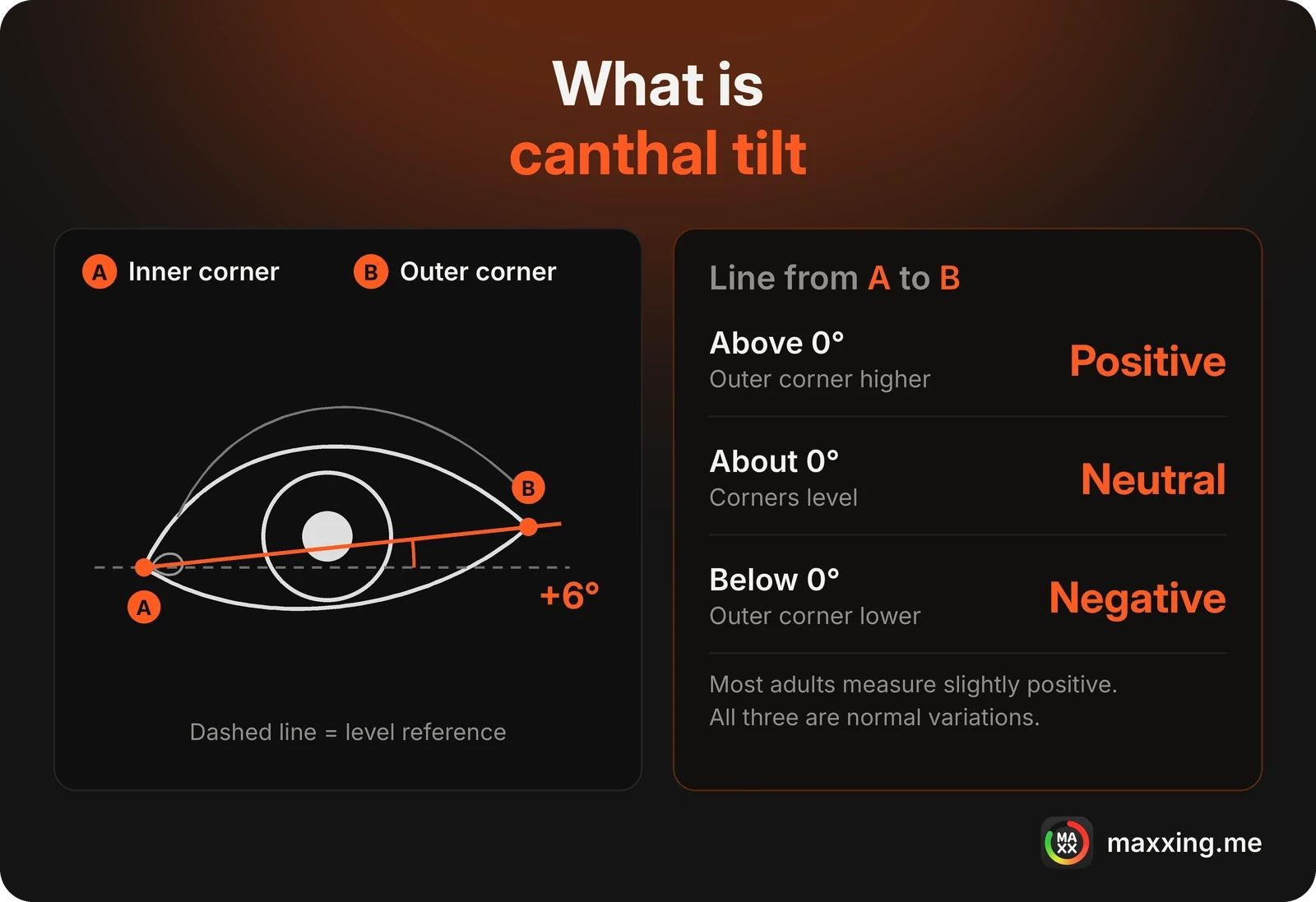
What that means in practice:
It's measured in degrees. Above zero — the outer corner is higher — is positive. Below zero is negative.
It describes your relaxed face. Smiling, squinting, or raising your brows changes how the corners look in a photo.
It's mostly structural. The corners sit where the eyelid tendons attach to bone, so canthal tilt isn't something that shifts day to day.
Each eye has its own tilt. Your left and right eyes rarely measure exactly the same, and small differences are normal.
Canthal Tilt vs. Medial Canthal Tilt
The two terms sound alike but describe different things. Canthal tilt is the slope of the whole eye line, from corner to corner. Medial canthal tilt refers to the angle at the inner corner of the eye only.
The difference matters because one well-known study is quoted as proof that canthal tilt drives attractiveness. In fact, it edited the inner corner of female faces only — more on that below.
Where the Term Comes From
Canthal tilt started as a measurement in eyelid surgery and anatomy research. Looksmaxxing forums borrowed it as a rating point, and it went mainstream with a TikTok filter that draws a red line across your eyes and labels the tilt. Videos with a negative result often end with "it's over" (MM+M).
That framing turns a normal anatomical variation into a pass/fail test, which it isn't. If you're new to the community's vocabulary, our guide to looksmaxxing explains where terms like this come from.
Positive, Neutral, and Negative Canthal Tilt
There are three types of canthal tilt: positive (the outer corner sits higher), neutral (the corners are level), and negative (the outer corner sits lower). Positive is the most common. All three are normal anatomical variations.
Type | Where the outer corner sits | How it often reads |
|---|---|---|
Positive | Higher than the inner corner | Lifted, alert; a strong tilt gets called "fox eyes" |
Neutral | Level with the inner corner | Calm, balanced |
Negative | Lower than the inner corner | Softer, sometimes tired or sad; often called "downturned eyes" |

There's no official cutoff in degrees between the types. The thresholds you see online come from apps and forums, so a reading of +1° or −1° says "close to neutral," not "one type or the other."
Positive Canthal Tilt
A positive canthal tilt means the outer corner of the eye sits higher than the inner corner, so the eye line slopes up toward the temple. It's the most common pattern: published adult averages are positive in every group studied (more on what's normal below).
How to tell if you have a positive canthal tilt:
Look straight into the camera with a relaxed face
Picture a line from your inner corner to your outer corner
If the line rises as it moves out toward your temple, your tilt is positive
Is a positive canthal tilt good? A slight one is typical and reads as alert. A very steep, pulled-up look — the kind you see in edited photos — tends to read as harsh rather than attractive.
Neutral Canthal Tilt
A neutral canthal tilt means the inner and outer corners sit roughly level, so the eye line runs close to horizontal. It's a normal result, not a flaw.
In fact, neutral is close to average for some groups. In a 3D study of young European adults, the average tilt in men was about +1° — practically level (Gao et al., 2025).
Is neutral better than positive? Neither is better on its own. How your eyes read depends just as much on brow position, how much eyelid shows, and the rest of your face.
Negative Canthal Tilt
A negative canthal tilt means the outer corner sits lower than the inner corner, so the eye line slopes down toward the temple — often called downturned eyes. It’s less common than positive or neutral in published averages, but it’s still normal variation. For causes, when it’s worth seeing a doctor, and what makeup can change, see our guide to negative canthal tilt.
Eyeliner for Positive Canthal Tilt
With a positive canthal tilt, eyeliner works best when it follows the upward angle your eye already has instead of fighting it. Keep the line thin and aim the wing along the natural slope.
Not sure which tilt you have? The measuring steps below take about a minute.
Find your angle. Picture the line from your inner corner to your outer corner and extend it out toward the tail of your brow. That's the direction your wing should take.
Line close to the lashes. Keep the line thin near the inner corner and let it thicken slightly toward the outer corner.
Draw the wing along that line. Don't make it steeper than your natural angle — a wing that's much sharper than your eye looks drawn on.
Keep it short if your tilt is already strong. A long, sharp flick on a steep eye can tip into the harsh, over-pulled look.
Go light on the lower lash line. Smudge shadow on the outer third at most. Fully lining the lower lid closes the outer corner and flattens the lift.
Some people use the TikTok canthal tilt filter as a guide here: the red line it draws shows the angle to follow with the wing.
If your tilt is neutral or negative, the approach flips: angle the wing slightly upward rather than along the eye line. Here’s step-by-step eyeliner for a negative canthal tilt.
For guys who don't want a visible wing: press a brown or black pencil into the upper lash roots (tightlining) and smudge it. It defines the lash line and sharpens the outer corner without looking like makeup.
What Is a Normal Canthal Tilt?
A normal canthal tilt is slightly positive: published adult averages run from about +1° to about +9°, depending on the group studied and how it was measured. Within each group, individual eyes vary by roughly 2–3° either way.
Group (study) | Men | Women | How it was measured |
|---|---|---|---|
Young European adults, 18–30 (Gao et al., 2025) | about +1° | about +2° | 3D photos |
Young Chinese adults, 18–30 (Gao et al., 2025) | about +5° | about +6° | 3D photos |
South Indian adults, 18–26 (Vasanthakumar et al., 2013) | +5.1° | +6.1° | Standardized front photos |
Korean adults (Park et al., 2008) | +7.9° | +8.8° | Adult values from 498 people of all ages |
A few things to keep in mind when you read these numbers:
Methods differ. Each study used its own photos, landmarks, and reference line, so the numbers don't line up to the decimal.
Groups overlap heavily. With a spread of 2–3° inside each group, plenty of people measure higher or lower than their group's average. A group average tells you nothing about any one face.
Samples are small. The Chinese group in the 3D study had 46 people, all students living in Germany, and the authors call for larger studies.
What percent of people have a positive canthal tilt? No study has counted it directly. But since every published average is above zero, most people in these samples land on the positive side — and in the groups with the lowest averages, many sit close to neutral.
For comparison, a study of 42 attractive European-descent celebrities measured +6.5° in men and +8.5° in women (Liu et al., 2023). That's a hand-picked sample, not a normal range.
Canthal Tilt in Men vs. Women
On average, women have a slightly more positive canthal tilt than men — by about 1–2° in the studies above. The gap isn't large, and not every study found it significant.
That difference is why a stronger upward tilt is usually read as a feminine trait, and a level or gently positive one as typical for men. So which canthal tilt is best for men? No study has set an ideal angle. A neutral to slightly positive tilt is the most common male pattern, and a steeply lifted outer corner tends to look less natural on a male face, not more attractive.
How to Measure Your Canthal Tilt
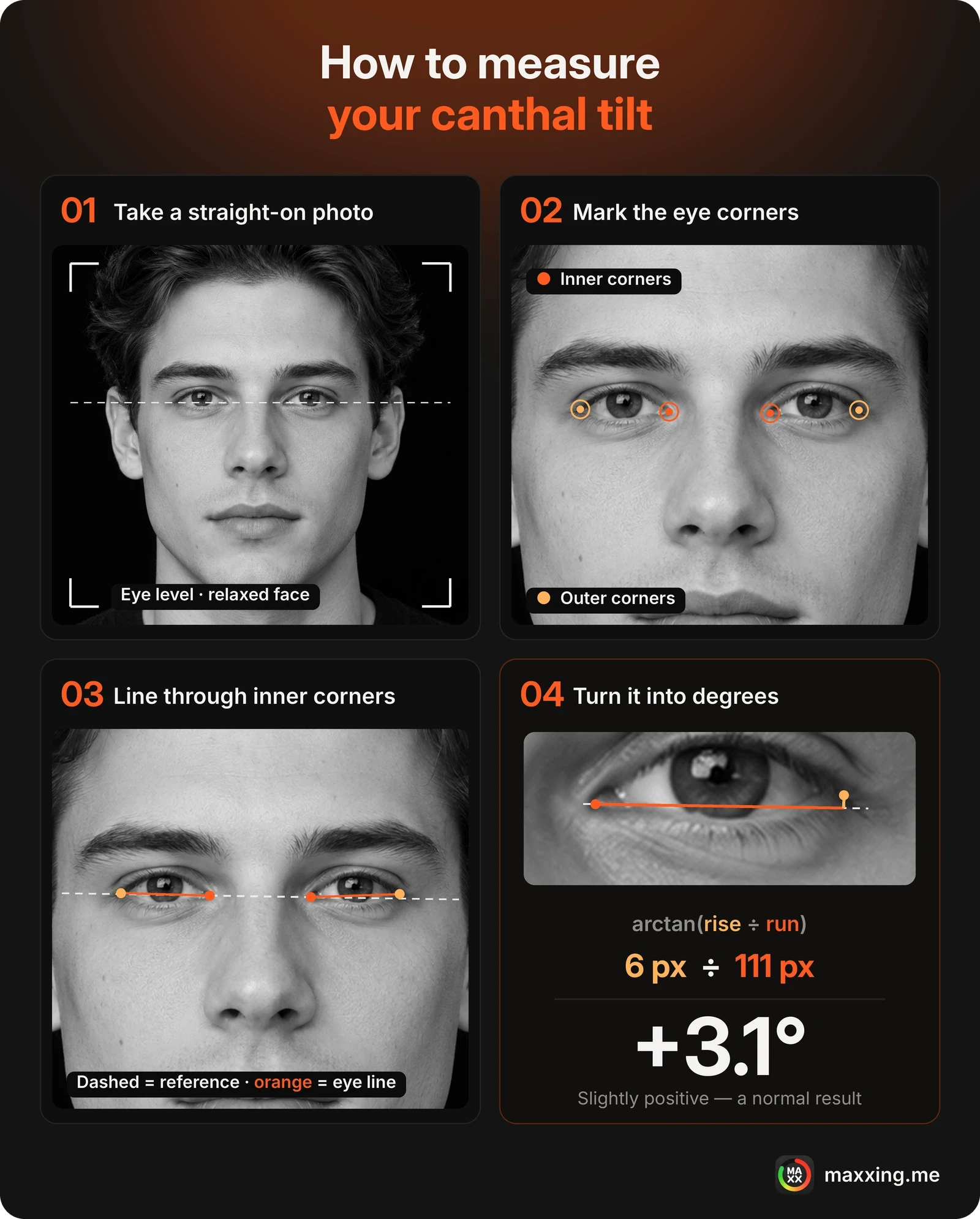
To measure your canthal tilt, take a straight-on photo with a relaxed face, mark the inner and outer corner of each eye, and measure how steeply the line between them rises against a line through both inner corners. Above zero is positive, below zero is negative.
Take the right photo. Hold the phone at eye level and at arm's length, look straight into the lens, and keep your face neutral — no smile, no squint, no raised brows. Use even light from the front and take glasses off.
Mark the corners. The inner corner is where the upper and lower lids meet near your nose, not the pink tissue inside it. The outer corner is where the lids meet at the side of the eye.
Draw the reference line through both inner corners. Measuring from this line instead of the edge of the photo cancels out a slight sideways head tilt. Researchers use the same reference (Gao et al., 2025).
Measure the rise and the run. In any photo editor that shows pixel positions, note how many pixels the outer corner sits above the reference line (the rise) and the horizontal distance from the inner to the outer corner (the run).
Turn it into degrees. Tilt = arctan(rise ÷ run). For example, a rise of 6 pixels over a run of 111 pixels is about 3.1°. You can type "arctan(6/111) in degrees" straight into Google.
Repeat for the other eye. A small difference between the eyes is normal. Average the two for one number.
The most common mistakes that throw the number off:
Tipping your head forward or back. It changes how the lids and their corners look in a photo (PMC8830303).
Smiling. It pushes the lower lid and cheek up and makes the outer corner look higher.
Measuring against the edge of the photo. Any head tilt then shows up as canthal tilt.
Using a filtered or retouched photo. Beauty filters often lift the outer corners on purpose.
Measuring with eyeliner on. A wing makes the corner look higher than it is.
How Accurate Are Canthal Tilt Filters and Calculators?
Canthal tilt filters and calculators give a useful estimate, not an exact measurement. They place the eye corners automatically, and a corner placed a few pixels off can move the result by a degree or more on a small face in the frame.
That's why two apps can label the same face differently:
Different reference lines. Some measure against the horizontal, others against the line through the inner corners.
Different cutoffs. Each app picks its own threshold for "neutral," so +1° can be neutral in one and positive in another.
Live video moves. A filter on a moving face shifts with every head turn and expression.
If an app's result surprises you, measure a clean photo by hand with the steps above. And remember that any AI reading of your face is a model's estimate, not an objective fact.
Curious how your eyes work with the rest of your face? Canthal tilt is one angle; how your face comes across depends just as much on your brows, cheekbones, jaw, and skin. The Maxxing scan takes a front and a side selfie and gives you an overall attractiveness score with a breakdown of features like face symmetry, jawline, and cheekbones. It doesn't report canthal tilt as a separate number. See what AI face analysis can and can't tell you.
Positive vs. Negative Canthal Tilt: Which Is More Attractive?
Research links a slight positive canthal tilt to attractive faces, but more tilt isn't better, and no study has set an ideal angle. Canthal tilt is one cue among many, not a score on its own.
What the studies actually show:
Attractive faces tilt a little more. Celebrities picked as attractive had more tilt than the 4.12° average cited for European-descent faces (Liu et al., 2023). Attractive Italian men and women also showed a greater upward inclination of the eye than a reference group (Sforza et al., 2015).
The famous "93%" study is about something else. It's often quoted as proof that canthal tilt drives attractiveness. It actually edited the inner corner of female faces only (Bashour & Geist, 2007), so it says nothing about the outer corner or about men.
Too much lift backfires. In a study with 2,081 raters, digitally raising the outer corner of the eye on an edited face lowered its attractiveness ratings (Kempa et al., 2025).
No study names an ideal number. The "ideal canthal tilt" figures quoted online come from apps and forums, not from research.
So does canthal tilt actually matter? A little. It shapes whether your eyes read as lifted, level, or soft, but brows, how much eyelid shows, skin around the eyes, and the rest of your face count just as much. We walk through these studies in more detail in our guide to what hunter eyes are.
Is Canthal Tilt Genetic, and Does It Change With Age?
Canthal tilt is mostly set by your bone structure and where the eyelid tendons attach, so it's largely inherited and fairly stable in adults. Aging changes it less than social media suggests.
Genetics. No study has measured how heritable canthal tilt is on its own. But facial shape as a whole is under strong genetic control (Tsagkrasoulis et al., 2017), and the corners of the eye are anchored to bone, so it's reasonable to expect canthal tilt to be largely inherited too.
Aging. The evidence is more mixed than "your tilt turns negative with age":
A Rotterdam study of 320 people aged 10 to 89 found that aging did not change the position of the outer eye corner. What did change was the lower eyelid, which sagged with age, especially in men (van den Bosch et al., 1999).
A Korean study reported that the slant of the eye gradually decreases with age, more in women (as summarized by Liu et al., 2023).
Put together: the tilt may flatten slightly over the decades, and a sagging lower lid can make the outer corner look lower than it is. A dramatic switch from positive to negative isn't what the studies show.
Can you change it? Without surgery, no method has been shown to move the corners of the eye. Makeup changes how the tilt looks; surgery on the outer corner of the eye repositions it but carries real risks, from scarring to a misplaced corner and dry eye. We cover the risks of eye-corner surgery in our hunter eyes guide. Anyone considering it should talk to a board-certified oculoplastic surgeon.
FAQ
What canthal tilt is hunter eyes?
Hunter eyes usually have a neutral to slightly positive canthal tilt — the outer corner sits level with or a little above the inner one. But tilt is only one of the five hunter eyes traits: the look also needs deep-set eyes, a low brow, little visible upper eyelid, and a long, narrow eye shape.
Are negative canthal tilts unattractive?
No. A negative canthal tilt is a normal variation, and plenty of faces considered attractive have one. A mild downward tilt mostly makes the eyes look softer. A pronounced one, especially with a sagging lower lid, is more likely to read as tired. More on whether a negative canthal tilt is bad.
Can canthal tilt change during puberty?
Yes, the eye area is still developing in your teens. A Korean study of 498 people found the slant of the eye peaks around ages 10 to 13 (as summarized in Ophthalmology Science, 2024), and in a study of 540 people, men aged 10–19 had a tilt about 1.6° lower on average than men in their 20s (Shao et al., 2024). If you’re still a teenager, how your eyes measure now isn’t final.
Does the Maxxing scan measure canthal tilt?
No, not as a separate number. The Maxxing scan gives you an overall attractiveness score and a breakdown of features like face symmetry, jawline, cheekbones, and skin, with a short explanation for each. Like any AI rating, it's a model's estimate, not an objective verdict. To measure your canthal tilt itself, use the measuring steps above.
Sources
Sforza et al. (2015): Soft-tissue orbital morphometry in attractive and normal Italian subjects
Bashour & Geist (2007): Is medial canthal tilt a powerful cue for facial attractiveness?
Tsagkrasoulis et al. (2017): Heritability maps of human face morphology
van den Bosch et al. (1999): Topographic anatomy of the eyelids, and the effects of sex and age
Liu et al. (2023): Age-related changes of the periocular morphology in Caucasians
Automatic measurement of normal eyelid contour by age and gender — Ophthalmology Science (2024)
Effect of sagittal head tilt on periorbital appearance (PMC8830303)
MM+M: The rise of TikTok's canthal tilt trend and its impact on beauty standards