



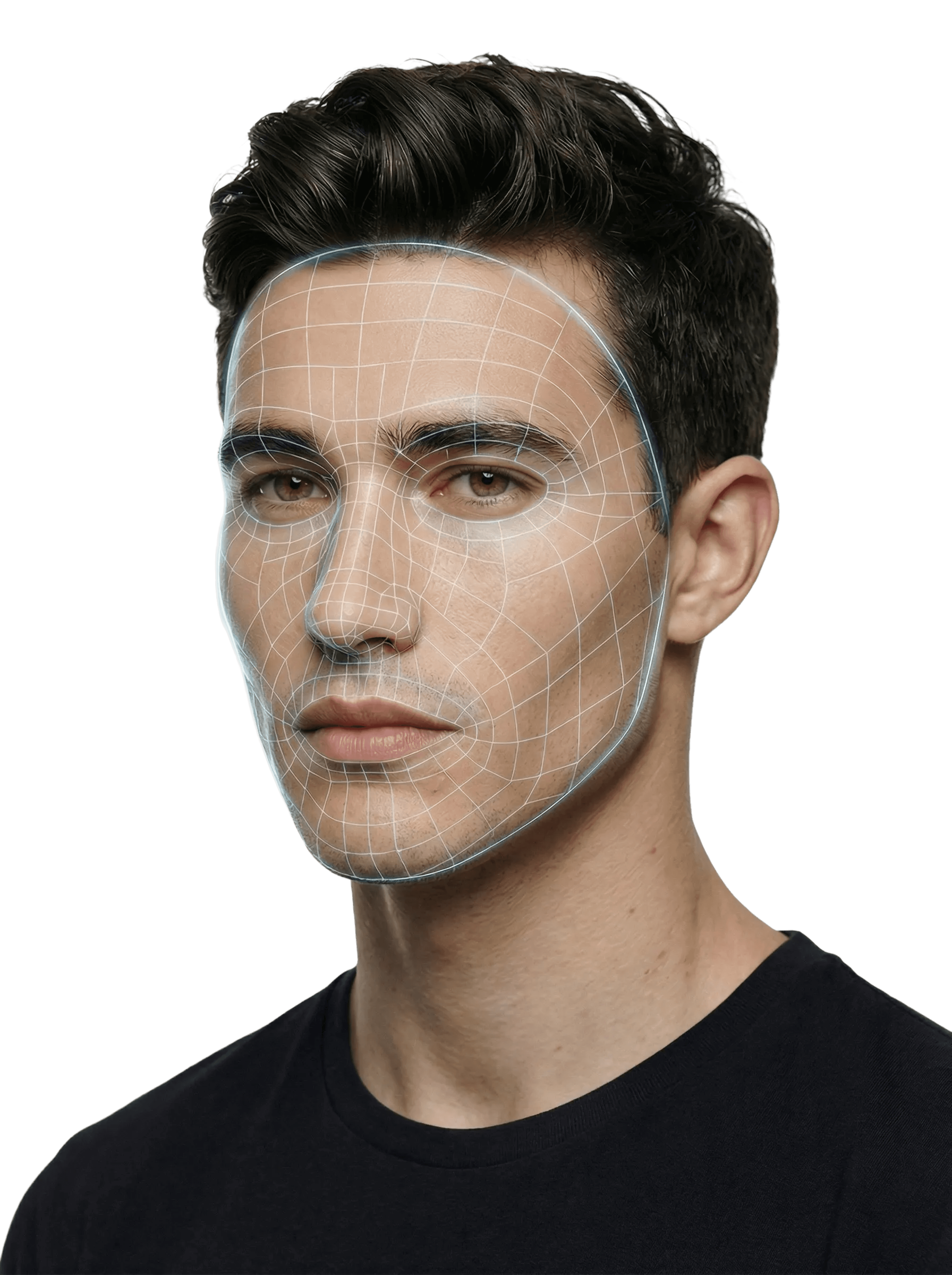
What Is Mewing? Meaning, Slang, Exercises, and Jawline Risks
Mewing is the practice of resting your whole tongue flat against the roof of your mouth, lips closed, in the hope of sharpening your jawline over time. Online, "mewing" is also Gen Z slang — a shushing gesture that means "I can't talk right now, I'm mewing."
The technique is one of the best-known methods in looksmaxxing, the online push to improve your looks feature by feature. The American Association of Orthodontists says there is no research showing it reshapes the jaw, and pushing too hard can shift your teeth.
Below: what mewing means, where it came from, how people do it, what it can and can't change, and who should skip it. If you're mewing to fix how your face reads in photos, it helps to know where you start — an AI attractiveness test shows how your jawline and other features score right now.
For the full breakdown — what the research shows, why mewing seems to work for some people, and whether it works for teens or adults — see the evidence on whether mewing actually works.
What Does Mewing Mean?
Mewing means keeping your tongue pressed flat against the roof of your mouth (the palate) as your default resting position, with lips sealed and teeth together or nearly together. The name comes from British orthodontists John Mew and his son Mike Mew, who promoted tongue posture as a way to guide how the face grows.
Their approach is called orthotropics. It rests on an older idea — the functional matrix hypothesis — that facial bones develop in response to how the surrounding muscles work. According to a 2019 commentary in the Journal of Oral and Maxillofacial Surgery, followers claim mewing can:
Define the jawline and cheekbones
Improve the nose-to-chin profile
Straighten teeth without braces
Help with sleep apnea, breathing, and swallowing
Ease jaw (TMJ) pain and even sinus problems
The same commentary concludes that none of this rests on sound scientific evidence.
Mewing Slang: Why Gen Z Says "I'm Mewing"
In slang, mewing is a joke excuse to stay silent: you can't answer because your tongue is busy on the roof of your mouth. Merriam-Webster traces the meme to classrooms, where students dodged a teacher's question this way, and says it went viral in spring 2024.
What the gesture looks like:
Index finger to the lips, like a "shh"
Then a finger traced along the jawline
Online, the emoji pair 🤫🧏 stands in for it
So when kids say "mewing," they usually mean the meme, not a serious face routine. The technique itself is mostly practiced by young men chasing a sharper jaw, which is how the word reached TikTok in the first place.
Why is it called mewing? The word comes from the Mew family name — it has nothing to do with a cat's "mew." That hasn't stopped the meme side: Dictionary.com notes funny posts showing cats, other animals, and cartoon characters that look like they're mewing.
Where Mewing Came From
Mewing started as an orthodontic theory and became an internet trend in about a decade. The short timeline:
1970s — John Mew develops orthotropics, arguing that tongue and jaw posture, not just genes, shape the face (Cleveland Clinic).
Mid-2010s — Mike Mew's YouTube videos on orthotropics spread on online forums (Merriam-Webster).
Late 2010s — mewing becomes a core looksmaxxing method.
2019 — John Mew loses his dental license from the UK's General Dental Council, and Google searches for "mewing" surge worldwide (JOMS, 2019).
Spring 2024 — the shushing meme goes viral in schools.
Today — mewing videos have passed 2 billion views on TikTok, according to a 2025 paper on looksmaxxing in Facial Plastic Surgery & Aesthetic Medicine.
How to Do Mewing: Step by Step
The basic mewing exercise is a resting posture, not a workout: tongue up, lips closed, jaw relaxed, breathing through your nose. Here is how it's usually described by WebMD and Cleveland Clinic:
Close your lips and relax your face.
Place the tip of your tongue on the roof of your mouth, just behind your upper front teeth — touching the gum ridge, not pushing on the teeth.
Flatten the rest of your tongue up against the palate, including the back third. Saying "ng" (as in "sing") lifts the back of the tongue into place.
Keep your jaw relaxed, teeth lightly together or slightly apart — never clenched.
Breathe through your nose.
Hold for 10–20 seconds, rest, and repeat a few times a day.

For the jawline, mewing videos often add a chin tuck or neck posture cue. That changes how your profile looks while you hold it — more on that below.
Should Your Teeth Touch When Mewing?
Sources disagree. WebMD says the teeth should gently touch; many mewing communities say they shouldn't touch at all. What they agree on: don't clench or grind. Clenching loads the jaw joint and is the opposite of the relaxed posture mewing is supposed to be.
How Long Should You Mew a Day?
Mewing fans aim to make the tongue position their default all day. According to a Northwell Health dentist, the Mews themselves recommended vigorous practice — around 30 minutes, six to seven times a week. Health sites suggest short holds of 10–20 seconds that you build up only as long as it stays comfortable.
The risk is in force, not time. "Hard mewing" — pushing the tongue into the palate as hard as you can — is the version orthodontists warn about, because steady pressure is exactly what moves teeth (see the risks below).
How to Tell If You're Mewing Wrong
Stop and rethink your technique if you notice:
Jaw pain, tightness, or clicking
Your teeth sore or pressing against each other
Your tongue tip pushing on your front teeth
Headaches or a tired face after mewing
Trouble breathing through your nose with your mouth closed
Can Mewing Change Your Jawline or Face?
There's no evidence that mewing reshapes an adult jaw or face. The American Association of Orthodontists says facial structure depends on genetics, bone growth, and muscle development, so tongue position alone won't remodel the jaw or straighten teeth. A 2025 review of looksmaxxing trends reaches the same conclusion.
What mewing can and can't do:
Can it change? | Why | |
|---|---|---|
Jaw and chin bone | No | Adult bone doesn't remodel from tongue pressure |
How your profile looks in the moment | Yes | Closed lips, tongue up, and head posture tighten the under-chin area while you hold them |
Tooth position | Yes — in the wrong direction | Steady pressure can shift teeth (see risks) |
Canthal tilt or eye area | No | The eye corners sit on bone and soft tissue the tongue doesn't touch |
Most of the "jawline" people want from mewing comes from things like body fat, the angle of the jaw, and the chin — the same traits a jawline rating looks at. The same goes for other looksmaxxing traits: tongue posture won't give you hunter eyes either.
If what bothers you is a double chin, mewing won't remove the fat under it. Holding the posture tightens the area only while you hold it.
Be skeptical of mewing "results" on social media, too. Head angle, lighting, and makeup contouring can change how a jawline looks in a photo far more than tongue posture.
Is Mewing Bad for You?
Gentle mewing — tongue resting on the palate, jaw relaxed — is unlikely to hurt you. The problems start with force. The American Association of Orthodontists lists these risks of pressing the tongue too hard or unevenly:

Shifting teeth — crowding or new gaps
Bite problems — overbite, underbite, or open bite
Jaw (TMJ) pain
Speech difficulties
Harder treatment later — if mewing makes misalignment worse, braces or other orthodontic work can take longer
Who Should Not Do Mewing
Skip DIY mewing, or ask an orthodontist first, if you:
Are a child or teen whose teeth and jaws are still developing
Wear braces, aligners, or a retainer
Have jaw pain, clicking, or a diagnosed TMJ disorder
Already have a bite problem you're hoping mewing will fix
Can't breathe comfortably through your nose
If your goal is straighter teeth or a different bite, an orthodontist can check your tongue posture and treat the actual cause. For bigger jaw concerns, see a board-certified specialist rather than a video tutorial.
What Do Dentists and Orthodontists Think of Mewing?
Most dentists and orthodontists don't recommend mewing as a jawline method. The American Association of Orthodontists advises against trying to move teeth or align the jaw without professional supervision, and oral surgeons writing in JOMS call it no substitute for proven treatment.
Where they do agree with mewing fans: tongue posture matters, especially while the face is growing. Clinicians just treat it as one part of a supervised plan, not a stand-alone way to change your face.
FAQ
What is Gen Z mewing?
For Gen Z, mewing is both a jawline technique and a meme. The meme version is a "shh" finger to the lips followed by a finger along the jawline, meaning "I can't talk, I'm mewing."
What is the jawline tongue trick?
The "jawline tongue trick" is another name for mewing: pressing your tongue flat against the roof of your mouth so the area under your chin looks tighter. The effect lasts only while you hold the position.
What happens if you mew every day?
If you mew gently, most likely nothing dramatic — there's no evidence it changes adult bone. If you push hard every day, the steady pressure can shift your teeth or strain your jaw joint.
Do doctors recommend mewing?
No. The American Association of Orthodontists and oral surgeons say there's no research supporting mewing for jawline or tooth changes and advise seeing an orthodontist instead.
Does mewing change your canthal tilt?
No. Canthal tilt depends on the bone and soft tissue around the eyes, which tongue posture doesn't reach. Here's what can and can't change your canthal tilt.
Does mewing give you hunter eyes?
No. Hunter eyes come from brow bone, eye set, and eyelid shape. See whether you can get hunter eyes and which methods are worth trying.
Is mewing the same as mogging?
No. Mewing is a tongue posture technique; mogging is slang for looking noticeably better than someone next to you. They show up together because both come from looksmaxxing culture.
Sources
American Association of Orthodontists. Does Mewing Actually Reshape Your Jaw? 2025.
Lee UK, Graves LL, Friedlander AH. Mewing: Social Media's Alternative to Orthognathic Surgery? Journal of Oral and Maxillofacial Surgery, 2019.
Konig DJ, Sidhu AS, Corpuz GS. Looksmaxxing: Straddling the Inflection Between Self-Enhancement and Self-Harm. Facial Plastic Surgery & Aesthetic Medicine, 2025.
Forsea J. Can Mewing Really Help Shape Your Jawline? The Well by Northwell, 2024.
Merriam-Webster. Mewing — Slang Meaning.
Dictionary.com. Mewing — Slang Meaning.
Cleveland Clinic. What Is Mewing?
WebMD. Mewing & Jawline Exercises.