



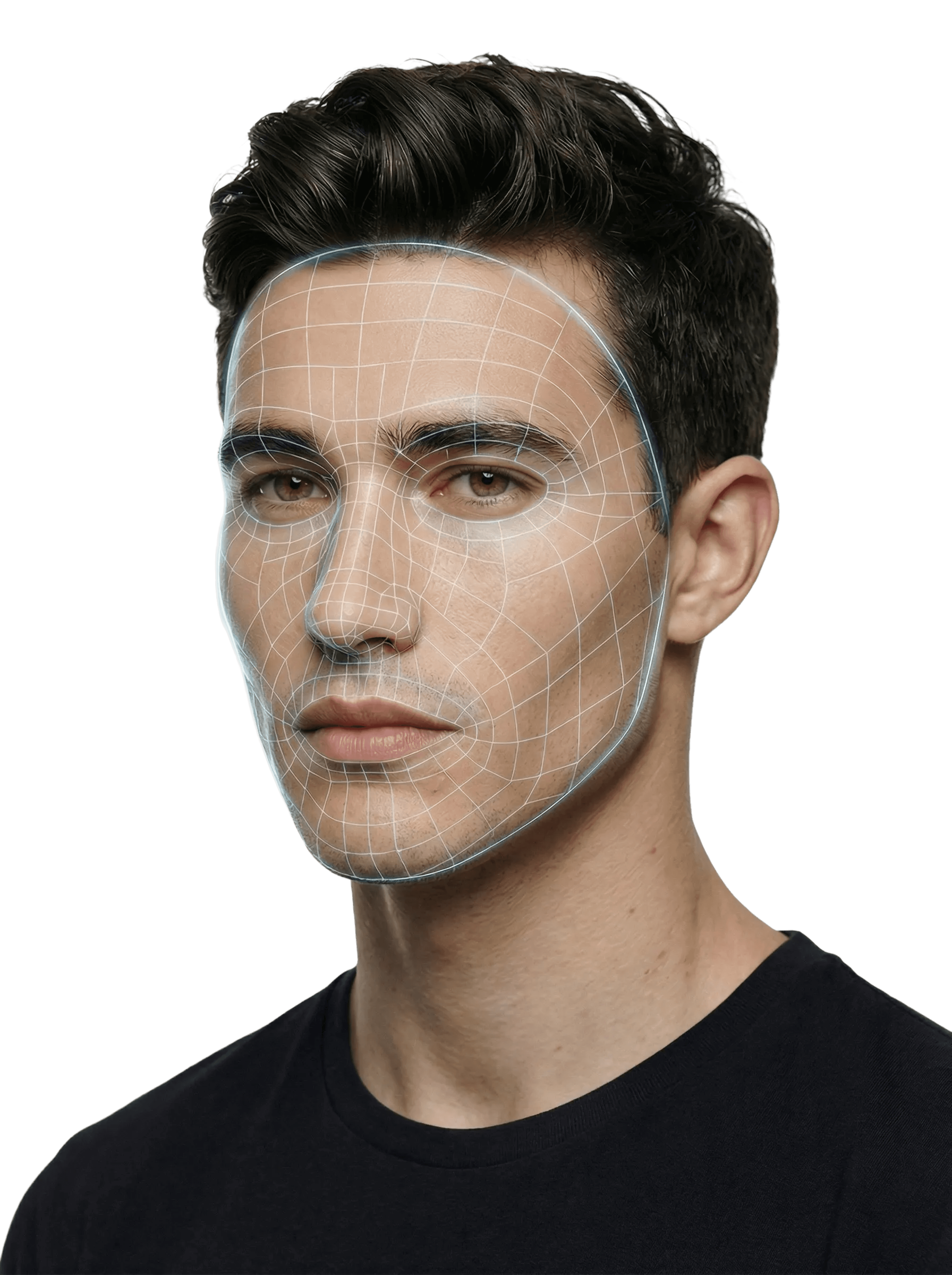
Forehead Shape Detector: How to Find Your Forehead Type
A forehead shape detector helps you identify the outline of your forehead by looking at your hairline, temple width, and overall proportions. You can check your forehead shape using a mirror or a clear front-facing photo — no AI tool required.
Your forehead is just one part of your facial structure. For a broader look at how your features work together, explore our facial feature analyzer or try an attractiveness test.
How to Detect Your Forehead Shape
To identify your forehead shape, look at three features: the curve of your hairline, the width of your forehead near your temples, and the outline of the upper face. Compare these features with the six common forehead shape descriptions below. You may find that more than one category fits.
Pull your hair back. Make sure your entire hairline and both temples are visible. Avoid lifting your eyebrows, which can change how tall your forehead appears.
Look straight into a mirror. Keep your head upright and your face relaxed. Avoid tilting your chin up or down.
Check your hairline. Is it mostly straight, rounded, or shaped like an M? Look for a central point or recession near the temples.
Compare the width. Notice whether your forehead looks wider near the temples, relatively even across the top, or narrower toward the hairline.
Match the closest shape. Use the six forehead types below as visual references. If two descriptions fit, note both rather than forcing a single result.

How to Check Your Forehead Shape From a Photo
A photo makes it easier to compare your forehead with different shape examples, but camera angle and hair placement can affect what you see.
For a clearer comparison:
Take a front-facing photo with your head level and your eyebrows relaxed.
Move your hair completely away from your forehead and temples.
Use even lighting so shadows don't hide your hairline.
Keep the camera around eye level and avoid close-up wide-angle selfies.
Compare the visible outline rather than judging your forehead by its apparent size alone.
If your hairline is partly hidden or uneven, your result may be uncertain. A forehead shape is a visual description, not a medical diagnosis or a precise anatomical classification.
6 Forehead Shapes and How to Recognize Yours
Forehead shapes are commonly described as round, square, straight, M-shaped, diamond-shaped, or oval. These are informal visual categories, not six scientifically standardized anatomical types. Some describe the forehead's outline, while others describe the hairline, so your forehead may fit more than one description.

Forehead Shape | What to Look For |
|---|---|
Round | A softly curved upper outline without pronounced corners |
Square | A broad, relatively angular outline with noticeable corners near the temples |
Straight | A mostly horizontal hairline with little curvature across the center |
M-shaped | A hairline that rises at both temples, creating an M-like outline |
Diamond-shaped | A forehead that appears narrower toward the hairline and wider around the temples |
Oval | A gently curved, elongated outline without sharp corners |
A round forehead has a softer, more compact-looking curve, while an oval forehead appears more elongated. A straight forehead describes the hairline itself, whereas a square forehead describes a broader, more angular outline that may include a straight hairline.
Round Forehead
A round forehead has a soft, curved outline with no strongly defined corners. The hairline may form a broad arc, and the transition toward the temples looks relatively smooth.
How to recognize it: Look for a rounded upper contour rather than a flat horizontal line or angular corners.
Square Forehead
A square forehead appears relatively broad, with straighter sides and more noticeable angles near the temples. The upper hairline may be fairly flat, giving the forehead a boxier outline.
How to recognize it: Check whether the upper corners and sides create a more angular shape than a continuous curve.
Straight Forehead
A straight forehead is usually identified by a hairline that runs almost horizontally across the upper forehead. It may have slightly rounded corners, but the central section looks relatively flat.
How to recognize it: Focus on the hairline itself. A straight hairline can occur on a wide, narrow, or otherwise rounded forehead.
M-Shaped Forehead
An M-shaped forehead has a hairline that extends farther back at the temples than in the center, creating two higher sections on either side. The central hairline may form a point or a rounded projection.
How to recognize it: Look for the two temple recessions that create an M-like pattern. An M-shaped hairline does not automatically mean hair loss.
An M-shaped hairline can be a natural variation, but a hairline that progressively recedes at the temples may also be a sign of hair loss.
Diamond-Shaped Forehead
A diamond-shaped forehead is a less standardized description of an upper-face outline that appears narrower near the hairline and relatively wider around the temples.
How to recognize it: Compare the width near the upper hairline with the width across the temples. This description overlaps with other forehead types and should not be confused with a diamond face shape.
Oval Forehead
An oval forehead has a gently curved outline that appears more elongated than a round forehead. The sides transition smoothly into the hairline without pronounced corners.
How to recognize it: Look for a soft upper curve combined with a relatively elongated appearance. The distinction between round and oval is subjective, especially when the hairline is partially covered.
Forehead Shape vs. Hairline Shape vs. Forehead Size
Forehead shape, hairline shape, and forehead size describe different features. Your forehead can be wide with a rounded hairline, tall with a straight hairline, or narrow with an M-shaped hairline. These characteristics overlap, so a single forehead type doesn't tell the whole story.
Feature | What It Describes | How to Check |
|---|---|---|
Forehead shape | The overall visible outline of the upper forehead | Look at the contour between the temples and hairline |
Hairline shape | The border where your scalp hair begins | Check for a straight, rounded, pointed, or M-shaped pattern |
Forehead width | The horizontal distance across the forehead | Compare the width near your temples with other facial widths |
Forehead height | The vertical distance from the hairline to the brow area | Compare it with the other vertical sections of your face |

A high forehead isn't necessarily wide, and a low forehead isn't necessarily narrow. Similarly, a widow's peak describes a central point in the hairline, not the overall dimensions of your forehead.
If you're interested in how forehead height relates to the rest of your face, see our guide to measuring your upper facial third. It explains how the upper, middle, and lower sections of the face are compared.
Your forehead also contributes to your overall facial outline, but it doesn't determine your face shape by itself. A face shape test considers additional features, including cheekbone width, jawline, and facial length.
Can AI Accurately Detect Your Forehead Shape?
AI can estimate certain facial proportions from a photo, but detecting your exact forehead shape is more complicated. Facial landmark models can locate features such as the eyes, eyebrows, and facial outline. However, identifying the natural hairline requires additional image analysis, and results can vary depending on the photo.
For example, Google's MediaPipe Face Landmarker estimates 478 three-dimensional facial landmarks. These points can help an application analyze facial geometry, but the standard model does not separately identify the natural hairline.
This matters because several forehead categories depend heavily on where the hair begins. An AI tool may estimate forehead width or proportions without accurately distinguishing a rounded hairline from an M-shaped one.
What can affect a forehead shape detector's result?
Bangs or loose hair: Can hide the hairline and temples.
Camera angle: Tilting your head changes the visible forehead proportions.
Close-up selfies: Perspective can exaggerate features closer to the camera.
Lighting and shadows: Can make the hairline harder to distinguish.
Hairline changes: Recession or thinning can alter the visible outline over time.
Treat an AI forehead shape result as an estimate rather than an exact measurement. If your result doesn't match what you see in a clear front-facing photo, compare the visible features yourself instead of relying on a single category.
Hairstyles for Different Forehead Shapes
Your forehead shape can help you choose how to frame your face, but it doesn't determine which hairstyles you can wear. Bangs, parting placement, and volume around the temples can change how much of your forehead is visible and which parts of its outline stand out.
Forehead Shape | Hairstyles to Try | Visual Effect |
|---|---|---|
Round | Side-swept bangs, textured layers | Add diagonal lines that break up the rounded outline |
Square | Curtain bangs, soft face-framing layers | Soften the appearance of angular corners |
Straight | Wispy bangs, off-center part | Break up a strong horizontal hairline |
M-shaped | Textured fringe, side part | Add coverage around the temples if desired |
Diamond-shaped | Curtain bangs, volume near the hairline | Change how the narrower upper forehead appears |
Oval | Middle part, layered fringe, slicked-back styles | Highlight or reveal the natural forehead outline |
These are styling options, not restrictions. Hair texture, density, growth patterns, and personal preference matter just as much as forehead shape.
If you want to see your natural forehead outline, try pulling your hair back completely. Then compare it with your usual hairstyle to see how much the framing changes its appearance.
FAQ
What forehead shape do I have?
Pull your hair back and compare your forehead's visible outline with the six shape descriptions: round, square, straight, M-shaped, diamond-shaped, and oval. Focus on your hairline, temples, and upper forehead contour. More than one description may fit.
Can I detect my forehead shape from a selfie?
Yes, you can estimate your forehead shape from a clear, front-facing selfie. Keep the camera at eye level, move your hair away from your forehead, and avoid close-up angles. A single photo may not show your natural proportions perfectly.
Is an M-shaped forehead the same as a widow's peak?
Not exactly. A widow's peak is a central downward point in the hairline, while an M-shaped hairline has higher sections around both temples. You can have a widow's peak without pronounced temple recession, or an M-shaped hairline without a sharp central point.
Which forehead shape is most attractive?
There is no scientifically established forehead shape that is universally the most attractive. Preferences vary, and forehead appearance is only one part of how a face is perceived. Hairline, facial proportions, hairstyle, and individual preferences all influence the overall impression.
Can forehead shape change with age?
Your visible forehead outline can change as your hairline shifts over time. Hair thinning or recession may expose more of the forehead or change the appearance of the temples. These changes don't necessarily mean the underlying bone structure has changed.
Sources
Google AI Edge — MediaPipe Face Landmarker. Official documentation describing facial landmark detection and model outputs.
MedlinePlus Genetics — Androgenetic Alopecia. Information on hairline recession and common patterns of hair loss.
American Academy of Dermatology — Hair Loss: Signs and Symptoms. Clinical guidance on recognizing changes in the hairline.