



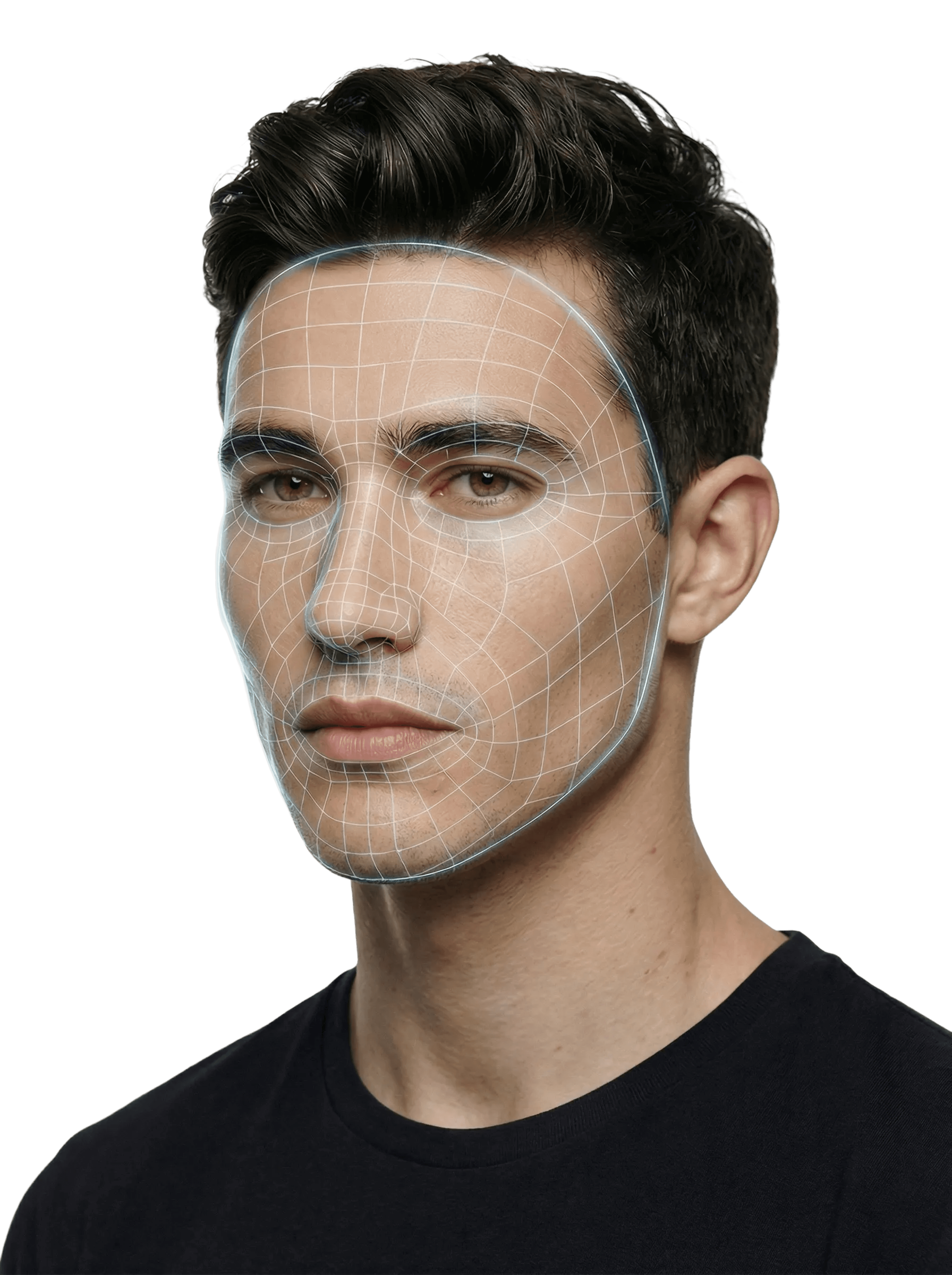
Is My Forehead Big? How to Check Your Forehead Size
Wondering, “Is my forehead big?” The easiest way to check is to measure the distance from your hairline to the area between your eyebrows, then compare it with your overall facial proportions. You can also try the forehead finger test for a quick estimate, but the number of fingers that fit isn't a reliable measurement on its own.
A forehead can be tall without being wide, and a naturally high hairline doesn't automatically mean you're losing hair. If you're more interested in the outline of your forehead than its size, our forehead shape detector guide explains how to identify different hairline and forehead shapes.
Forehead size is just one part of your appearance. If you want to explore how your features look together, our attractiveness test explains how AI evaluates facial features and proportions from photos.
Do I Have a Big Forehead? Take the Quick Test
To check whether your forehead is relatively large, start with a simple finger test, then compare your forehead height with the rest of your face. The finger test gives you a rough impression, while measurements provide a more consistent way to assess your proportions. Neither method determines whether your forehead is attractive.
Expose your hairline. Pull your hair back and keep your eyebrows relaxed.
Try the finger test. Count how many horizontal finger widths fit between your eyebrows and hairline.
Check your proportions. Measure your forehead height with a ruler and compare it with your total face height using the method below.
The Forehead Finger Test: 3, 4, or 5 Fingers?
If you're wondering how to measure forehead with fingers, start just above your eyebrows and place your fingers together horizontally across your forehead. Count how many finger widths fit between your eyebrows and your natural hairline. This forehead finger test gives you a quick estimate, not an exact measurement.
Finger Count | What It Tells You |
|---|---|
2 fingers | A relatively short distance in your own finger widths |
3 fingers | More space than two fingers, but not automatically a small or average forehead |
4 fingers | A common reference in online forehead tests, not a scientific cutoff |
5 fingers | A taller measurement in finger widths, but not proof of an unusually large forehead |
Is a four-finger forehead big? Not necessarily. Four fingers are often described as average in online discussions, but there is no universally validated four-finger standard. The result depends on your finger width and where you start measuring.
Likewise, a five-finger forehead doesn't automatically mean your forehead is unusually large. To understand how big your forehead is relative to your face, use a ruler and compare your facial proportions.

Why the Finger Test Can Be Misleading
Two people with identical forehead heights can get different finger counts because their fingers aren't the same width. Even your own result can change depending on how tightly you press your fingers together or where you position them.
Other factors can affect the test:
Eyebrow position: Raising your eyebrows can stretch the visible forehead area.
Hairline shape: A widow's peak or M-shaped hairline makes the starting and ending points less obvious.
Hair placement: Bangs or loose strands can hide the natural hairline.
Measurement angle: Fingers placed diagonally measure a different distance than fingers held horizontally.
Think of the finger test as a quick visual check, not a forehead size calculator. For a more meaningful comparison, measure your forehead height in centimeters and relate it to your face height.
How to Measure Forehead Size With a Ruler
To measure your forehead size more consistently, check its height and width separately. Forehead height is the vertical distance from your hairline to a defined point between your eyebrows, while forehead width is the horizontal distance across the upper forehead. You can then compare your forehead height with your total face height to understand its proportions.
How to Measure Forehead Height
For a facial-proportions measurement, use two anatomical landmarks: the trichion, where the central hairline meets the forehead, and the glabella, the prominent point between your eyebrows just above the bridge of your nose. These landmarks are used in published facial anthropometry research, including Evaluation of Facial Beauty Using Anthropometric Proportions.
Pull your hair away from your forehead and stand in front of a mirror.
Find the center of your natural hairline. This is your upper measurement point.
Locate the glabella between your eyebrows, rather than measuring to the top of either eyebrow.
Hold a flexible measuring tape vertically along the center of your forehead, or use a ruler while looking straight ahead.
Record the approximate distance in centimeters or inches.
If you have a widow's peak, an uneven hairline, or thinning hair, the upper landmark may be difficult to identify consistently. Note where you measured instead of treating the result as exact.
This is different from placing fingers directly above your eyebrows, which is why the finger test and ruler measurement may not match. Home measurements are approximate and are not equivalent to professional anthropometric measurements.
How to Measure Forehead Width
Forehead width measurement uses the horizontal distance between two anatomical points called the frontotemporale, located near the temples where the forehead transitions toward the sides of the head.
In standardized anthropometric terminology, forehead breadth is measured between these points using calipers, as described in Elements of Morphology: Standard Terminology for the Head and Face.
For an approximate home measurement:
Face a mirror with your head upright and hair pulled back.
Locate the left and right temple regions where the forehead contour begins to turn toward the sides of your head.
Estimate the straight horizontal distance between these points using a ruler or measuring tape. Because the forehead is curved and the landmarks are difficult to identify precisely, treat this as an approximate measurement.
Record the width separately from your forehead height.
The exact frontotemporale landmarks can be difficult to locate without training. Your home result is an estimate, so use the same reference points if you repeat the measurement.
A wide forehead isn't necessarily tall. Someone can have a broad upper face with a relatively low hairline, or a narrow forehead that appears tall because of a higher hairline.

How to Calculate Your Forehead-to-Face Ratio
One way to understand your forehead height is to compare it with your total facial height. The traditional facial-thirds method divides the face into three vertical sections:
Upper third: Hairline (trichion) to glabella.
Middle third: Glabella to subnasale, the point beneath the nose.
Lower third: Subnasale to the bottom of the chin (menton).
These landmarks and the horizontal-thirds method are described in Facial Contouring by Using Dermal Fillers and Botulinum Toxin A: A Practical Approach.
Measure all three sections using the same method. Add them together to get the total vertical distance, then calculate:
Forehead-to-face ratio (%) = Upper third ÷ Total face height × 100
For example, suppose your measurements are:
Facial Section | Measurement |
|---|---|
Upper third | 6.5 cm |
Middle third | 6.0 cm |
Lower third | 6.5 cm |
Total | 19.0 cm |
Your upper-third ratio would be:
6.5 ÷ 19 × 100 = 34.2%
In the classical facial-thirds model, each section is approximately one-third of the total, or 33.3%. In this example, the upper third is slightly longer than one-third of the measured face height.
That doesn't automatically mean you have a big forehead. The facial-thirds model is a reference for comparing proportions, not a universal standard that every face should match.

Learn how to measure your upper facial third and compare it with the middle and lower thirds of your face.
What Is Considered a Big Forehead?
If you're asking, “How big is my forehead?”, your measurement in centimeters is only part of the answer — its proportion to your total face height provides more context. A big forehead usually means that the forehead appears relatively tall, wide, or both compared with the rest of the face. There is no single measurement that classifies every forehead as small, average, or large.
Forehead Size in Inches and Centimeters
Measuring your forehead in centimeters or inches is more repeatable than counting fingers, provided you use the same anatomical landmarks each time. However, a home measurement is still approximate, and the number alone doesn't tell you whether your forehead is unusually large.
For example:
5 cm (about 2 inches): A measured height, not automatically a small forehead.
6 cm (about 2.4 inches): Cannot be classified without considering the rest of the face.
7 cm (about 2.8 inches): May represent a larger share of a shorter face than a longer one.
8 cm (about 3.1 inches): A longer absolute measurement than the examples above, but not a diagnosis or universal cutoff.
These are measurement examples, not scientifically established size categories. Studies of facial anthropometry use defined anatomical landmarks and specific populations, so their averages shouldn't be applied to everyone as universal beauty standards.
The more useful question is how your measured forehead height compares with your total face height. A 7 cm forehead on a 19 cm face represents about 36.8% of the measured facial height, while the same 7 cm on a 22 cm face represents about 31.8%.
Big Forehead vs. Small Forehead
A small forehead generally has less vertical space between the hairline and brow area, while a tall forehead has more. Width is a separate measurement: you can have a tall, narrow forehead or a short, wide one. To check whether forehead width affects your overall facial outline, use our face shape test.
Big Forehead vs. Receding Hairline: How to Tell
A naturally high forehead and a receding hairline can look similar in a single photo. The main difference is whether your hairline has stayed relatively stable or moved backward over time. Changes in hair density, especially around the temples, can also provide clues, but appearance alone cannot establish the cause.
What to Check | Naturally High Forehead | Possible Receding Hairline |
|---|---|---|
Earlier photos | Hairline appears similarly high | Hairline looks lower or fuller in older photos |
Temples | Shape has remained relatively stable | Increasing recession may be visible |
Hair density | Similar density near the hairline over time | Hair may become finer or thinner |
Forehead height | May have been tall for years | Visible forehead area may increase |
Changes over time | Little noticeable change | Gradual or sometimes more noticeable changes |
If you're asking, “Do I have a receding hairline or a big forehead?”, compare photographs taken several months or years apart rather than judging one selfie.
How to Check Whether Your Hairline Has Changed
Find older photos. Choose clear pictures where your hairline and temples are visible.
Match the viewing angle. Compare photos taken from similar distances, with your head upright.
Look at both temples. Check whether the corners of your hairline have moved backward.
Check hair density. Look for increased scalp visibility or finer-looking hair near the front.
Consider the timeline. Note whether changes appeared gradually, suddenly, or after a period of increased shedding.
An M-shaped hairline or widow's peak doesn't automatically mean you're balding. Some people naturally have higher temples, and hairline shape varies.
According to the American Academy of Dermatology, a receding hairline, gradual thinning, and other changes in hair density can be signs of hair loss. If you notice progressive recession, sudden shedding, or patchy hair loss, a dermatologist can help identify the cause.
A finger test or forehead measurement cannot tell you whether you're losing hair. It measures the visible distance between your hairline and brow area, not why your hairline is positioned there.
Can You Make a Big Forehead Look Smaller?
If you want your forehead to appear shorter, try a textured fringe, curtain bangs, or a side-swept style. These change how much of your forehead is visible without changing its actual height. The best option also depends on your hair texture, density, and preferred style.
Can You Actually Reduce Forehead Size?
Hairstyles can make your forehead look shorter or narrower, but they don't physically reduce its size. Facial exercises, massage, and mewing have not been shown to reliably lower the hairline or shorten the forehead.
Medical procedures such as hairline-lowering surgery may change the position of the hairline in selected patients. A 2021 systematic review by Vila and colleagues reported forehead reduction outcomes and complications, including scarring, altered sensation, and hair loss around the surgical area. A 2026 systematic review and meta-analysis also documented postoperative complications, although estimates varied across studies.
These procedures require individualized assessment. Anyone considering surgery should discuss the potential benefits, limitations, and risks with an appropriately qualified, board-certified specialist rather than making a decision based on an online forehead test.
FAQ
Is 4 fingers a big forehead?
Not necessarily. Four fingers are often used as an informal reference, but finger widths vary between people. A four-finger result doesn't establish that your forehead is large or average. Measure your forehead height and compare it with your overall facial proportions for more context.
Is a 5-finger forehead normal?
A five-finger forehead can be a natural variation. The finger test isn't standardized, so five fingers don't correspond to one fixed measurement in centimeters. A high hairline can also be a long-standing feature rather than a sign of hair loss.
Is a 3-finger forehead big?
Three fingers generally cover less distance than four or five of your own fingers, but that doesn't automatically classify your forehead as small, average, or large. The result depends on finger width, placement, and your natural hairline.
Is a 2-finger forehead big?
A two-finger result suggests a relatively short distance when measured using your own fingers. It isn't enough to classify your forehead size. A ruler and consistent anatomical landmarks provide a more useful measurement.
How many inches of forehead is normal?
There is no single forehead height in inches that applies to everyone. Researchers measure forehead dimensions using specific landmarks and populations, so results vary. Measure your forehead from the central hairline to the glabella and consider its proportion relative to your face.
Is a big forehead attractive?
A large forehead isn't inherently attractive or unattractive. How it looks depends on facial proportions, hairline shape, hairstyle, and individual preferences. There is no universal forehead size that determines someone's overall attractiveness.
Can you tell if your forehead is big from a photo?
A front-facing photo can help you estimate your forehead-to-face ratio, but camera perspective and an unclear hairline can affect the result. Use the same anatomical landmarks as in the ruler method and treat photo-based measurements as approximate.
Can you reduce forehead size naturally?
You can make your forehead appear smaller with bangs, styling, or changes in hair volume, but these don't physically shorten it. There is no established evidence that facial exercises or mewing can reduce forehead height.
Sources
Allanson JE, et al. — Elements of Morphology: Standard Terminology for the Head and Face (2009). Anatomical terminology for forehead breadth and hairline position.
Evaluation of Facial Beauty Using Anthropometric Proportions (2014). Facial anthropometric measurements and comparisons of the upper, middle, and lower facial thirds.
Facial Contouring by Using Dermal Fillers and Botulinum Toxin A: A Practical Approach (2019). Anatomical landmarks and the traditional facial-thirds model.
American Academy of Dermatology — Hair Loss: Signs and Symptoms. Clinical guidance on recognizing hairline recession and other signs of hair loss.
Vila PM, et al. — Forehead Reduction: A Systematic Review and Meta-Analysis of Outcomes (2021). Published evidence on forehead reduction outcomes and surgical complications.
Alabdulkarim A, et al. — Forehead Length Reduction Surgery: Quantifying Complications and Outcomes Through Systematic Review and Meta-Analysis (2026). Updated review of surgical outcomes and reported complications.