
Face Age Test: How AI Estimates Your Age and How to Look Younger
What is a face age test? A face age test is an AI-powered tool that analyzes your facial features and predicts how old you appear. These apps process the unique combination of skin texture, facial shape, eye clarity and contrast to estimate your perceived age—often called your “face age.” They work differently from a chronological age calculator because they focus on appearance cues rather than your actual birth date. You might see them marketed as a face age calculator, facial age test or AI face age scan. While the idea of having an algorithm judge how old you look can sound unsettling, it’s a popular way for people to check in on their appearance and track improvements over time. For readers curious about overall attractiveness, our in-depth attractiveness test explains how facial symmetry and proportions are assessed in a similar way.
How Do Face Age Tests Work?
Most AI face age tests follow a three-step process:
Upload a clear, front-facing photo. The system needs a high-resolution image with even lighting and your head centered. Remove glasses, hats and heavy makeup so the algorithm can accurately assess skin texture and bone structure.
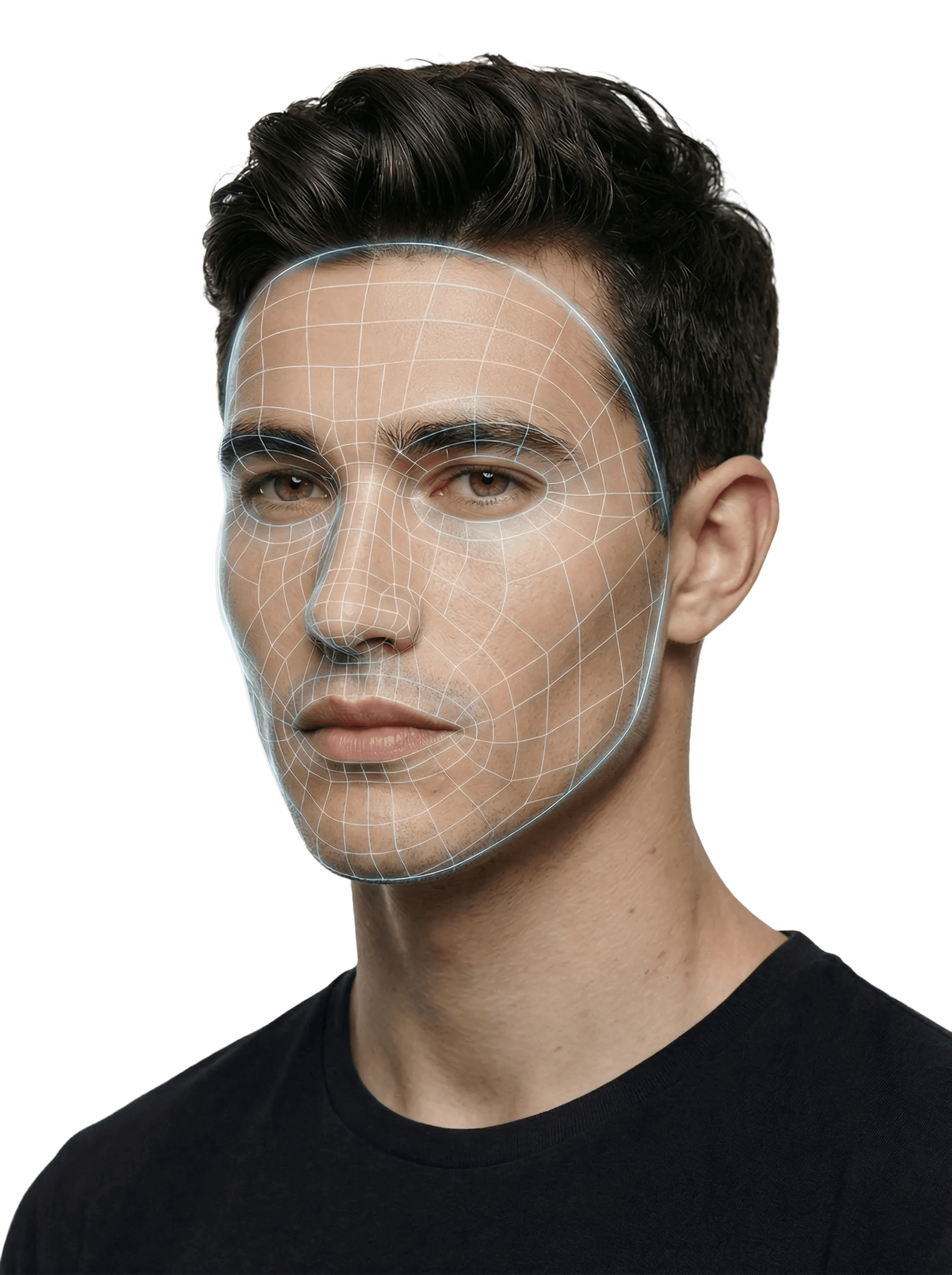
Analyze facial cues. The AI detects landmarks such as the eyes, eyebrows, nose, mouth and jawline. It measures factors like skin smoothness, wrinkle depth, facial contrast and color homogeneity, and may assess eye brightness or sclera color. Advanced models also analyze fine lines, pore visibility and sagging to gauge skin elasticity.
Calculate an age estimate. Your facial metrics are compared with a large database of age-rated faces. Some apps provide more context, highlighting which features aged you up or down, while others give a single number or range. Always remember that these results are for entertainment and self-assessment—don’t treat them as a clinical diagnosis.
Are AI Age Tests Accurate?
AI models learn from large datasets of faces labeled with chronological ages. Research shows that facial contrast—the color and luminance difference between your eyes, brows, lips and the surrounding skin—decreases with age, and increasing that contrast makes faces look younger (source: Aspects of Facial Contrast Decrease with Age and Are Cues for Age Perception) (source: Facial Contrast Is a Cross-Cultural Cue for Perceiving Age). Models trained on these cues can produce surprisingly precise estimates. For instance, a deep-learning study used eye color intensity and a dataset of 270,000 face images to predict age with a mean error of ±8.69 years (source: A Deep Learning Approach to Predict Chronological Age).
However, biases in training data affect accuracy. Many datasets over-represent certain age ranges, ethnicities and genders, leading to systematic errors for people outside those groups. Context matters too: experiments show that a person’s age estimate changes when their face is flanked by younger or older faces (source: Contextual and Own-Age Effects in Age Perception). Adaptation studies reveal that viewing younger faces makes subsequent faces appear older and vice versa (source: A Simple Normalization Underlies Adaptation to Facial Age), so your environment influences perception. These findings highlight why AI scores should be taken as approximations rather than absolute truths.
What Makes a Face Look Older or Younger?
Facial Contrast and Color
Facial contrast refers to the difference in color and brightness between your features and skin. As we age, the lips, eyes and brows become less vivid relative to the surrounding skin, leading to a duller overall appearance (source: Aspects of Facial Contrast Decrease with Age and Are Cues for Age Perception). Enhancing facial contrast—through makeup, tinted moisturizers or simple grooming—can reduce perceived age. The cross-cultural nature of this effect is striking: studies show that increasing facial contrast makes Chinese, Latin American, South African and Caucasian faces look younger (source: Facial Contrast Is a Cross-Cultural Cue for Perceiving Age).
Skin Texture and Wrinkles
Smooth, even skin is a key marker of youth. Wrinkles, sagging and uneven pigmentation are strong predictors of perceived age. Research demonstrates that digitally removing wrinkles and evening out skin tone significantly reduces perceived age in both Chinese and Caucasian women. Similarly, increasing red-green color information can bias facial age estimates and reduce disagreement among observers (source: Colour Information Biases Facial Age Estimation and Reduces Inter-Observer Variability). These findings validate why skincare routines and sun protection matter.
Facial Shape and Volume
Loss of facial fat and changes in bone structure occur with age, altering facial proportions. Cheeks may become hollow, jawlines soften and eyelids sag. While AI tests can detect these cues, they aren’t the only factor: cross-cultural studies note that internal features like lips, eyes and eyebrows vary with age and provide additional information (source: Facial Contrast Is a Cross-Cultural Cue for Perceiving Age). Keeping muscles toned and maintaining a healthy body composition can help your face retain a youthful shape.
Eyes, Sclera and Eyelids
Eye clarity matters. Research on facial cues used in age perception includes the eye region—changes around the eyes, brows, and surrounding contrast can shift how old a face looks (source: Facial Contrast Is a Cross-Cultural Cue for Perceiving Age). Bright, white sclera and full, lifted eyelids are signs of youth, whereas drooping lids and yellowed whites suggest aging. AI algorithms measure eye size, brightness and the ratio of eye width to height when estimating age.
Hairstyle and Colour
Hair frames the face and can accentuate or soften age cues. Research on age perception shows that external framing and overall facial appearance can shift perceived age alongside internal facial cues (source: Facial Contrast Is a Cross-Cultural Cue for Perceiving Age). Lighter, warmer tones and styles that add volume around the crown can rejuvenate your look. See our detailed face shape test for haircut suggestions tailored to different head shapes.
Context and Adaptation
Human age perception isn’t fixed—it adapts based on what we see. Experiments demonstrate that faces flanked by younger faces are perceived as younger, while faces flanked by older faces seem older (source: Contextual and Own-Age Effects in Age Perception). This “contextual averaging” effect means your social environment can skew how old you look to others. Another line of research found that exposure to younger or older faces biases subsequent age judgments (source: A Simple Normalization Underlies Adaptation to Facial Age). AI tests ignore this context, but it helps explain why your perceived age may differ in different situations.
How to Get a More Accurate AI Face Age Estimate
To ensure your AI face age result reflects your real appearance, follow these tips:
Use natural, even lighting. Avoid harsh shadows or bright backlighting. Outdoor daylight or soft diffused light works best.
Face the camera directly. A straight-on, neutral expression allows the algorithm to analyze symmetrical features. Keep your head level and eyes open.
Keep the image high resolution. Higher pixel counts let the AI detect fine details like wrinkles or skin texture. Blurry photos can lead to misestimates.
Minimize makeup and filters. Heavy foundation, contouring or filters can conceal skin texture and distort color cues, misleading the AI.
Take multiple photos. If possible, compare results across several shots to see whether the estimates are consistent. Large variations likely indicate the model struggles with your photo quality or features.
How to Look Younger: Science-Based Strategies
Improving perceived age isn’t about erasing every wrinkle or chasing unrealistic standards. It’s about enhancing the features that signal youth and health. Here are practical, evidence-based tips:
Boost facial contrast. Brighten your lips with a subtle tint or clear balm, groom your eyebrows and use mascara or eyeliner to darken your lashes. Studies show that increasing the contrast between facial features and skin makes faces look younger across cultures (source: Facial Contrast Is a Cross-Cultural Cue for Perceiving Age).
Prioritize skincare. Protect your skin from UV exposure with daily sunscreen, moisturize to maintain hydration and consider retinoids or antioxidants to stimulate collagen. Research shows that smoothing wrinkles and evening out pigmentation lowers perceived age (source: Facial Contrast Is a Cross-Cultural Cue for Perceiving Age). Our beauty test offers a comprehensive look at your complexion and areas to improve.
Maintain a healthy lifestyle. Balanced nutrition, regular exercise and adequate sleep support skin repair and muscle tone. The link between body composition and facial appearance is explored in our attractiveness calculator.
Keep your eyes bright. Stay hydrated, manage allergies and get enough rest to reduce redness and puffiness. Clear eye-area cues (like brightness and contrast around the eyes) contribute to a youthful appearance (source: Facial Contrast Is a Cross-Cultural Cue for Perceiving Age).
Choose youthful hairstyles. Styles that add volume and movement—like layers or soft waves—can soften age cues. Overall framing and contrast cues influence age perception alongside internal facial features (source: Facial Contrast Is a Cross-Cultural Cue for Perceiving Age). For personalised guidance, check our looksmaxxing guide or how to looksmaxx page.
Consider eyelash, brow and lip enhancements. Small changes like lash serums, brow shaping or lip plumping (non-invasive options) can subtly increase feature prominence.
Cultivate confidence and posture. Perception of age also reflects how you carry yourself. Standing tall with relaxed shoulders and an open expression can make you appear more energetic.
Limitations and Ethical Concerns
While face age tests offer fun insights, they come with caveats:
Bias in training data. Many models are trained on limited demographics. If you don’t resemble the training set, your estimated age could be off.
Privacy risks. Uploading your photo to unknown services may expose your data. Only use platforms with transparent privacy policies.
Mental health impact. Obsessing over a number can harm self-esteem. Use AI age estimates as one data point among many.
Generalization issues. Age perception varies across contexts and individual observers (source: Contextual and Own-Age Effects in Age Perception), so one algorithm cannot capture all nuances.
Conclusion: More Than Just a Number
A face age test offers a snapshot of how algorithms interpret your facial cues. Research shows that facial contrast, skin texture, and color information contribute to perceived age (source: Aspects of Facial Contrast Decrease with Age and Are Cues for Age Perception) (source: Colour Information Biases Facial Age Estimation and Reduces Inter-Observer Variability). However, your perceived age is malleable: context, lifestyle and small grooming choices can shift how old you look. Instead of fixating on a specific number, focus on habits that promote health and confidence. Our comprehensive how old do I look guide expands on these principles and provides more age-specific advice. For deeper analysis, try our AI-powered face age test and age detector tools or explore the playful guess my age and ai age guesser posts.
Ready to start your glow-up? Maxxing’s multi-domain system uses AI to analyze your unique features, prioritize high-impact changes and build a personalized roadmap. Learn which improvements will make you look and feel younger by trying our AI age test and full attractiveness test today. Combine your results with our rate my photo and celebrity look alike tools for a complete picture, and then follow the step-by-step plan to achieve lasting results. Your transformation starts now.